Henrico was named for a county in Virginia. Ingalls Shipbuilding launched her at Pascagoula on 31 March 1943 as Sea Darter, for the Maritime Commission, and Mrs. W. D. Pelan sponsored her. The Navy acquired her on 23 June 1943 and commissioned her the next day only so she could move to Bethlehem Steel at Hoboken to be converted. She came out of commission on 8 July. Commander J. H. Willis recommissioned her on 26 November 1943. Her class was Bayfield.
Shakedown in Chesapeake Bay turned into training for Army combat teams. She left Norfolk for New York on 2 February 1944, arrived next day, embarked troops, and sailed for Scotland on 11 February. In the Firth of Clyde on 22 February the amphibious work for Normandy began. Invasion troops boarded at Portland, England, on 26 May. On 5 June she sailed in Rear Admiral Hall's Omaha assault force. Next day she put them into the opening wave. Seas were heavy and the shore works were strong. Wounded came back from the beaches, and she was in Portland again before the day was over. Shuttle duty held her until 19 June, when she sailed for the Firth of Clyde. On 4 July she started for the Mediterranean and the landing on the southern coast of France. Naples on 16 July, rehearsals, then a sailing from Castellamare on 13 August. Opposition was light when the troops landed at Boie de Pompelonne. She left the next day for Oran. For two months she kept bringing troops and cargo into that beach, and the last shuttle carried English and Polish repatriates into Naples. She sailed from Naples on 17 October and reached Boston in November.
Troops and replacement boats were aboard when she left Norfolk on 13 December. The Panama Canal and San Diego were on the way to Pearl Harbor, Pearl Harbor on 23 January 1945. After five days in port she pointed toward the Philippines and made Leyte on 21 February, having called at several Pacific bases along the way. Drills there pointed at Okinawa. She was assigned to Rear Admiral Riland's attack group for Kerama Retto and began landing on 26 March. Those islands were wanted as a nearby base before the Okinawa assault. They were in hand on 30 March. She retired at night. Japanese air attacks hardly paused. On 2 April, during one of those retirements, a fast suicide bomber came down out of the clouds. Guns were brought onto it, but the plane struck the bridge on the starboard side and the bombs burst underneath. Power failed. The fire parties got the flames in hand. Forty-nine officers and men died. Her captain was among them, with the division commander embarked in her and the two commanders of the troops. The executive officer took command and brought her into Kerama Retto. She left for San Francisco on her own engines on 14 April and arrived on 13 May.
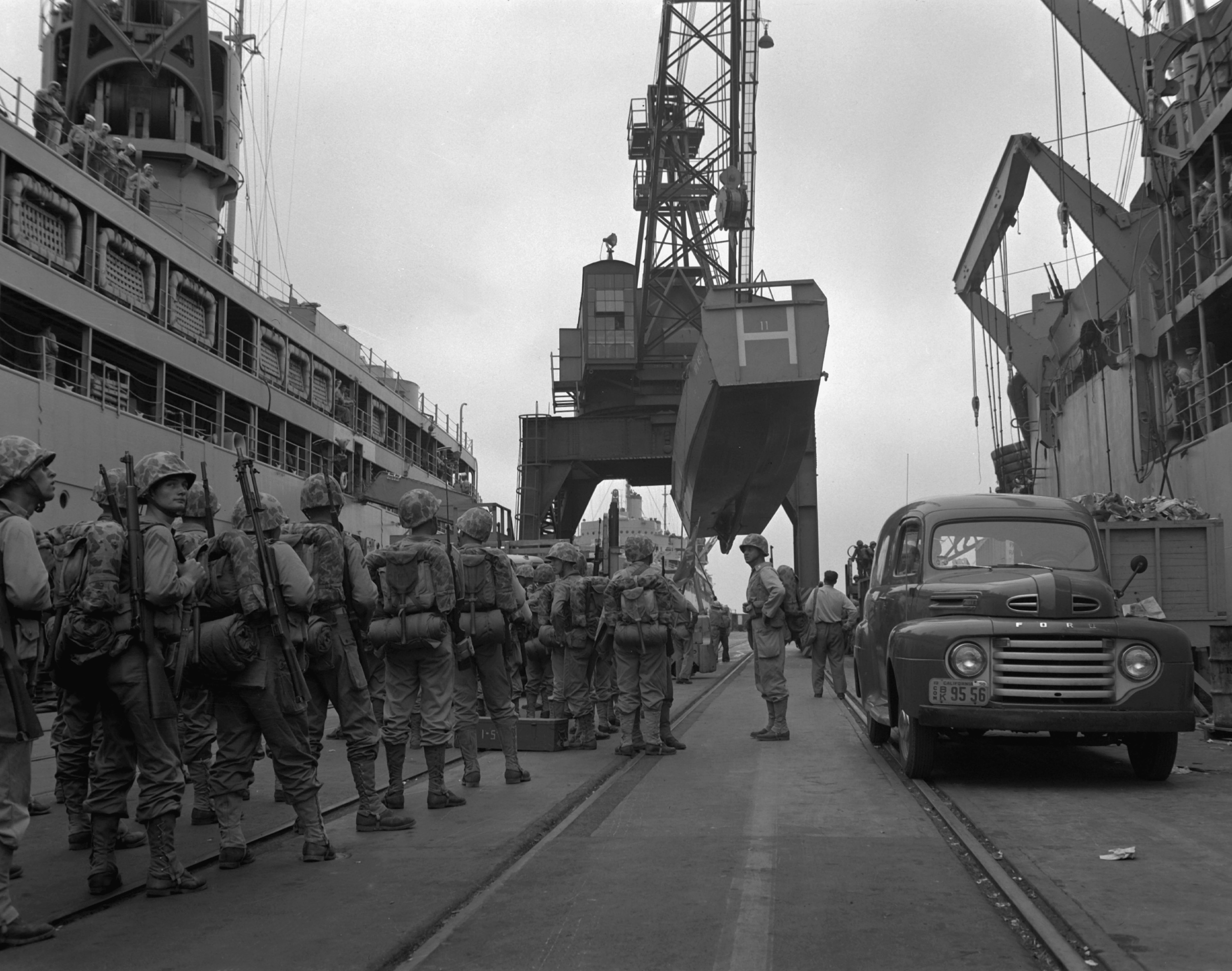
On 1 September she sailed from San Francisco Bay with replacement troops for the Philippines, Magic Carpet work, bringing Pacific soldiers home, occupied her into May 1946. From Pearl Harbor on 25 May she went to the Bikini atomic tests, Operation Crossroads, supported the experiments for three months, and was back at San Francisco on 29 August 1946. Coastal duty followed. A western Pacific cruise began on 6 February 1947 and ended in July. Tsingtao, in China, was her station from 6 July 1948 until 25 February 1949, backing American soldiers ashore. The new year opened with Caribbean landing exercises, finished at San Diego on 8 April 1950. When South Korea was invaded, the 1st Marine Brigade came aboard, and on 12 July she sailed for Korea. Mechanical trouble turned her back two days later. She was at sea again on 18 July and on 2 August entered Pusan with the original group.
Troops landed from her at Inchon on 15 September 1950. As United Nations forces moved north she carried soldiers and supplies among ports. Chinese troops appeared on a large scale in November. By December the troops holding Wonsan and the troops holding Hungnam had been cut off. That month she helped take thousands of soldiers out of both ports. Seattle on 22 March 1951. Repairs and landing practice, then a second Korean sailing on 16 October 1951, taking troops to coastal points and joining training landings, until San Diego on 26 July 1952. Pearl Harbor repairs and training in September led to another departure on 7 March 1953. She shifted troops along the Korean coasts and to Japan, operated between Pusan and Japan in July and August, and joined the prisoner transfer that followed the armistice. A Navy Unit Commendation recognized the opening months of that war. San Francisco on 24 August 1953 began a year of coastal training. She sailed for the Far East on 24 October 1954, took part in an amphibious exercise in December, and on 8 February 1955 went in to evacuate Nationalist Chinese troops when fighting threatened the Tachen Islands. She made Keelung, on Formosa, on 13 February. Philippine ports and Hong Kong were the ends of the troop lifts that followed. San Diego again on 22 April 1955.
Each year afterward she deployed west with the 7th Fleet, training for landings in Korea, at Okinawa, and in the Philippines, beside United States Marines and beside troops of SEATO members. Communist missiles placed in Cuba brought an American quarantine of the island. She was diverted to the Caribbean on 27 October 1962 and arrived on 5 November. Embarked Marines were part of a force held ready if the blockade had to be reinforced. When the missiles left and the crisis faded, she departed on 6 December and reached San Diego on 15 December. West Coast training lasted until 16 December 1964. She then deployed with the 7th Fleet again. A battalion landing team of Marines loaded at Okinawa. Hong Kong was the next call: she left on 11 January 1965 and arrived on 14 January. On 20 January she began special duty in the South China Sea as American strength gathered in Southeast Asia. Marines landed at Da Nang in early March. A second team from Okinawa reached Da Nang on 15 April. By 21 April a third team was embarked for Chu Lai and went ashore on 7 May. A fourth run to Okinawa brought back the 3d Marine Division headquarters, which arrived at Chu Lai on 21 May. She sailed from Yokosuka on 28 May and reached San Diego on 16 June. Thirteen months out of that port went to squadron exercises and landing training along the Southern California coast. Marines embarked at San Diego, and on 27 July, after that stretch, she sailed for the Far East and put them ashore at Da Nang a month later. Over the seven months that followed, Okinawa and the Philippines supplied reinforcement drafts and replacement drafts for the American bases in South Vietnam. She also worked the coast, the demilitarized zone at one end and the Mekong Delta at the other, backing assaults on Viet Cong holds along that shore. She left Vietnam late in March 1967 and was at San Diego the next month. Into mid-1967 she stayed ready to go back. The Second World War brought three battle stars and Korea nine, besides the Navy Unit Commendation.