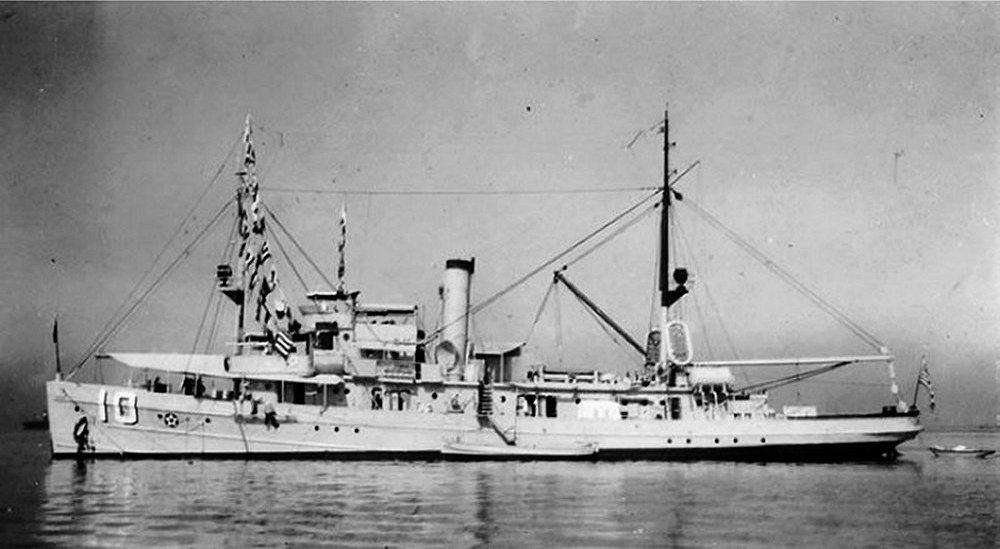
Heron was a Lapwing-class minesweeper, Minesweeper No. 10. Standard Shipbuilding launched her on 18 May 1918. Miss Astrid Rundquist, daughter of the officer who was to command her, sponsored her. She was commissioned on 30 October 1918, with Lieutenant K. Rundquist in command. She was designated AM-10 in February 1920.
She was given as 840 tons, 187 feet 10 inches long, with a beam of 35 feet 6 inches and a draft of 9 feet 9 inches, a speed of 14 knots, a complement of 78, and two 3-inch guns. She was decommissioned at Cavite on 6 April 1922. She was commissioned again on 18 December 1924 as a seaplane tender with the aircraft squadron of the Asiatic Fleet. On 22 January 1936 she was reclassified AVP-2.
When the war opened she was in Philippine waters tending patrol planes, with Lieutenant Commander William L. Kabler in command. She was not at Cavite on 10 December.
She fell back to the Moluccas and set up a base at Ambon. On 29 December 1941 she got underway to help the destroyer Peary. The next morning she turned back toward Ambon. On 31 December Japanese aircraft bombed her. About twenty-six of her people were casualties. She returned to Ambon, and at the end of February 1942 she retired to Australia. She received the Navy Unit Commendation for that period. She earned four battle stars.
She was decommissioned at Subic Bay on 12 February 1946. In July 1947 she was transferred for disposal. She had survived the war, including the bombing of 31 December 1941.
A note on sources. The launch, the sponsor, Rundquist, the Port Ciego sentence naming Kabler, the 31 December bombing, the Navy Unit Commendation, the four stars, and the decommissioning at Subic Bay are the Navy's ship history. That history spells the January 1936 reclassification with a doubled letter in the month. A second account lays her down on 26 August 1917, dates AM-10 on 17 February 1920, gives 950 tons and a draft of 9 feet 10 inches, strikes her on 1 May 1946, and sells her for scrap on 25 July 1947. The same account ends Kabler's tour on 10 September 1941 and begins Lieutenant Richard Cross Lake that day. The combat narrative still names Kabler, and it puts her at Balabac rather than Port Ciego. It also gives his initials as William L. Kabler, which agrees with the ship history and not with a bare initial. This is AM-10, later AVP-2. It is not the minehunter Heron (MHC-52).