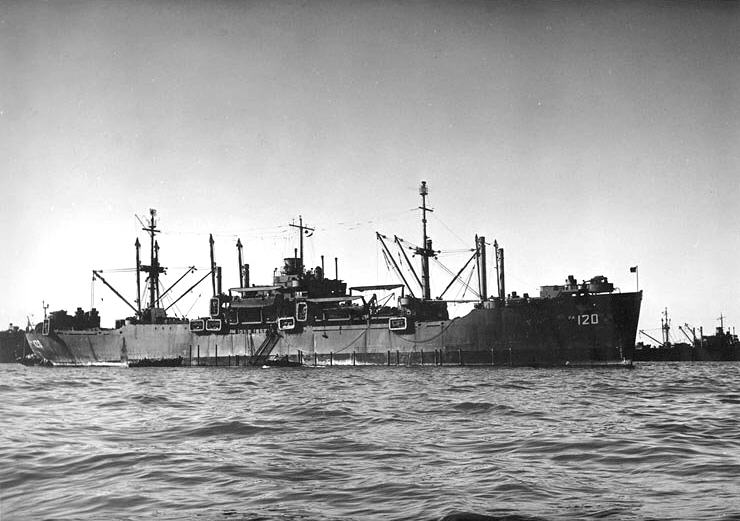
Hinsdale was named for Hinsdale County, Colorado. California Shipbuilding at Wilmington launched her on 22 July 1944; she had been Maritime Commission hull 30. Mrs. M. E. Harper sponsored her. Commander Edward Flood Beyer, USNR, took command when she was commissioned on 15 October 1944.
Shakedown was spent in the San Diego and San Pedro area. She then crossed the Pacific and entered Pearl Harbor on 12 December carrying 175 passengers. On 27 December about 1,200 Marines came aboard for Iwo Jima. As flagship of Transport Division 44 she used nearly a month for landing drills. The ship left Hawaii on 27 January 1945, paused at Saipan to join a large transport body, and was off Iwo Jima at dawn on 19 February. Her Marines landed in the opening wave. For more than a week she stayed nearby, shifting troops and cargo and treating serious wounds in the role of an extra hospital ship. Japanese shore guns and mortars fired throughout. The morning of 25 February was the dangerous one off Iwo Jima. A shell exploded just off the side, a Marine captain died on deck, and several men near him were hurt. She got underway on 27 February, took fuel at Saipan, and on 3 March reached Guam, where 166 casualties went ashore.
Guam was only a pause. On 9 March she was at Saipan again, loading for Okinawa. Nearly 1,500 Marines and sailors were embarked, and the landing was rehearsed at length. She sailed on 27 March with the Joint Expeditionary Force, a body of 1,213 ships and more than half a million troops. Before dawn on 1 April, Marines already topside and ready to go ashore, lookouts caught an aircraft skimming the water. Warning was a matter of seconds. At 0600 the kamikaze struck just above the waterline on the port side. The engine room was ripped open. A series of three blasts followed, the bombs going off inside the ship and tearing that space apart. Boiler steam swept the engine-room watch. Only one of those men lived. Power, lights, and interior phones failed together, and the ship stopped dead with three holes open on the port side. Marines who had been lined up to land were moved over to the starboard rail to ease a growing list, while repair parties felt their way through smoke, put out fires, and set temporary patches. The count afterward was fifteen dead, and forty more missing or hurt.
She got her Marines ashore anyway. A diesel generator restored limited power, the thirteen-degree port list was corrected, and ATR-80 took her in tow at about five knots for the twenty-mile haul to Kerama Retto. Patching continued while suicide attacks went on, and her guns shared in shooting down at least two of the planes. Equipment and stores the Marines still needed were shifted across to Pitt (APA-223). Hinsdale was then used as a receiving ship for men taken off other kamikaze victims. On 14 April Leo (AKA-6) towed her clear in company with LSTs. The slow convoy made Ulithi on 25 April. The repair ship Vulcan worked her back into shape, and on 20 May she sailed for home.
Brooklyn Navy Yard took her in on 2 July for a full overhaul. Japan surrendered while the yard work was unfinished, but one more Pacific passage was still ahead. She left on 21 November on Magic Carpet duty, called at Pearl Harbor, and went on to Sasebo and Nagasaki. More than a thousand troops boarded for the return, and she reached San Francisco on 24 January 1946. Norfolk Navy Yard was the next port, on 20 February. Decommissioning came on 8 April. The Maritime Commission received her on 12 April, and her name was stricken on 1 May. She was afterward berthed with the National Defense Reserve Fleet in the James River near Norfolk. Two battle stars stand on her wartime record.