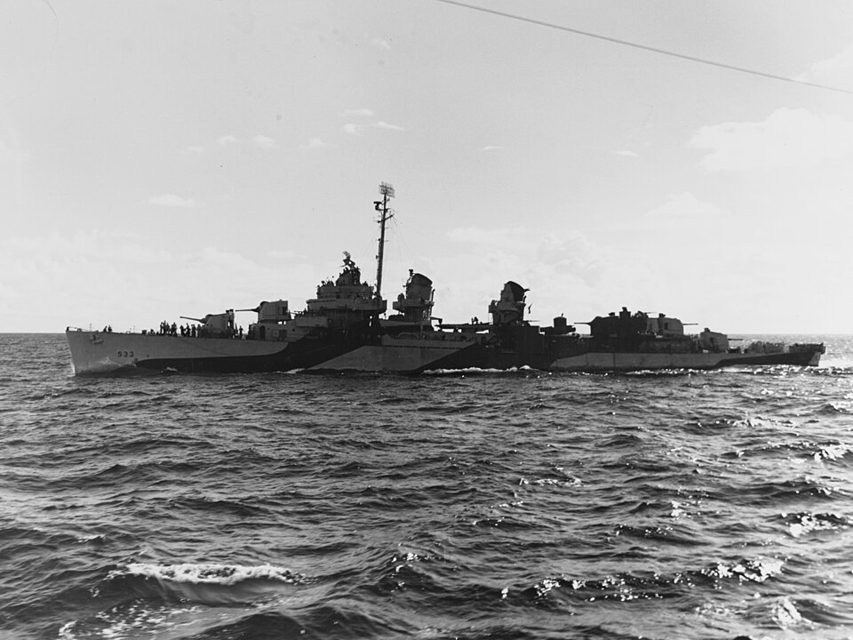
Hoel was a Fletcher-class destroyer, built by Bethlehem at San Francisco. She was launched on 19 December 1942 and commissioned on 29 July 1943. The name is William R. Hoel, a gunboat man on the Mississippi in the Civil War. Commander William Dow Thomas commissioned her. She spent her year with the escort carriers and the amphibious forces. At Makin, on 24 November 1943, she was in the screen when the submarine I-175 put a torpedo into the escort carrier Liscome Bay. The bomb magazine went up. Hoel's men watched the flame. The carrier was gone in about twenty-three minutes, and 644 men with her, including Rear Admiral Mullinnix. The destroyers took 272 out of the water. Hoel was not hit. She bombarded at Eniwetok, shelled a warehouse on New Hanover, and in September 1944 was back with the escort carriers for Peleliu. In October she was with Taffy 3, off Samar.
By then Commander Leon S. Kintberger had the ship. Thomas, her first captain, was aboard as commander of the screen. On the morning of 25 October 1944 the Japanese center force came out of the squall to the north: battleships, heavy cruisers, and destroyers, against six escort carriers and seven ships of the screen. Johnston turned toward them on her own. Hoel went in with her.
She closed the battleships and opened fire on the way in. A salvo hit the bridge and the gun director. Voice radio, the radar picture, and bridge steering went out. The blast killed men on the bridge and wounded both Thomas and Kintberger. She kept going. At about 9,000 yards she fired five torpedoes at the leading battleship. They did not hit. American accounts say the battleship turned away from them. The Japanese record says they passed ahead and she did not have to turn. Either way, no ship is credited to that spread.
The heavy cruisers were then on her quarter. At about 6,000 yards she fired the other five at the leading cruiser. Kintberger watched them run hot and straight, and at the time they should have arrived he saw columns of water at the target. No Japanese ship confirms the hit. She is not credited with one.
What she did after that was get in the way. For the next hour she fishtailed, chased salvos, and fired what guns she had left, and the heavy ships fired at her instead of only at the carriers. The shells were 5-inch, 8-inch, and bigger. Which ships made them is not pinned down. Kintberger counted more than forty hits. Around 0830 an 8-inch shell stopped the last engine. The engine room was flooding, a magazine was burning, and she was listing to port and going down by the stern. He ordered the crew to prepare to abandon. The Japanese kept firing while the men went over the side. At least one shell hit men in the water. At 0855 she rolled over and sank. Johnston was already finished, or nearly. Heermann got out. So did four of the carriers. Gambier Bay did not.
Eighty-six of her men lived through the battle and the water. The Navy histories put the dead at 252 or 253. Kintberger wrote that the place where she sank was small and known, and that planes saw the rafts and knew what they were, and that it still took two days for ships to come. The first rescue force that night was sent to the wrong spot. One raft started with about seventy men. Two of them, Raymond Bruner and Francis Stetler, reached Samar five days later. At least forty-three men who got off the ship were never found. Thomas and Kintberger both lived. Both were given the Navy Cross. The ship was given the Presidential Unit Citation.