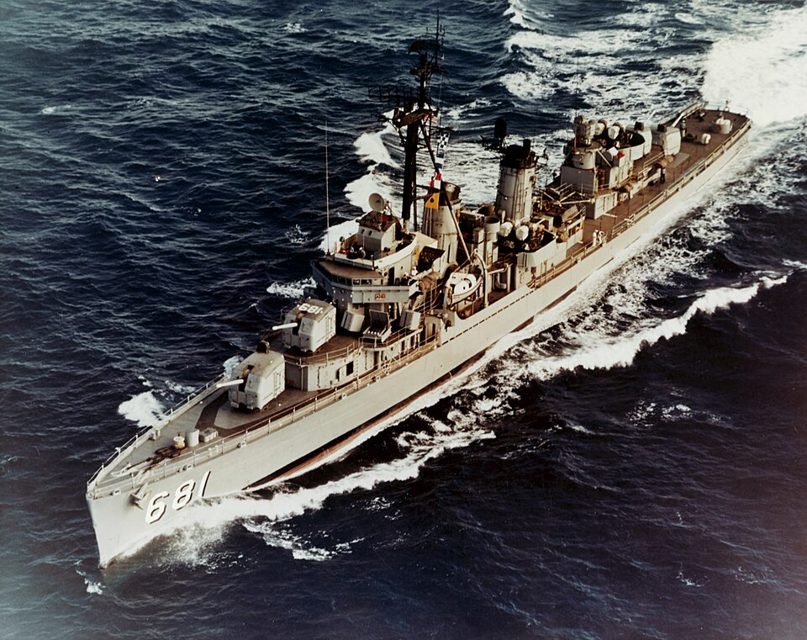
USS Hopewell (DD-681) was a Fletcher-class destroyer. She was launched on 2 May 1943 and commissioned on 30 September 1943 under Corbin Clark Schute, who commanded her until 25 September 1944. After working up off San Diego she sailed for Hawaii on 13 January 1944, and on 23 January she headed for the invasion of the Marshalls, steaming ahead of the amphibious force as a picket. She arrived off Kwajalein on 31 January and fired in support of the opening assault. That night her guns pounded Roi and Namur, and on 1 February she turned to screening and patrol among the rest of the atoll. Once the landings were secure she left for Pearl Harbor, arriving on 24 February.
On 14 March she reached Purvis Bay in the Florida Islands for the offensive along the northern coast of New Guinea. Screening, patrol, and shore fire filled her time, including the bombardment that accompanied the Aitape landings inside the Hollandia operation. Aitape, on 22 April, met no opposition. Hopewell remained with the Seventh Fleet. On 29 May she and three other destroyers shelled ground the Japanese held on New Ireland, and in June she joined the escort carrier Hoggatt Bay on patrol against submarines.
Morotai followed, seized as an airfield for the Philippines campaign still to come. Hopewell arrived on 16 September, one day behind the first troops, and took up screening. The same day she downed a Japanese plane that attacked the ships. On 18 September she covered a secondary landing on the island, and on 25 September she sailed with a convoy for Humboldt Bay. Warner S. Rodimon relieved Schute that day.
The invasion of the Philippines opened with the Leyte landings on 20 October, and Hopewell came in four days later with a reinforcement group. Damage to a propeller held her out of the Battle of Leyte Gulf on 24 and 25 October, the fight in which the Imperial Japanese Navy was defeated. The next day she led a convoy toward Humboldt Bay, where the damage could be repaired. At the eastern entrance to the gulf the convoy was attacked. Hopewell spread smoke to hide the ships and brought down two planes. She sailed for Leyte again on 8 November. After two convoy runs from Humboldt Bay to Leyte and back, she joined the Mindoro invasion. Heavy air attacks hit the force on the way. Off the assault beaches on 15 December she fired as the troops went ashore, helped extinguish fires on LST-472, and shared in downing further planes, then left for Leyte at noon.
Mindoro was in Allied hands, and airfields for the move against Luzon were under construction. Hopewell made ready for Lingayen Gulf, sailed on 4 January, and beat off kamikaze attacks on the passage. For the landings on 9 January she screened an escort-carrier group whose planes covered the beachhead. On 14 February she joined the assault on Corregidor. While her gunfire was breaking up obstructions in Mariveles Bay she engaged a heavy battery on the island, then laid smoke and closed to help the damaged YMS-48. Four hits wrecked the station that controlled her battery. Seventeen men were casualties. She stayed in Manila Bay through 18 February, then went to Manus for repairs and on to San Francisco, arriving 17 March. Further work complete, she sailed for Pearl Harbor on 28 May 1945. Richard Michael Hayes took command on 9 June. Hawaiian drills occupied her until 20 July, when she headed for Eniwetok and Guam. On the day Japan surrendered she left Guam with a refueling group in support of Task Force 38. She operated in Japanese waters for the occupation, and on 21 October 1945 she started home by way of Pearl Harbor. She arrived at Puget Sound Navy Yard on 8 November, later moved to San Diego, and on 15 January 1947 decommissioned into the Pacific Reserve Fleet. She had come through the Second World War.
The Korean War brought her out of reserve. She recommissioned at San Diego on 28 March 1951, finished a new shakedown, and on 18 June steamed west. With Task Force 77 she screened the carriers while their aircraft struck Communist positions, and she bombarded Wonsan. From August through September 1951 she served on the Formosa Patrol, then reached Mare Island on 5 February 1952. A second tour began on 11 August 1952 after more shakedown and training. While the armies ashore were deadlocked, the fleet kept hitting supply routes and fortified points, and Hopewell once more guarded the carriers and the heavy ships in Task Force 77. She patrolled off Formosa again and afterward shelled Wonsan once more. In December she went to Formosa to train sailors of Nationalist China. Late in January 1953 she was briefly back off Korea, screening the battleship Missouri during a coastal bombardment, and on 3 March 1953 she sailed for the United States.
Several months of antisubmarine training off California followed. On 27 October 1953 she sailed for the Far East, joined exercises and patrols off Formosa, and returned to San Diego on 23 May 1954. Her fourth cruise coincided with a fresh crisis between Communist China and Formosa, and in February she took part in evacuating the Tachen Islands. Fleet exercises in the western Pacific came next, and she reached San Diego on 22 May 1955. The rest of that year she trained off the coast. On 11 November, during an amphibious exercise, a single-engine attack bomber struck her amidships, killing five and igniting gasoline. Fire parties got the flames under control, and she returned to San Diego for a long repair. The crash destroyed Mount 53, a 5-inch/38 gun, and the mount was left off the ship, so she became the only Fletcher-class destroyer with four of those mounts. On 24 March 1956 she sailed again for the Far East and settled into cruises among Formosa, Okinawa, and Japan, with readiness training off the West Coast between them. On those deployments she operated with Korean ships and with ships of Nationalist China. On 11 February 1972 she was sunk as a target.