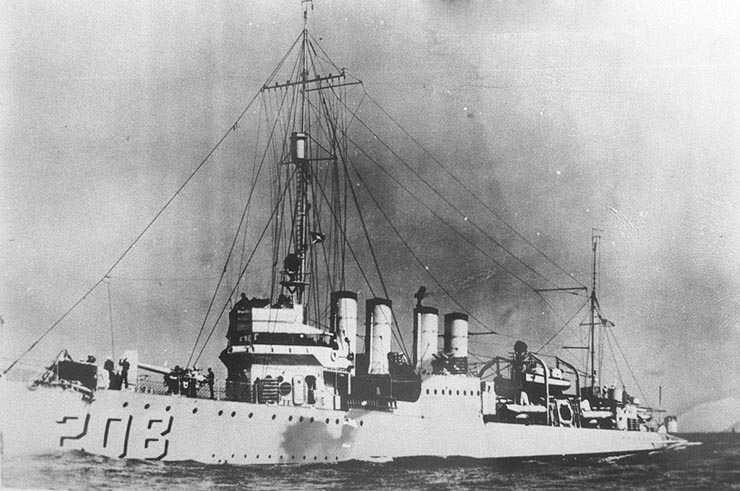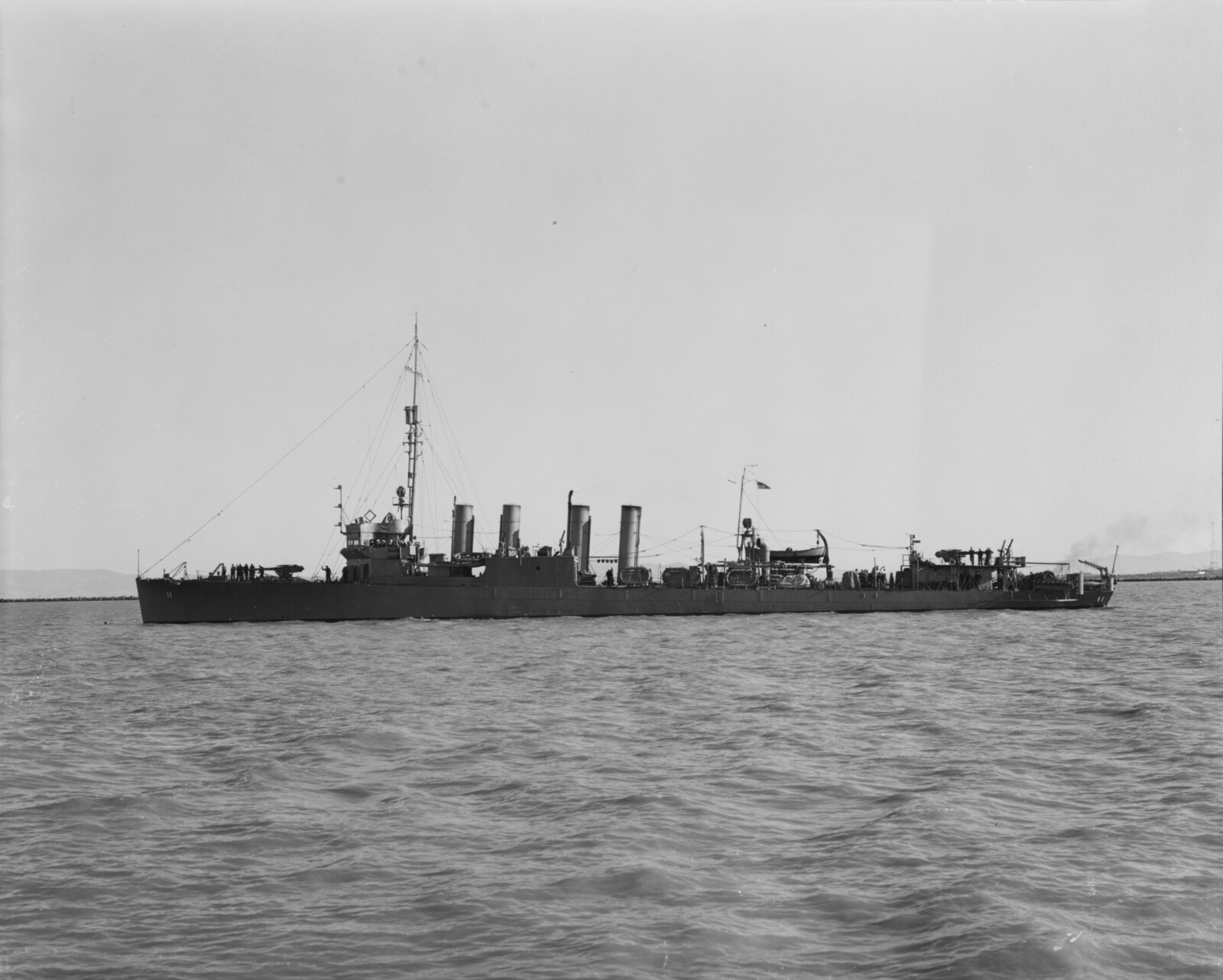
Hovey, DMS-11, was named for Charles Emerson Hovey. He was born at Portsmouth, New Hampshire, on 10 January 1885, graduated from the Naval Academy in 1907, and served in Pampanga in the Philippines in 1911. On 24 September 1911, in charge of a shore party on Basilan, he was killed by gunshot when the party was attacked. The ship was launched on 26 April 1919 by William Cramp and Sons at Philadelphia, sponsored by Mrs. Louise F. Kautz, sister of Ensign Hovey. She was commissioned on 2 October 1919, Commander Stephen Booth McKinney in command. She was built as Destroyer No. 208, a ship of the Clemson class: displacement 1,190, length 314 feet 4 inches, beam 30 feet 8 inches, draft 9 feet 3 inches, 35 knots, complement 167, four 4-inch guns, eight .50-caliber machine guns, and two depth-charge tracks.
After shakedown off Florida and in the Caribbean she sailed from Newport on 19 December 1919 with Chandler for the Azores and Brest, as station ship. She sailed from Dalmatia on 10 July 1920 for the Adriatic with papers and claims, reached Constantinople on 12 July, and visited Russian ports as station ship until 17 December, when she sailed for Port Said and the Asiatic Fleet. She stayed on the Asiatic station until she returned to San Francisco on 2 October 1922 and was decommissioned at San Diego on 1 February 1923. She was recommissioned at San Diego on 20 February 1930, Commander Stuart Osmond Greig in command. After shakedown from San Diego and Mare Island she trained reservists until 9 April 1934, when she transited the Panama Canal and reached New York on 31 May. Training and fleet exercises out of New England and off Florida followed. She returned to San Diego on 9 November. After overhaul at Mare Island she worked the west coast, with exercises in the Canal Zone and Hawaiian waters.
She was converted to a high-speed minesweeper and reclassified DMS-11 on 19 November 1940. After training she sailed on 4 February 1941 for Pearl Harbor. On 7 December 1941 she was steaming with Chandler as antisubmarine screen for Minneapolis, at gunnery practice off Pearl Harbor. Lieutenant Commander John Edwards Florance, who had her from 15 January 1940 to 16 December 1941, had her at sea that morning. She took up patrol and convoy duty around Pearl Harbor until 20 May, when she escorted a twenty-ship convoy to San Francisco, arriving on 31 May.
She returned to Pearl Harbor in mid-June. Lieutenant Commander Wilton Stewart Heald had her from 16 December 1941 to 21 September 1942. On 10 July she sailed for the southwest Pacific escorting Argonne, in company with Southard. She reached the Fiji Islands on 23 July and joined the minesweeping group of Rear Admiral Richmond K. Turner's South Pacific Amphibious Force on the 31st. On 7 August, during the invasion of Guadalcanal, she had a screening station for the transports. Shortly before 0800 she took a bombardment station to cover the landings east of Gavutu. Japanese shore batteries opened and were quickly silenced by fire from Hovey and the other ships on that station. She then joined the other high-speed minesweepers for sweeps between Gavutu and Bungana. Commander William H. Hartt, Jr., had the Minesweeper Group, Task Group 62.5. Morison's task organization and the combat narrative name Lieutenant Commander Wilton S. Heald as her commanding officer. The next morning she steamed into Lengo Channel against a squadron of torpedo bombers. The fire from the surface ships was so intense that the enemy dropped their torpedoes early, at too great a range, and the attack did little harm. She stayed around Guadalcanal until she retired to New Caledonia on 13 September for replenishment. Heald was relieved on 21 September.
From New Caledonia she went to Samoa, then back to Ndeni in the Santa Cruz Islands with a Marine reconnaissance party. Lieutenant Commander Edwin Anderson McDonald had her from 21 September 1942 to 24 January 1944. Returning to New Caledonia, she left on 10 October with two motor torpedo boats in tow and 127 drums of aviation gasoline, and delivered them to Tulagi two days later. Escort duty between Guadalcanal and Espiritu Santo continued until she reached San Francisco on 19 April 1943 for overhaul. She joined a convoy out of Mare Island on 31 May for New Caledonia, arriving on 10 August, and resumed escort and patrol until 30 October, when she joined Rear Admiral T. S. Wilkinson's III Amphibious Force for the Cape Torokina landing on 1 November 1943. No major landing in the Pacific had yet been made so close to a major enemy air base as Torokina was to Rabaul. Wilkinson's force had air coverage, and the landing went well enough that he told his transports they could bombard Cape Torokina. For the next week, during the seizure of Empress Augusta Bay, she screened transports and made prelanding sweeps.
Lieutenant Commander Asa Allan Clark III relieved McDonald on 24 January 1944 and had her until 22 December 1944. Screening and escort in the Solomons lasted until 5 April 1944, when she escorted Lindenwald from Tulagi to Majuro. She returned to Espiritu Santo on 11 April and on the 20th joined Task Unit 34.9.3, Captain Kane in Petrof Bay, delivering replacement planes to other carriers at Manus. The unit met Fast Carrier Task Force 58 on 29 April to furnish planes for the first strikes on Truk. She then went to Florida Island and departed for the west coast, arriving on 31 May by way of Pearl Harbor. Repairs finished, she sailed for Pearl Harbor on 29 July to become flagship of Mine Squadron 2 under Commander W. R. Loud. She sortied from Port Purvis on 6 September in the antisubmarine screen of Rear Admiral Oldendorf's Western Gunfire Support Group for the southern Palaus. After sweeps between Angaur and Peleliu and in Kossol Passage she patrolled the transport area off Peleliu. She joined the minesweeping and hydrographic group of Rear Admiral Thomas Sprague's escort-carrier group for Leyte, from 17 to 25 October 1944. On the 17th she swept ahead of the high-speed transports and fire-support ships on the approach to the beaches on Dinagat. After more sweeps through Looc Bay and the Tacloban-Dulag approach she retired to Manus on 25 October.
As flagship for Commander Loud's minesweeping and hydrographic group she left Manus on 23 December and reached Leyte Gulf on the 30th. Lieutenant Ben Node Cole had her from 22 December 1944. She sortied on 2 January 1945, went south through Surigao Strait, and entered the Mindanao Sea for the landings on Lingayen, Luzon. Snoopers harassed the convoy at night. No attacks developed until the morning of the 3rd. From then on the air attacks were so frequent that she adopted a policy of not firing unless she was directly under attack, so as not to expend her ammunition. The minesweepers reached the entrance to Lingayen Gulf. At 0800 they came under attack and she splashed one suicide plane. On a return sweep, two suicide planes made straight runs on the last two ships in the column and crashed Brooks and Long. She slipped her gear and stood in to assist Long. Long's entire bridge and well deck were on fire, with intermittent explosions from the forward magazine and ready ammunition. Because of the explosions and the air attacks she could not get alongside. She spent an hour picking up 149 survivors. At dark the sweepers made their night retirement and steamed off the entrance. No more attacks came until 0425 on 7 January, when aircraft were picked up on radar. At 0450 a plane low on the water came in from the starboard quarter and passed ahead of her. A few moments later another plane, from the port beam, was set on fire by Chandler. That plane passed very low over Hovey and crashed on the starboard beam. At 0455, the instant the burning plane crashed, a torpedo struck her starboard side in the after engine room. Lights and power went at once. The stern stayed nearly level and settled to the top of the after deckhouse. The bow listed 40 degrees to starboard and rose. The ship broke in half. Two minutes later the bow listed to 90 degrees, rose vertically, and sank in 54 fathoms. Twenty-four of her own men were killed, and twenty-four more who were survivors from Long and Brooks. Cole was her commanding officer that morning. She received eight battle stars for service that carried her through eight major operations, from the minesweeping and fire support of the landings to the escorts in between.
A note on sources. The career is the Dictionary of American Naval Fighting Ships entry for Hovey. Commanding officers are NavSource's page for DD-208. The 7 August assignment, and Heald's name in it, are the combat narrative, chapter 5, and Morison, volume IV, pages 270 to 274. The Dictionary gives the commissioning officer as Commander Stephen B. McKinney and the 1930 commanding officer as Commander Stuart O. Greig. NavSource gives Stephen Booth McKinney and Stuart Osmond Greig. The Dictionary prints the distance off Pearl Harbor on 7 December as "2C miles," which is not a readable figure, so no distance is given here. It prints the day the sweepers were in the entrance to Lingayen Gulf as "(i January," so that day is not stated. Southard's entry has that ship begin sweeping at Lingayen on 6 January, and the two are not combined here. NavSource does not say whether Lieutenant Ben Node Cole was among the twenty-four of Hovey's men killed on 7 January. The Dictionary closes with a sentence it attributes to John Paul Jones in 1778. That sentence is not used here.