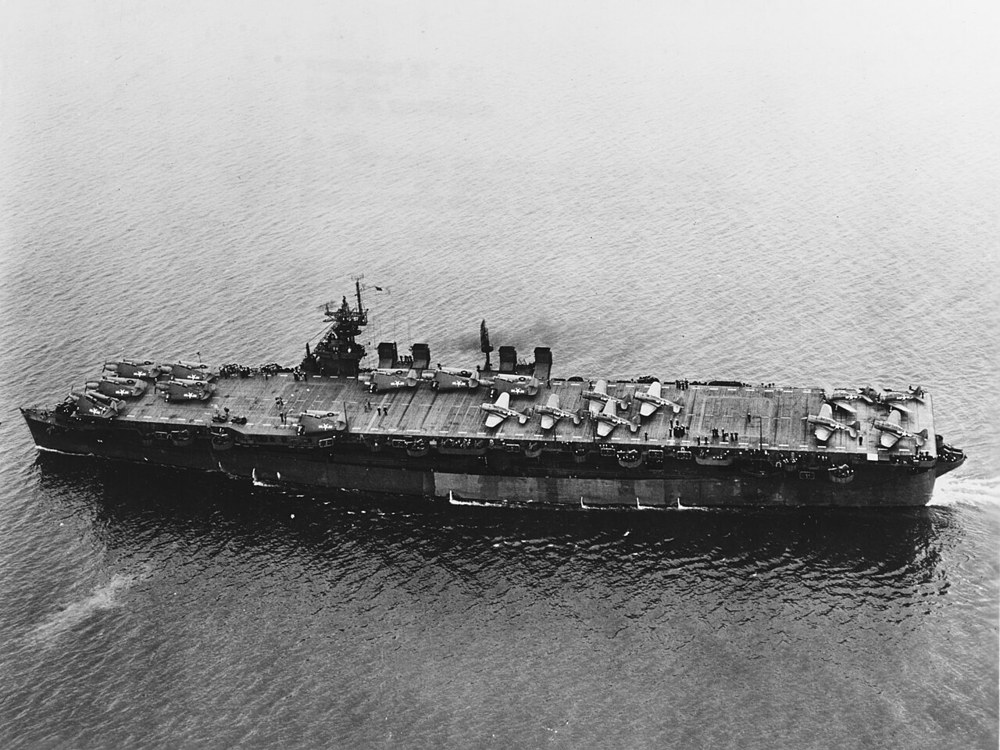
USS Independence (CVL-22) was the first of nine light carriers built on cruiser hulls. She was begun as the light cruiser Amsterdam (CL-59), launched as a carrier on 22 August 1942 by the New York Shipbuilding Corporation at Camden and commissioned on 14 January 1943, Captain George R. Fairlamb, Jr. in command. She was redesignated CVL-22 on 15 July 1943. She is the fourth Independence.
She reached San Francisco on 3 July 1943. With the carriers Essex and Yorktown she raided Marcus Island on 1 September and Wake on 5 and 6 October 1943, then struck Rabaul on 11 November. At Tarawa on 20 November 1943 a Japanese torpedo plane put a torpedo into her starboard quarter. She was repaired at San Francisco and came back to Pearl Harbor in July 1944 with an extra catapult, and began pioneering night carrier operations from Eniwetok in August.
She flew night search and night fighters for Task Force 38 in the Palaus and Philippines raids. On 24 October 1944 her task group found Kurita's force in the Sibuyan Sea, and her aircraft joined the attacks that sank the battleship Musashi. Her night search planes shadowed Ozawa's carriers until dawn on 26 October. She supported the Lingayen landings and the South China Sea raid in January 1945, was repaired at Pearl Harbor, and struck Okinawa from 30 March 1945 until 10 June. She joined the final strikes on Japan in July and August. She survived the 1946 Bikini atomic tests as a target ship and was scuttled off California on 29 January 1951.
Her wartime commanding officers, from NavSource: Captain George Richardson Fairlamb Jr., 14 January 1943 to 27 September 1943; Captain Rudolph Lincoln Johnson, 27 September 1943 to 26 July 1944; Captain Edward Coyle Ewen, 26 July 1944 to 11 February 1945; Captain Nolan Martin Kindell, 11 February 1945 to 28 August 1946.
Sources: Dictionary of American Naval Fighting Ships (DANFS), Wikipedia, NavSource Online (commanding officers) and Wikimedia Commons (photograph records).