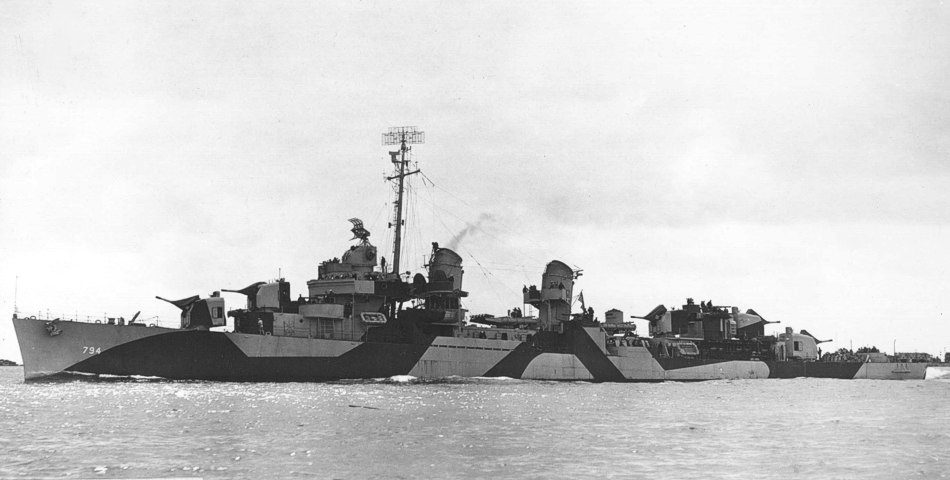
USS Irwin (DD-794) was a Fletcher-class destroyer. She was launched on 31 October 1943 and commissioned on 14 February 1944, with Daniel B. Miller in command from that day.
With shakedown behind her, she left San Diego on 26 April 1944 for Hawaii and continued to Eniwetok, the staging point for the Marianas invasion. On 11 June she sailed in company with escort carriers whose aircraft covered the Saipan landings of 15 June. In the Battle of the Philippine Sea, from 19 to 21 June, the Japanese Mobile Fleet was driven off in defeat, and Irwin downed a torpedo bomber while those carriers fought off air attacks. She shelled Saipan from 21 to 29 June, guarded the escort carriers that covered the Tinian landing on 23 July, and fired in support of troops fighting on Guam.
She then screened fast carriers striking Japanese bases in the Palau Islands and along Luzon, Okinawa, and Formosa. Off Formosa on 14 October 1944 she destroyed a torpedo bomber. She helped see Houston (CL-81) and Canberra (CA-70), both hurt by bombs, out of danger, and rejoined the fast carriers for air cover of the Leyte landings on 20 October 1944.
On 24 October the Japanese fleet closed the Philippines on three separate paths in the Battle of Leyte Gulf. Aircraft from the carrier group Irwin was screening struck the Center Force of battleships and cruisers. Shore-based bombers hit back, and one bomb landed on the light carrier Princeton (CVL-23). Irwin came alongside through fire, violent blasts, falling wreckage, and shells cooking off. In thick smoke and a rough sea her men passed hoses over and worked the blaze on the forward hangar. When a huge explosion tore away most of the carrier's stern, she launched boats at once. Sailors went into the water after survivors, among them Charles Edward Kahler and Bert Townsend Jr., named as the ship's strong swimmers. Damaged in the effort, she stayed at close quarters until 646 men had been taken from the sea and from Princeton. The Navy Unit Commendation marked that rescue. She shaped course for Ulithi with the survivors while, in the same wide battle, most of the Southern Force was wiped out in the Battle of Surigao Strait, Japanese carriers were lost off Cape Engaño, and the heavy surface force sent against the beachhead was stopped in the Battle off Samar.
Overhaul at the San Francisco Naval Shipyard kept her from 17 November 1944 to 23 January 1945. She then steamed by way of Hawaii and the Marshalls and reached Saipan on 14 February 1945. From 19 to 23 February she screened attack carriers giving close air cover for the Iwo Jima landings. Assigned to Task Force 54 for Okinawa, she joined the bombardment ahead of the assault, from 27 to 31 March. Japan threw its widest kamikaze offensive of the war at that island, and Irwin also met ordinary attack planes, torpedo boats, and suicide boats. On 30 March she beat off three Japanese torpedo boats, sinking one, damaging a second, and chasing the last away.
On 1 April 1945, as Marines landed on Okinawa, she downed a two-engine bomber and pulled one enemy airman from the wreck's survivors. For about two months her guns worked over artillery, machine-gun nests, troop gatherings, caves, and hideouts used by suicide boats. A suicide torpedo bomber fell on 12 April, another aircraft on the 16th while she covered the Ie Shima landings, and a further suicide plane on 21 May. On the night of 16 June she helped save men from Twiggs (DD-591), lost under air, torpedo, and suicide attack together. She remained off Okinawa until Japan stopped fighting on 15 August 1945, entered Tokyo Bay on 31 August, and shepherded occupation forces running between Okinawa and Japan through 28 October. She then left Yokosuka and reached San Diego on 15 November 1945. After an inactivation overhaul she was decommissioned there on 31 May 1946 and entered the Pacific Reserve Fleet.
The Navy returned her to service at Long Beach, California, on 26 February 1951. On 12 May 1951 she sailed for an overhaul at the Philadelphia Navy Yard. From January through June 1952 she added weight to the 6th Fleet in the Mediterranean, then drilled off the Atlantic coast and on 16 December 1952 took Newport, Rhode Island, as her base. On 1 April 1953 she sailed from Fall River, Massachusetts, passed the Panama Canal, called at San Diego and Hawaii, and joined the 7th Fleet in the waters off Korea. She screened fast carriers striking targets deep inland and, in repeated coastal bombardments of her own, hit enemy supply routes and depots in support of United Nations troops ashore. After the truce she transited the Suez Canal, visited Mediterranean ports, and arrived at Boston on 2 October 1953.
Local duty from Newport continued until 5 January 1955, when she left for NATO exercises in the North Atlantic and another stretch in the Mediterranean, returning to Newport on 26 May 1955. Atlantic coast work lasted until 29 March 1956, when she shifted to Long Beach and arrived on 15 April. That summer she deployed with the 7th Fleet between Japan, Okinawa, the Philippines, and Taiwan, and was back at Long Beach on 11 August. Later drills reached as far as Hawaii. On 12 March 1957 she sailed once more to the 7th Fleet in the Far East for a Taiwan Strait patrol, combined maneuvers with SEATO navies, and goodwill calls in the Philippines and Japan. She returned to Long Beach on 24 August 1957 to inactivate and was decommissioned on 10 January 1958. For World War II she received the Navy Unit Commendation and six battle stars, and for Korean service one battle star. On 10 May 1968 she was transferred to Brazil.