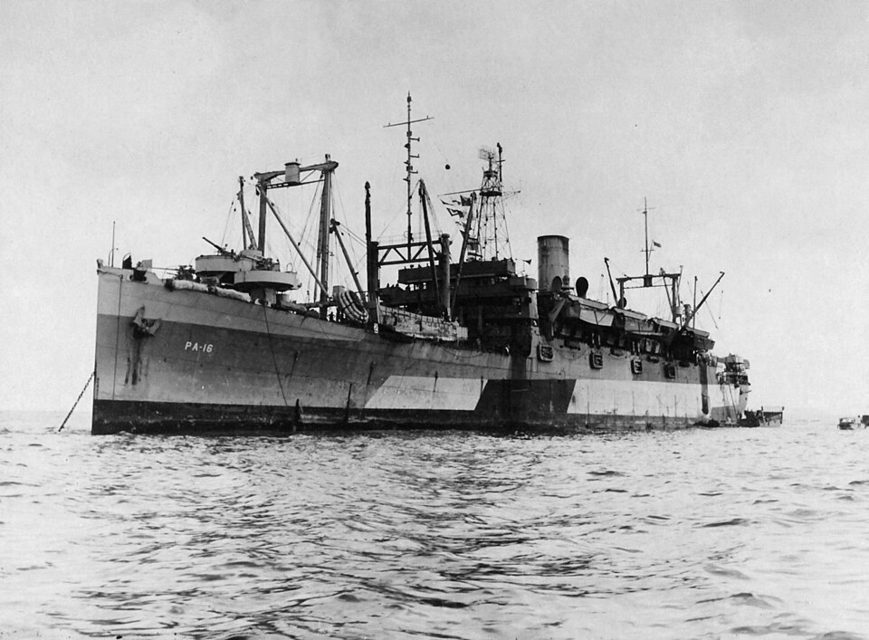
J. Franklin Bell, APA-16, began as a passenger liner and had a long career before the Navy took her. New York Shipbuilding laid her down at Camden for the Emergency Fleet Corporation as Keystone State, launched her on 15 May 1920 (NavSource gives 5 May 1920), and delivered her on 28 May 1921. She ran as President McKinley in the Pacific. In December 1937 she helped take about 630 people off Kasho-to when the liner President Hoover ran aground. The Army acquired her on 26 October 1940 and renamed her for General J. Franklin Bell, Army Chief of Staff from 1906 to 1910. The Navy took her over in December 1941 and commissioned her as AP-34 on 2 April 1942, Captain Herbert J. Grassie in command. She became APA-16 on 1 February 1943.
She carried about 1,500 troops to Adak in 1942, landed troops at Attu on 11 May 1943 in fog and rough surf, and landed at Kiska on 15 August after the Japanese had left. At Tarawa on 20 November 1943 she was straddled by gunfire off Betio, moved out of range, and landed her Marines at Bairiki the next day.
She reached Kwajalein on 31 January 1944 with more than 1,500 soldiers, entered the lagoon on 2 February, unloaded supplies and received casualties. On 5 February her landing boats assaulted Gugegwe. She left on 8 February with more than 2,000 soldiers. She debarked troops at Saipan on 17 June 1944, made a feint landing off the south end of Tinian on 24 July, carried 438 Japanese prisoners to Pearl Harbor in August, and was off Dulag, Leyte, on 20 October.
She was decommissioned and returned to the Army on 21 March 1946 and struck from the Navy list on 12 April 1946. She was transferred to the Maritime Commission on 12 February 1947 and sold for scrap on 2 January 1948. She earned seven battle stars.