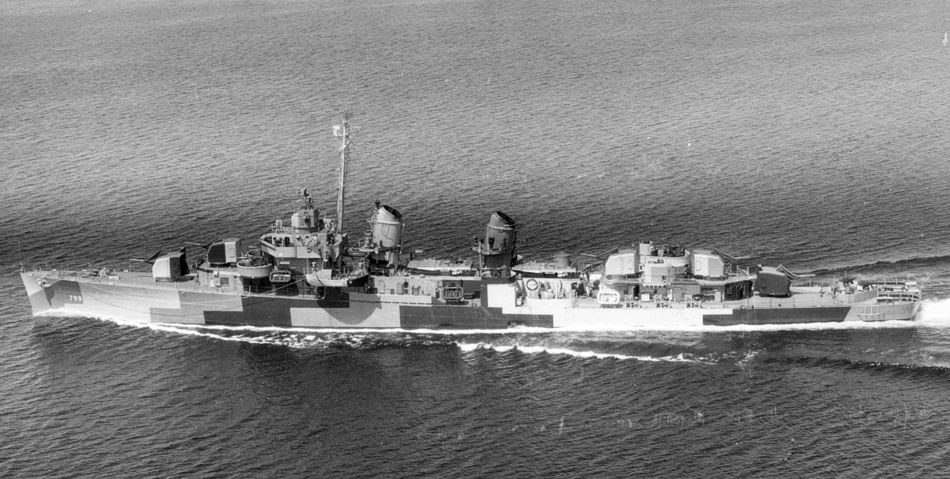
USS Jarvis (DD-799) was a Fletcher-class destroyer. She was launched on 14 February 1944 and commissioned on 3 June 1944, with Ernest Bradford Ellsworth in command from that day. After a shakedown off the California coast, she left Seattle on 25 August 1944 screening the battleship South Dakota and entered Pearl Harbor on 31 August.
On 3 September she went on alone to Adak, Alaska, and joined the North Pacific Force for operations against the Kurile Islands. Working from Adak and from Attu, she faced rough seas and long stretches of bad weather while making eight raids on ships and coastal installations between Paramushiru and Matsuwa. She was back at Adak on 15 August 1945 after the last of those raids. That North Pacific duty earned her one battle star.
She then steamed to Aomori on Honshu to support the occupation and arrived on 8 September. In the Sea of Japan she helped put occupation parties ashore and took part in wrecking military works on Honshu and Hokkaido. Jarvis left Yokosuka on 19 November for the United States, reached Pearl Harbor on 29 November, and on 1 December joined the Magic Carpet lift. She carried Pacific War veterans east by way of San Diego and the Panama Canal and arrived at Charleston, South Carolina, on 22 December. She went inactive with the Atlantic Reserve Fleet on 11 April 1946 and left commission on 29 June.
As the Korean War grew, Jarvis was recommissioned on 8 February 1951. She spent more than a year in the Atlantic, working from Charleston and from Norfolk, Virginia, then left Norfolk on 15 May 1952 for Korea. The passage took her through the Canal, along the West Coast, and on to Japan. Off the eastern coast of Korea on 23 June she opened blockade and interdiction patrols. Commanded by Commander C. D. McCall, she covered the shore from Songjin to Chongjin with the 7th Fleet until she returned to Yokosuka on 18 August. Korean service brought her a second battle star.
After more time in Japanese waters she took a turn on the Formosa Patrol, running from 26 September to 10 October. She continued to the Philippines and on 18 October sailed from Subic Bay for home by way of Ceylon, Suez, and Gibraltar, reaching Norfolk on 12 December 1952. With the Atlantic Fleet again, she deployed to the Mediterranean on 4 May 1954 and arrived at Naples on 18 May. She operated with the 6th Fleet and was back at Norfolk on 9 July.
On 5 January 1955 Jarvis cleared Norfolk for the West Coast and reached Long Beach on 26 January. After training off California she sailed on 21 April on the first of five Far East deployments that followed the Korean War. As part of the 7th Fleet she moved about the western Pacific between Japan and the Philippines. During the 1955 deployment she helped move thousands of refugees from North Vietnam to South Vietnam in Operation Passage to Freedom. On every one of those deployments she patrolled the Formosa Strait. In 1958 she gave aid to the Chinese Nationalists when Communist forces threatened to invade Quemoy and Matsu.
She returned to Long Beach from the fifth deployment on 4 March 1960 and resumed coastal duty until 24 September, when she headed for the East Coast. She arrived at Philadelphia on 16 October, decommissioned on 24 October, and entered the Atlantic Reserve Fleet. On 3 November 1960 Spain received her on a five-year loan that could be renewed, under the Military Assistance Program. The Spanish Navy named her Alcalá Galiano, first with hull number 44 and later D 24. She was stricken on 15 December 1988 and was broken up as scrap.