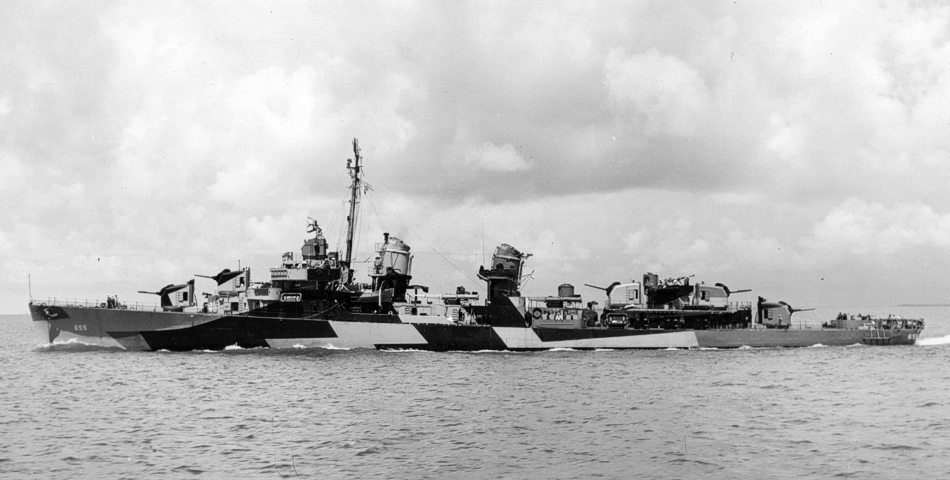
USS John Hood (DD-655) was a Fletcher-class destroyer of the United States Navy. She was launched on 25 October 1943 and commissioned on 7 June 1944, with Captain Thomas James Thornhill in command. Her trials were carried out in the Caribbean. On 21 August 1944 she set out for the Pacific and on 6 September arrived at Mare Island Naval Shipyard.
She next steamed for the Aleutian Islands and reached Adak, Alaska, on 18 September. There she joined Destroyer Squadron 57 in Rear Admiral John L. McCrea’s Task Force 92. From that arrival until the fighting ended, her duty lay in the rough waters of the North Pacific. The force was charged with keeping pressure on Japanese outposts in the Kuril Islands, a chain more than 600 miles west of Attu. Foul weather hung over the ships, and they operated far beyond friendly air cover. The task force sortied nine times toward the Kurils and five times into the Sea of Okhotsk. Of all the ships in the force, John Hood alone went on every sortie from the day she reported through the end of the war.
In November her guns took part in shelling the Japanese station on Matsuwa, and the place was left badly damaged. Patrols and further raids among the Kurils continued through the winter and the spring of 1945. Captain Allan Lorentz Reed took command on 10 December 1944. On 25 June 1945, during a patrol in the Sea of Okhotsk, John Hood met a convoy trying to push late reinforcements into worn Japanese garrisons. She helped sink one cargo ship and shared credit for the probable loss of a second. On 11 August her task group broke up another convoy, among the last naval actions of the war.
When the fighting stopped she returned to Adak and made ready for occupation service. On 31 August she sailed from Adak in a large force bound for northern Japan and remained with the occupation forces in those waters until 18 November. She then headed home and entered Charleston, South Carolina, on 22 December. She stayed in that port until 3 July 1946, when she was decommissioned and placed in the Atlantic Reserve Fleet. A single battle star marked her World War II service.
The Navy commissioned her again on 3 August 1951. Extensive alterations followed so she could fill a place in the postwar fleet. On 29 June she left Norfolk on a voyage around the world that included quiet patrols with the Seventh Fleet off Korea. She was back at Norfolk on 6 February 1954 for overhaul and coastal training, then on 5 November 1955 sailed to serve with the Sixth Fleet in the Mediterranean. That cruise brought her to Norfolk again on 26 February 1956.
Workers then repaired a mast hurt in heavy weather, and over the summer she carried midshipmen. In the fall, during the Suez Crisis, she went with Task Force 26 to Lisbon and waited in case the fleet was called forward. December found her once more off the Virginia Capes. After more drills along the Atlantic seaboard she made a second Sixth Fleet cruise in 1957, while the Middle East was still unsettled. Early in 1958 her work shifted to training cruises. She spent time at the Fleet Sonar School and ran antisubmarine drills. On 1 October 1959 she shifted to the reserve destroyer squadron at New York and drilled reservists there.
On 1 August 1961, in the Berlin crisis, President John F. Kennedy called reservists back to active duty to strengthen the armed forces, and John Hood answered with them. The crisis faded short of a wider war. In August 1962 she returned to reserve training at New York. Her active career closed when she decommissioned on 30 June 1964. The hull stayed in reserve until 1 December 1974, when her name was removed from the Navy List. On 12 April 1976 Luria Bros. and Co., Inc., of Cleveland, Ohio, bought her for scrap, and by the end of that month she had passed out of Navy custody.