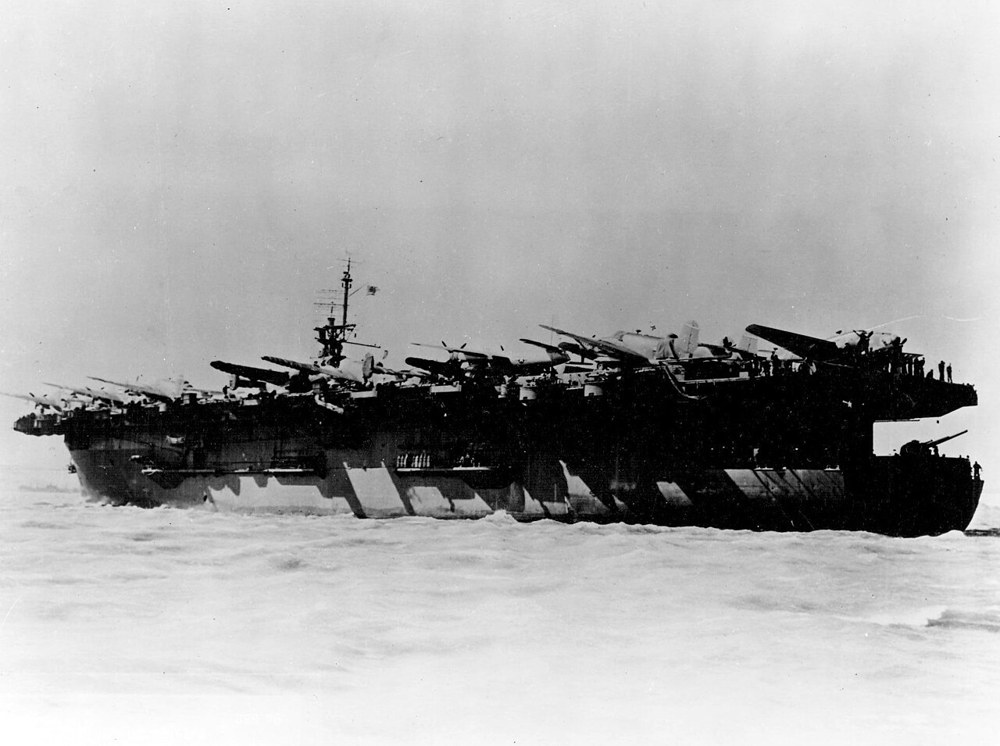
Kadashan Bay (AVG-76) was reclassified ACV-76 20 August 1942; reclassified CVE-76 15 July 1943 and launched 11 December 1943 by Kaiser Co., Inc., Vancouver, Wash., under a Maritime Commission contract, sponsored by Miss Audrey Ackerman and commissioned 18 January 1944, Captain R.N. Hunter in command.
After shakedown, Kadashan Bay departed San Diego 6 March 1944 on the first of two cruises to Espiritu Santo. She transported a total of 154 aircraft on these assignments before returning San Diego 13 May. Following repairs and training, the escort carrier sailed 10 July to join a carrier division at Pearl Harbor. One month later, she sailed for Tulagi and final preparations for the September assault on the Palaus.
Kadashan Bay departed Tulagi 6 September and, six days later, her air group launched a preinvasion air attack against enemy positions on Peleliu. Ground forces landed 15 September to gain control of the island as an air base to support the Philippine operation. After preparations were concluded at Manus, the escort carrier steamed toward Leyte Gulf, 14 October.
Arriving there 21 October, she immediately commenced raids and strikes in support of troops ashore. Four days later, one of her patrol planes, piloted by Ens. Hans L. Jensen, sighted the Central Force of the Japanese fleet off Samar. After reporting his sighting, he launched an unsupported attack against the leading cruiser, beginning the famous Battle off Samar. The carrier's air group launched three fighter and three torpedo strikes against Kurita's force. The fliers' courage and gallantry contributed greatly to the sound defeat from which the Japanese never recovered. Upon completion of this mission, Kadashan Bay steamed toward Manus, arriving 3 November.
As the action in the Philippines continued, Kadashan Bay's air group accounted for 11 planes in encounters with the enemy during mid-December. Preparations were now underway for the Luzon landings and the escort carrier rendezvoused with the main force 3 January 1945. She arrived off Luzon 5 days later and commenced an early morning air attack. That same morning a kamikaze aimed his death dive at Kadashan Bay. Despite repeated hits, the enemy plane plunged into the ship amidships directly below the bridge. After an hour and a half of feverish damage control effort, fires and flooding were checked, and the escort carrier returned to Leyte 12 January for temporary repairs before returning San Francisco 13 February for complete overhaul.
Kadashan Bay sailed for Pearl Harbor 8 April, arriving 14 April. She then commenced ferrying aircraft and passengers among the Pacific islands. During July, the escort carrier was assigned as a replenishment carrier for the 3d Fleet and was on her way from Pearl Harbor to begin her new duty when news of Japan's collapse came. Kadashan Bay joined the "Magic-Carpet" fleet at Guam in September and arrived in San Francisco 26 September with her group of veterans. For the next 3 months, the escort carrier made runs from Pearl Harbor, Guam, Okinawa and China to return battle weary Americans home. She arrived San Pedro 22 December from her last Pacific cruise, and departed San Diego 10 January 1946 for Boston. Kadashan Bay arrived Boston 29 January, decommissioned 14 June 1946, and was placed in Atlantic Reserve fleet there. She was reclassified CVU-76 on June 12 1956 and scrapped 13 August 1959.
Her wartime commanding officers, from NavSource: Captain Robert Nisbet Hunter, 18 January 1944 to 6 February 1945; Captain Jack Pendleton Monroe, 6 February 1945 to 8 February 1946.
Sources: Dictionary of American Naval Fighting Ships (DANFS), Wikipedia, NavSource Online (commanding officers) and Wikimedia Commons (photograph records).