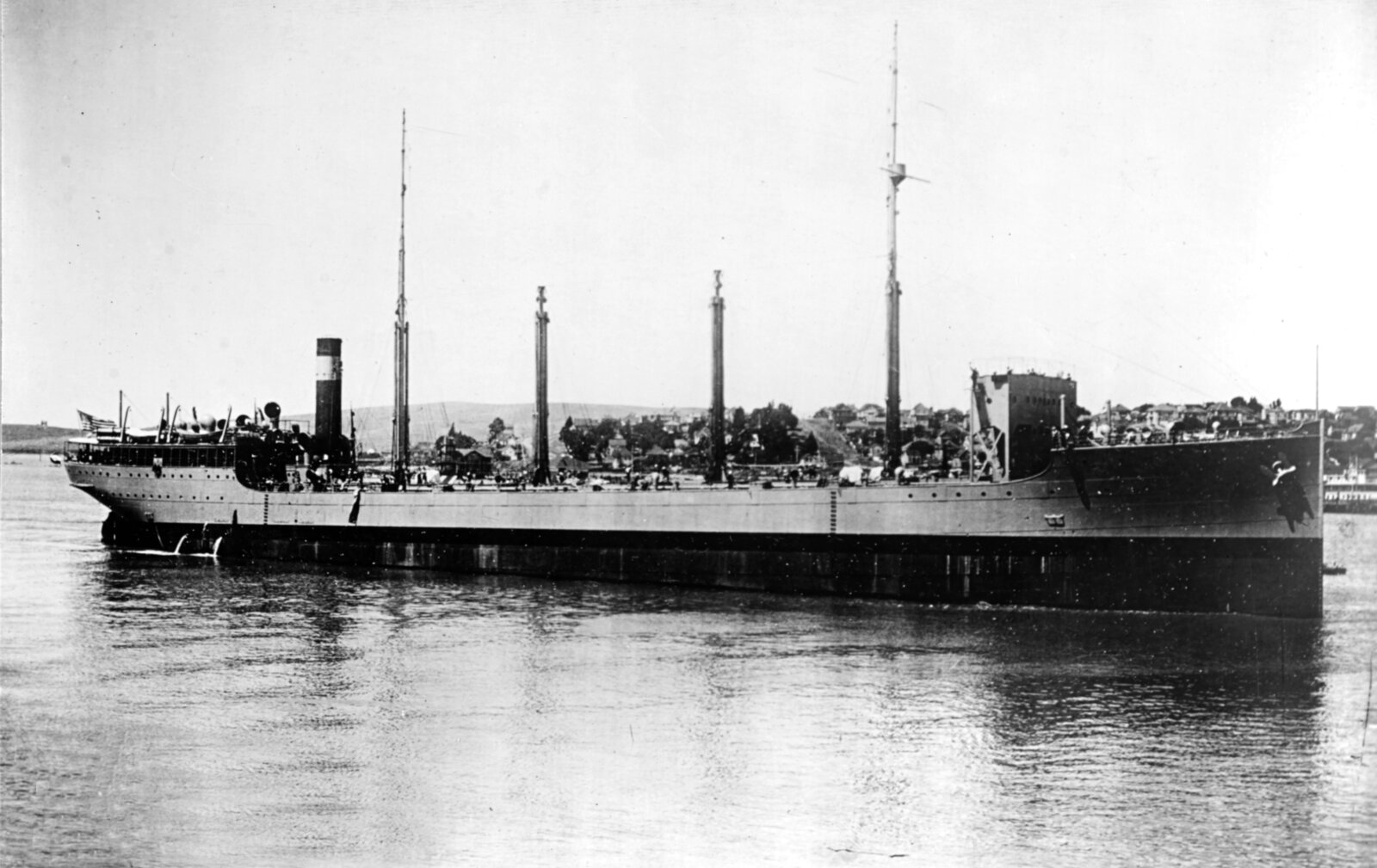
Kanawha, AO-1, was the third ship of the name, and the name ship of her class. She was named for the river in West Virginia formed by the New and the Gauley at Gauley Bridge, which empties into the Ohio at Point Pleasant. She was laid down at the Mare Island Navy Yard on 8 December 1913, launched on 11 July 1914, and sponsored by Miss Dorothy Bennett. She displaced 5,723 tons light and 14,800 fully loaded, on a length of 475 feet 7 inches, a beam of 56 feet 3 inches, and a draft of 26 feet 8 inches. She made 14 knots, with a complement of 317. She was commissioned on 5 June 1915 as Fuel Ship No. 13. Richard Werner, a master in the Naval Auxiliary Service, was her first commanding officer. She was designated AO-1 on 17 July 1920. She commissioned with four 4-inch guns.
She cleared San Diego on 9 June 1915 for Newport and the Atlantic Fleet. In the next year she made seven trips to Port Arthur for fuel oil and gasoline. On 11 October 1916 she was assigned to the Atlantic Fleet and, besides fueling, took part in tactical exercises, carried mail, and towed targets. After the United States entered the First World War she was assigned to Commander, Destroyer Force, Atlantic Fleet, as escort for the first American Expeditionary Force sent to France. She cleared New York on 17 June 1917, crossed the Atlantic through submarine waters, and arrived at St. Nazaire on 2 July. She was back in New York on 10 August for repairs and sailed again on 23 September. She cruised in the Atlantic until 1 November, supplying the cruiser force and escorting convoys to Europe. After repairs at Philadelphia she joined the Naval Overseas Transportation Service on 8 January 1918. For the rest of the war she carried fuel oil from Halifax to ports in the United Kingdom and France, and she kept the run through torpedo warnings. She reached New York on 1 May 1919 from her last wartime cruise and was detached on 12 May. Werner returned from sick leave on 1 November 1918, by then a commander in the Naval Reserve Force, and stayed until 21 June 1919.
She left Port Arthur on 24 July 1919 and reached San Pedro on 9 August. From 1919 to 1929, except for three cruises to Port Arthur for the Atlantic coast, she operated in the Pacific. She took part in the Army-Navy maneuvers in Hawaii in April 1925, then went with the Battle Fleet on a goodwill cruise to Australia and New Zealand, and resumed coastal fueling on 25 September 1925. She was decommissioned at the Puget Sound Navy Yard on 18 December 1929. She was recommissioned on 5 June 1934. Commander Clyde Gray West, Naval Academy class of 1908, took her on 6 June, and she cleared Bremerton on 21 June for San Pedro. For six years she cruised the West Coast and supplied oil and gasoline to the Canal Zone, the Caribbean, and Hawaii. In 1941 she went east to Midway and Wake and as far north as Alaska. She was at Mare Island, in overhaul, when the Japanese attacked Pearl Harbor.
Commander Kendall Sturtevant Reed, Naval Academy class of 1919, had her from 1 April 1941 to 26 October 1942. She left San Pedro on 21 March 1942 with a convoy of supplies for Hawaii and continued the California to Pearl Harbor run until 18 May, when she arrived at Tongatabu for fueling in the South Pacific. Through the summer she cruised to New Caledonia, Espiritu Santo, and Efate, providing fuel for destroyers and transports on the way to the campaigns. On 21 July 1942 she lay at anchor in Nukualofa Harbour, Tongatabu. Navy photograph 80-G-K-526, taken from Wasp, shows her there. For the Guadalcanal and Tulagi landings she was in the Fueling Group of Task Force 61 with Platte, Cimarron, Kaskaskia, and Sabine. Morison names her commanding officer as Commander Kendall S. Reed, and the combat narrative of the landing does the same. She left Pago Pago on 12 October and put into San Francisco on 29 October for repairs. Reed had been relieved three days earlier.
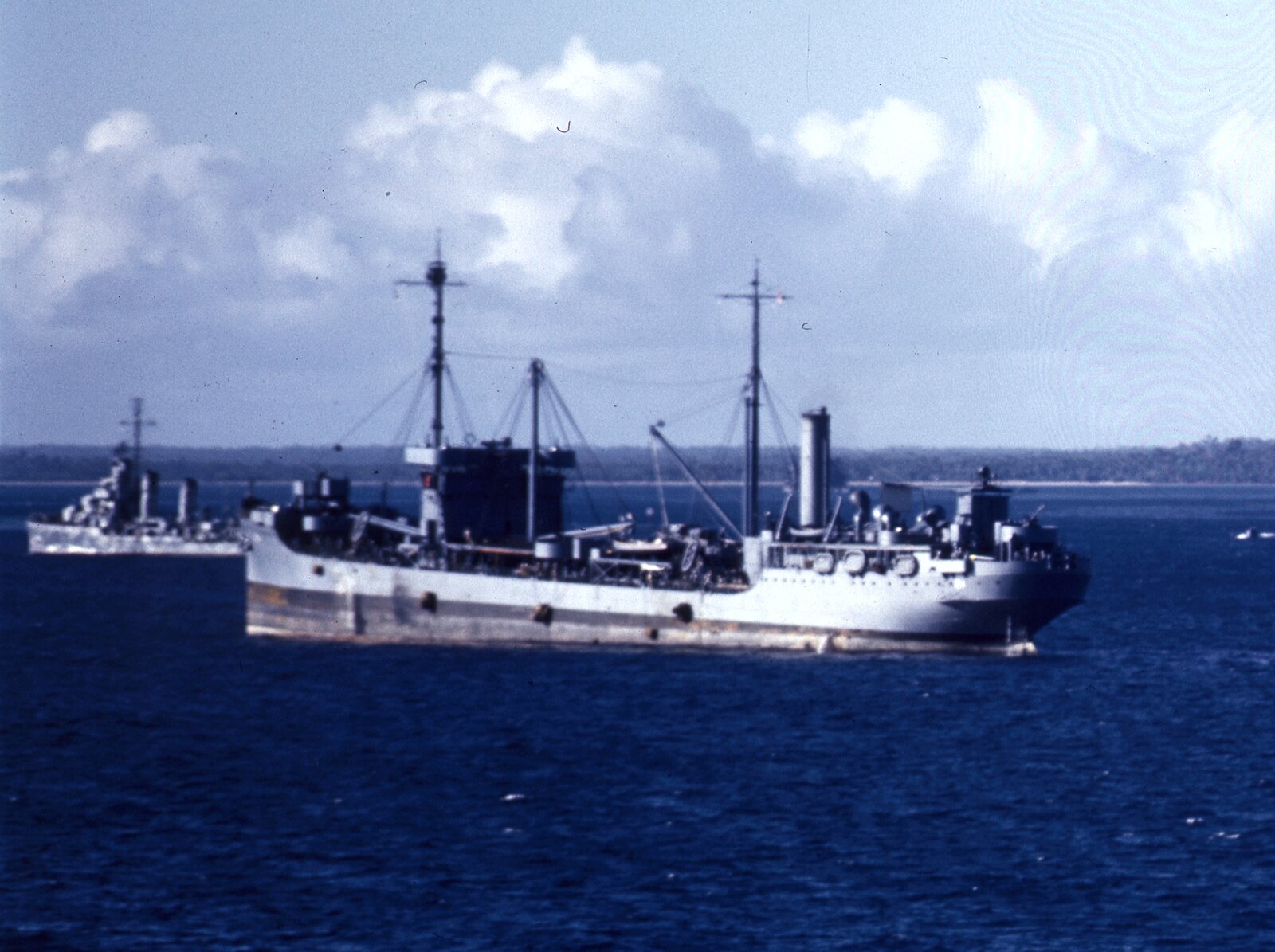
Commander John Gilbreth Cross had her from 26 October 1942 to 5 January 1943, through the overhaul. Off Mare Island on 2 January 1943 she was in her final configuration. Two 5-inch/51 guns, both aft, had replaced the four 4-inch/50 guns. Photograph 19-N-39486 shows that arrangement. Lieutenant Commander Brainard Norton Bock, Naval Academy class of 1924, relieved Cross on 5 January 1943. She resumed fueling on her return to Pago Pago on 13 February. For the next two months she serviced ships in the Solomon Islands.
On 7 April 1943 a group of enemy Val dive bombers came through the fighter defense and found her waiting for an escort in Tulagi Harbor. At 1502, shortly after she cleared the harbor, the first five planes hit an oil tank under the bridge. Fires spread along the deck. Bock ordered the ship abandoned, to get the crew away from burning oil on the water. After the rescue was underway, volunteers went back aboard and put out fires while ammunition exploded. The tug Rail towed her to the west side of Tulagi. She was beached shortly before midnight. She slid off into deep water and sank at 0400 on 8 April, before daybreak, northeast of Soghonangola Island at the entrance to Tulagi Harbor. Nineteen of her crew were lost. She was struck on 19 May 1943. She received one battle star for her service in the Second World War.
A note on sources. The career is the Dictionary of American Naval Fighting Ships entry for Kanawha III (AO-1), on the Naval History and Heritage Command site. Commanding officers, the 17 July 1920 designation, the recommissioning, the armament, the 0400 time, Soghonangola Island, and the 19 May striking are NavSource's page for AO-1. The Fueling Group is Morison, volume IV, pages 270 to 274, and the combat narrative, chapter 5. Photograph 80-G-K-526 is the 21 July 1942 view from Wasp. Photograph 19-N-39486 is the 2 January 1943 Mare Island broadside. The Dictionary commissions her under Lieutenant Commander Richard Werner, USNRF, and heads her at a displacement of 4,990, a beam of 56 feet, a draft of 10 feet, a complement of 150, and four 4-inch guns. NavSource commissions her under Richard Werner, Master, Naval Auxiliary Service, and gives 5,723 tons light and 14,800 full, a beam of 56 feet 3 inches, a draft of 26 feet 8 inches, and a complement of 317. The Dictionary recommissions her on 5 June 1934. NavSource recommissions her on 6 June 1934, the day Commander West took command. NavSource's 1915 armament line and the 1943 photograph give four 4-inch/50 guns, replaced by two 5-inch/51. Another NavSource armament line says the two 5-inch/51 mounts replaced an original battery of four 5-inch/50 guns. The name John Gilbreth Cross is the NavSource entry for 26 October 1942 to 5 January 1943, printed there surname first, and no other source used here gives it. Both accounts give one battle star and nineteen men lost.