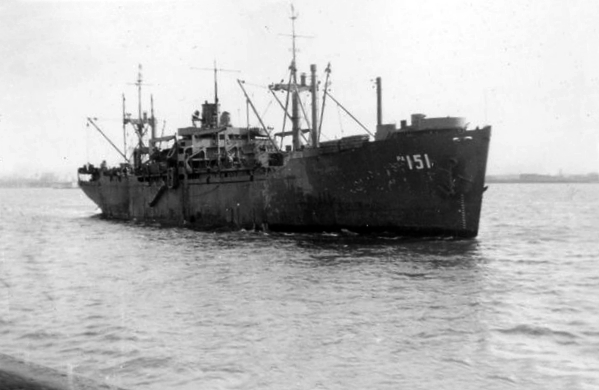
La Porte was named for a county in northwestern Indiana. Oregon Shipbuilding at Portland laid her down on 15 May 1944 under a Maritime Commission contract and launched her on 30 June. Mrs. Charles N. Niles sponsored the ship. Commander Marion C. Thompson was commanding officer from her commissioning on 14 August 1944.
Shakedown finished, she left San Francisco on 22 October 1944 to join the amphibious forces in the Pacific. Milne Bay, reached on 8 November, was used for training. On 2 January 1945 she sailed from Manus toward Luzon. Nine days later she was in Lingayen Gulf. Men and gear went ashore while Japanese aircraft attacked the ships. That assignment done, she was back at Leyte on 16 January to prepare for Okinawa.
Fifteen hundred troops were loaded, and on 27 March she left San Pedro Bay, Leyte, for the largest amphibious operation in the Pacific. The beach landing opened on 1 April. Two days afterward a kamikaze dove at the transport where she lay offshore. Antiaircraft fire from the fleet brought the plane down before it could reach her. She departed Okinawa on 5 April and was in San Francisco three weeks later for a short replenishment. Ie Shima saw her again on 14 July, when 1,300 Army engineer replacements went ashore. She then headed east and entered San Francisco on 10 August.
With the fighting over, she prepared to carry occupation troops out to Asia. Carrying 1,146 replacements, she left San Francisco and landed them at Leyte on 15 September. The next two months were spent in the western Pacific, moving troops into occupied Japan and into areas of China that had been liberated. Servicemen bound home embarked at Manila. She sailed on 25 November and reached Seattle three weeks later. Norfolk was the end of the cruise, on 14 February 1946. Decommissioning came on 25 March, and three days after that she was returned to the War Shipping Administration. The National Defense Reserve Fleet berthed her in the James River. One battle star was credited for the war.