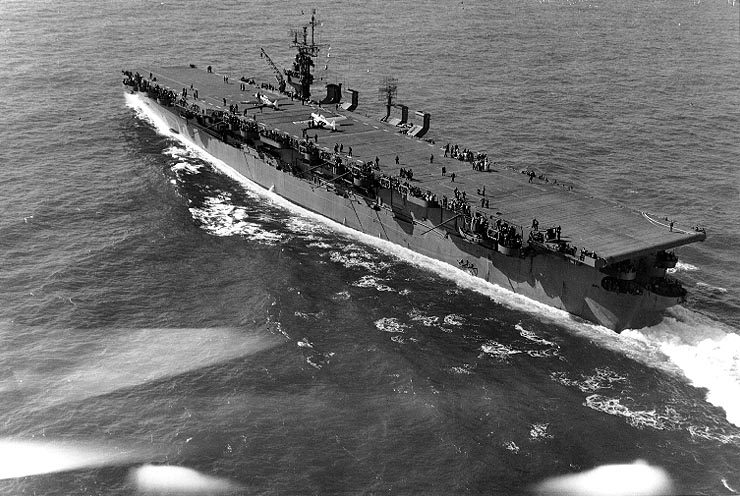
This is Langley, CVL-27, an Independence-class light carrier, not the first Langley (CV-1), which was lost south of Java in February 1942. She was ordered as the Cleveland-class light cruiser Fargo (CL-85), completed as a carrier, renamed Crown Point and then Langley on 13 November 1942. New York Shipbuilding laid her down at Camden on 11 April 1942 and launched her on 22 May 1943, sponsored by Mrs. Harry L. Hopkins. She became CVL-27 on 15 July 1943 and was commissioned on 31 August 1943, Captain W. M. Dillon in command.
She joined Rear Admiral Marc Mitscher's Task Force 58 and sailed from Pearl Harbor on 19 January 1944. From 29 January to 6 February her air group raided Wotje and Taroa to support the Kwajalein landings, and it repeated the work at Eniwetok from 10 to 28 February. She then hit Palau, Yap and Woleai from 30 March to 1 April, supported Hollandia on 25 April and struck Truk, where she and her aircraft accounted for about 35 enemy planes destroyed or damaged at the cost of one of her own.
She sailed from Majuro on 7 June 1944 for the Marianas and fought in the Battle of the Philippine Sea on 19 and 20 June. In the fall she struck Peleliu and the Philippines with Task Force 38, then Formosa and the Pescadores. On 24 October her planes helped blunt Admiral Kurita's Center Force, and on 25 October at Cape Engano they helped destroy the carriers Zuiho and Zuikaku. She raided Luzon, Formosa, Indochina and the China coast from 30 December 1944 to 25 January 1945, swept Tokyo and the Nansei Shoto for Iwo Jima from 10 February to 18 March, and struck Kyushu airfields while covering Okinawa until 11 May.
After repairs at San Francisco she was at Pearl Harbor when the war ended and made Magic Carpet voyages, including two trips to Europe for returning soldiers. She was decommissioned on 11 February 1947. The United States transferred her to France on 8 January 1951, and she served as Lafayette (R-96) until 20 March 1963, when she was returned and scrapped at Baltimore. She earned nine battle stars.