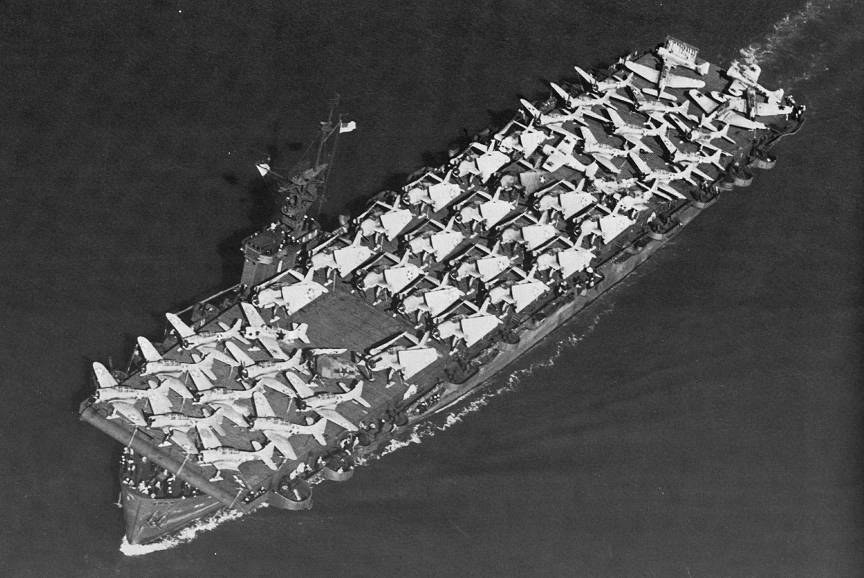
Liscome Bay (CVE-56) was laid down 9 December 1942 by Kaiser Shipbuilding Co., Vancouver, Wash., under a Maritime Commission contract, Iaunched 19 April 1943, sponsored by Mrs. Ben Moreell: named Liscome Bay 28 June 1943; redesignated CVE-56 15 July 1943; acquired by the Navy and commissioned 7 August 1943, Capt. I. D. Wiltsie in command.
After training operations along the west coast, Liscome Bay departed San Diego 21 October 1943 and arrived Pearl Harbor 1 week later. Having completed additional drills and operational exercises, the escort carrier set forth upon what was to be her first and last battle mission. As a unit of CarDiv 24, she departed Pearl Harbor 10 November attached to TF 52, Northern Attack Force, under Rear Adm. Richmond K. Turner, bound for the invasion of the Gilbert Islands.
The invasion bombardment announcing America's first major thrust into the central Pacific began 20 November at 0500, and 76 battle-fllled hours later Tarawa and Makin Islands were captured. Liscome Bay , aircraft played their part well in the 2,278 action sorties provided by carrier-based planes which neutralized enemy airbases supported landings and ground operations in powerful bombing and strafing missions, and intercepted enemy raids. With the islands secured, the U.S. forces began a retirement.
On 23 November the Japanese submarine I-175 arrived off Makin. The temporary task group built around Rear Adm. H. M. Mullinnix's three escorts, Liscome Bay , Coral Sea (CVE-57) and Corregidor (CVE-58) commanded by Rear Adm. Robert M. Griftin in New Mexico was steaming 20 miles southwest of Butaritari Island at 15 knots. At 0430, 24 November, reveille was made in Liscome Bay . The ship went to routine general quarters at 0505 as flight crews prepared their planes for dawn launchings. There was no warning of a submarine in the area until about 0510 when a lookout shouted: " . . . here comes a torpedo!" The missile struck abaft the after engine room an instant later with a shattering roar. A second major detonation closely followed the first, the entire interior burst into flames. At 0533 Liscome Bay listed to starboard and sank carrying Admiral Mullinix, Captain Wiltsie, 53 other officers, and 591 enlisted men down with her; 272 of her crew were rescued. Gallantly her men had served; gallantly they died in the victorious campaign giving their lives for the Nation's future.
Liscome Bay received one battle star for World War II service.
Her wartime commanding officers, from NavSource: Captain Irving Day Wiltsie, 7 August 1943 to 24 November 1943.
Sources: Dictionary of American Naval Fighting Ships (DANFS), Wikipedia, NavSource Online (commanding officers) and Wikimedia Commons (photograph records).