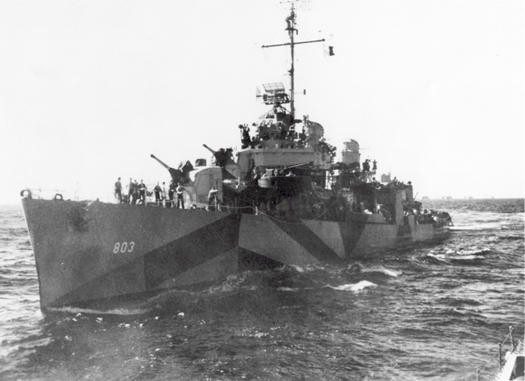
A second Little
USS Little (DD-803) carried a Revolutionary War sailor’s name from the shipyards of Seattle to the radar-picket line off Okinawa. Her namesake, Captain George Little, had served in the Massachusetts navy during the Revolution and later commanded the frigate Boston during the Quasi-War with France. This Fletcher-class destroyer was the second American warship named for him, not the earlier Little, DD-79, which became the fast transport APD-4 and was lost off Guadalcanal in 1942.
Seattle-Tacoma Shipbuilding laid her keel on 13 September 1943. Launched on 22 May 1944, she was sponsored by Dorothy P. O’Hara and commissioned on 19 August, Commander Madison Hall Jr. in command. Hall would remain her captain throughout her short career. She joined Destroyer Squadron 58, Destroyer Division 115, and began fitting out in Puget Sound before sailing south for the training that would turn a newly commissioned ship into a fighting destroyer.
Learning the work
Little reached San Diego on 12 September 1944. Her shakedown covered antisubmarine tactics, radar calibration, gunnery, torpedo launching, towing and sonar work, ending with a battle problem on 20 October. After her post-shakedown availability in Puget Sound she escorted a merchant convoy across the Pacific, reaching Pearl Harbor on 23 November. The next eight weeks brought more exercises, carrier screening and plane-guard work, and repeated practice bombardments off Kahoolawe.
She sailed from Pearl Harbor on 22 January 1945 with Tractor Group Able, bound for Iwo Jima by way of Eniwetok and Saipan. Rehearsals off Saipan preceded the real landings on 19 February. Little first screened the invasion shipping, then took a fire-support assignment that afternoon. Her guns fired harassing missions and night illumination before answering calls for fire the following morning. Japanese shore batteries fired back, but their shells did not damage her.
The work was not all bombardment. On 21 February she took two men from a distressed tracked landing vehicle and tried to tow it; when it began sinking and the tow parted, she destroyed it with gunfire. After an escort trip to Saipan she returned to Iwo Jima in March, alternating screening, fire support and radar-picket duty. On 12 March she left to escort the gasoline tanker Wabash back to Saipan, arriving two days later.
Okinawa
For Okinawa, Little joined the Demonstration Group. On 1 and 2 April she screened the decoy landings on the island’s southeastern coast while the main assault went ashore at Hagushi in the west. Transport screening and convoy escort followed. She later illuminated and bombarded targets on Ie Shima, screened against suicide boats, and served on the exposed radar-picket stations intended to give the fleet warning of approaching aircraft.
At Station 1 she worked with Shea and then Cowell. Enemy aircraft repeatedly approached at night, and both Little and Cowell reported radar jamming on 20 April. On the afternoon of 29 April, after further screening assignments, Little moved to Radar Picket Station 10, west of Kerama Retto. Weather kept the Japanese away on 2 May, but the following afternoon brought calmer seas and clearing skies. The fifth mass kamikaze offensive, Kikusui No. 5, was beginning.
Station 10, 3 May 1945
Little patrolled in column with Aaron Ward (DM-34). The rocket-armed LSM(R)-195 and three support landing craft were several miles to the west. At 1813 Little sighted the first aircraft of a raid estimated at 18 to 24 planes. Four American Hellcats tried to intercept, but the approaching attackers escaped them; the fighters were eventually ordered clear so the ships could fire without hitting friendly aircraft.
At 1841 Little saw an aircraft crash into Aaron Ward. Two minutes later an attacker struck Little’s port side amidships despite hits from her light antiaircraft guns. Another plane was shot down, but a second crash struck close to the first. Ammunition began exploding. A third aircraft crashed amidships and a fourth plunged into the after torpedo mount. In less than five minutes the destroyer lost power, steering and communications. Her keel was broken, and the after machinery spaces lay open to the sea.
By 1850 her main deck was awash and she was listing to starboard. Hall ordered abandon ship. At 1855 the weakened hull folded, the bow and stern rose, and Little disappeared about 28 miles west of Kume Shima. The battle continued around the men in the water. LSM(R)-195 was also hit and sank, while Aaron Ward survived her own repeated crashes to be towed to Kerama Retto the next morning. Support craft and ships arriving to help recovered survivors after the attacks.
The revised Navy history records 30 of Little’s 339 men killed or missing and 79 injured. She was struck from the Navy List on 2 June 1945 and received two battle stars for World War II. Hall received a Gold Star in place of a second Silver Star for his conduct in the final action. Less than nine months had passed between commissioning in Seattle and the destruction of his ship off Okinawa.
Sources
- Stephanie Harry, NHHC DANFS, “Little II (DD-803),” 25 April 2019: https://www.history.navy.mil/research/histories/ship-histories/danfs/l/little-ii.html
- NHHC DANFS, “Little I (Destroyer No. 79)” (namesake and earlier ship only): https://www.history.navy.mil/research/histories/ship-histories/danfs/l/little-i.html
- Guy Nasuti, NHHC, “Those Suicide Pilots Knew Where to Hit”: The Sinking of USS Little, April 2020: https://www.history.navy.mil/browse-by-topic/wars-conflicts-and-operations/world-war-ii/1945/battle-of-okinawa/sinking-of-little.html
- Samuel J. Cox, NHHC H-Gram 046, attachment 1, May 2020: https://www.history.navy.mil/about-us/leadership/director/directors-corner/h-grams/h-gram-046/h-046-1.html