Built for rockets
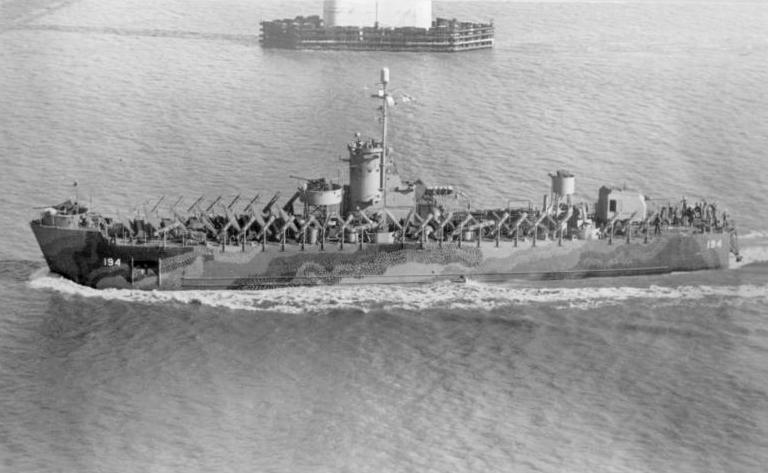
USS LSM(R)-194 was a rocket-armed medium landing ship lost off Okinawa on 4 May 1945. She was a sister of LSM(R)-195, not the same ship: LSM(R)-195 went down on 3 May at Radar Picket Station 10, while LSM(R)-194 was lost the following morning at Station 1. The Navy photograph on this page shows 194 herself, with her hull number visible, underway at Charleston before her brief Pacific service.
Charleston Navy Yard laid her keel on 29 August 1944, launched her on 7 October, and commissioned her on 21 November. Lieutenant (junior grade) Allen M. Hirshberg, USNR, took command. She belonged to the LSM(R)-188 class, a group of twelve medium landing ships extensively modified to deliver concentrated rocket fire in support of amphibious landings. These were specialized fire-support vessels, not ordinary landing ships carrying the same number without the rocket designation.
NavSource gives her length as 203 feet 6 inches and beam as 34 feet 6 inches. Her weapons included a single 5-inch/38 gun, two 40-mm and three 20-mm antiaircraft guns, and banks of rocket launchers. A photograph taken on 2 December 1944 shows her passing under the Cooper River Bridge at Charleston, the rocket rails plainly visible across the deck. That official Navy Yard image is the photograph used here.
An exposed assignment
Assigned to LSM Flotilla Nine, LSM(R)-194 took part in the assault and occupation of Okinawa, with NavSource dating her campaign service from 26 March to 4 May 1945. Her role carried her beyond the invasion beaches to the radar-picket line, where small amphibious support vessels accompanied the destroyers that warned the fleet of approaching Japanese aircraft. Those supporting ships could help recover survivors when a picket was hit, but they were themselves exposed to the same attacks.
The danger was especially acute for the rocket ships. Samuel J. Cox’s Navy history records that the commander of Flotilla Nine had recommended in April against putting them on radar-picket duty. They had no radar, were poorly suited to antiaircraft defense, and carried so many rockets that their vulnerability resembled that of ammunition ships. There were only twelve of these specialized vessels. The recommendation was not promptly implemented, and three would be lost during the attacks of 3 and 4 May.
Station 1, 4 May 1945
On the morning of 4 May, during Kikusui No. 5, LSM(R)-194 supported Radar Picket Station 1 with three large support landing craft. The station’s destroyers were Morrison and Ingraham. Radar began reporting large incoming raids about 0715, and American fighters intercepted many of the approaching aircraft. Enough attackers penetrated the fighter screen, however, to put the ships under repeated bombing, strafing and suicide attacks.
Morrison was struck repeatedly and sank at about 0840. Ingraham was also hit and seriously damaged. LSM(R)-194 maneuvered to assist the crippled destroyer and Morrison’s survivors. At 0850 a damaged Japanese aircraft crashed into her stern. American accounts identified it as a Tony fighter, but Cox notes that Japanese records do not support that identification for this particular attack. The aircraft type therefore remains uncertain here; the devastating effect of the hit does not.
The crash and the rocket ammunition proved a fatal combination. LSM(R)-194 sank quickly, with a large explosion as she went down. The blast damaged LCS(L)-21, which was coming to her assistance. Hirshberg’s Navy Cross citation describes him directing damage control from the conn and, when abandonment became necessary, remaining to supervise antiaircraft fire against further attacks. The effort to save the ship became an effort to get her men clear while the battle continued.
Survivors and remembrance
Cox records thirteen of her men missing and later declared dead, with twenty-three wounded. LCS(L)-21 recovered forty-nine survivors from LSM(R)-194, and LCS(L)-31 picked up the remainder. The rescue craft had their own damage and casualties, yet continued taking men out of the water. LSM(R)-194 received a Navy Unit Commendation, and NavSource credits her with one battle star for World War II service. Hirshberg received the Navy Cross.
Her loss followed that of LSM(R)-195 the previous evening and came during the same morning that LSM(R)-190 was lost at another station. The Navy history treats these losses as a costly demonstration that scarce, rocket-laden fire-support ships should not have been used on the picket line. LSM(R)-194’s own career lasted less than six months, from commissioning at Charleston to the rescue action in which she was destroyed off Okinawa.
Sources
- Samuel J. Cox, NHHC H-Gram 046, attachment 2, “Kikusui No. 5—Chrysanthemums from Hell,” May 2020: https://www.history.navy.mil/about-us/leadership/director/directors-corner/h-grams/h-gram-046/h-046-2.html
- NavSource, “USS LSM(R)-194” (construction, specifications, campaign, photograph provenance and awards): https://www.navsource.net/archives/10/06/06194.htm
- Wikimedia Commons, “File:Uss LSMR-194.jpg,” official Navy photograph 3520-44 and public-domain declaration: https://commons.wikimedia.org/wiki/File:Uss_LSMR-194.jpg
