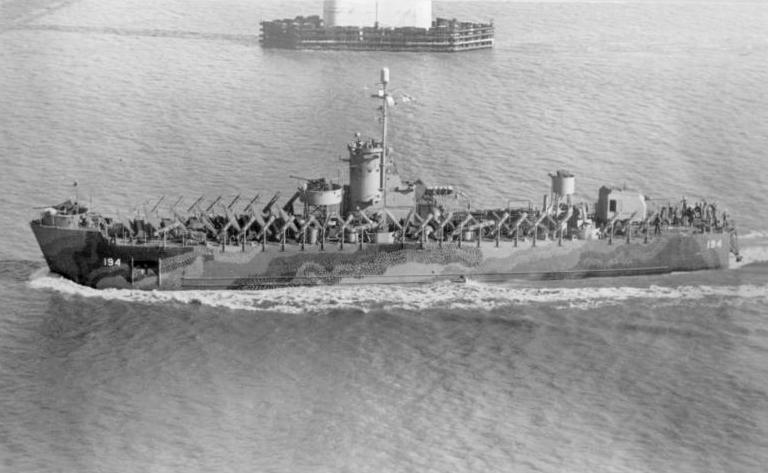

Rockets for the landing force
USS LSM(R)-195 was a rocket-armed medium landing ship whose brief war ended on the Okinawa radar-picket line. One of the LSM(R)-188 class, she carried the weapons of an amphibious fire-support ship on a small hull: a 5-inch gun, light antiaircraft guns and banks of rocket launchers. The rockets made her useful to an assault force, but they would also become a deadly hazard when a suicide aircraft set the ship on fire.
Charleston Navy Yard laid her down on 29 August 1944 and launched her on 7 October. She was commissioned on 21 November 1944 under Lieutenant (junior grade) William E. Woodson, USNR. Unlike the destroyers beside which she would fight, she had no personal namesake: LSM meant Landing Ship Medium, with the additional R identifying her rocket armament. NavSource places her in LSM Flotilla Nine and credits her with the Okinawa operation from 26 March to 3 May 1945.
Beyond the beaches
By the evening of 3 May she was supporting Radar Picket Station 10, west of Okinawa and Kerama Retto. Little (DD-803) and the light minelayer Aaron Ward (DM-34) formed the station’s larger-ship element. LSM(R)-195 steamed with three support landing craft several miles to their west. Those small vessels were there to support the pickets; when the larger ships were hit, rescue and firefighting became essential parts of their work.
The attack came at the beginning of Kikusui No. 5, another of the massed Japanese kamikaze offensives against the fleet off Okinawa. The weather had improved after rain and strong winds, but low cloud still helped to hide incoming aircraft. Little sighted the approaching raid at 1813. The station’s combat air patrol failed to stop the attackers, and before sunset both Little and Aaron Ward were fighting for their lives against planes coming in from different directions.
Fire among the rockets
As the support vessels moved to help, they too came under attack. The Navy’s H-Gram account describes two aircraft attacking LSM(R)-195 almost together, one strafing and the other making a suicide run. The aircraft that crashed into her was identified as a twin-engined Ki-45, called Nick by the Allies; the historian regards that identification as probable rather than certain. Its impact and bomb explosion disabled the fire main and auxiliary pumps, taking away vital means of fighting the fires.
The ship’s rocket armament now worked against her. Fire caused secondary explosions among her seventy-five quadruple-rail Mk. 36 launchers, and rockets discharged in different directions. Woodson ordered the crew to abandon ship. A massive explosion followed and the landing ship sank. The revised DANFS history of Little places the fatal hit several minutes after the destroyer went down and says LSM(R)-195 sank within fifteen minutes of being struck. The precise minute is not established here.
H-Gram 046-1 records nine men lost and sixteen wounded from an eighty-one-man crew. Most survivors were taken aboard the destroyer Bache, which came from nearby Radar Picket Station 9 to help. Little was gone as well; Aaron Ward, though terribly damaged, remained afloat and reached Kerama Retto under tow the next morning. NavSource credits LSM(R)-195 with one battle star for World War II. Her service had lasted less than six months, from a November commissioning to the picket-line disaster of 3 May 1945.
Sources
- Samuel J. Cox, NHHC H-Gram 046, attachment 1, May 2020 (action, armament, commanding officer at loss, rescue and casualties): https://www.history.navy.mil/about-us/leadership/director/directors-corner/h-grams/h-gram-046/h-046-1.html
- Stephanie Harry, NHHC DANFS, “Little II (DD-803),” 25 April 2019 (station composition and loss sequence): https://www.history.navy.mil/research/histories/ship-histories/danfs/l/little-ii.html
- NavSource, “USS LSM(R)-195” (construction, commissioning, class, command table, campaign and battle star): https://www.navsource.net/archives/10/06/06195.htm
- Guy Nasuti, NHHC, The Sinking of USS Little, April 2020 (action context): https://www.history.navy.mil/browse-by-topic/wars-conflicts-and-operations/world-war-ii/1945/battle-of-okinawa/sinking-of-little.html