LST-715 was a tank landing ship, and the hull number was her wartime name. She was an LST-542-class ship. Jeffersonville Boat and Machine, at Jeffersonville, Indiana, laid her down on 7 June 1944 and launched her on 20 July 1944. NavSource uses Machine in the yard's name. Dictionary entries for sister ships from the same yard often say Machinery. The Navy commissioned her on 15 August 1944, Ensign Robert I. Trapp, United States Navy, in command. Her own NavSource page prints a crew of 9 officers and 120 enlisted, and six LCVP. The class line printed for her sisters is 13 officers and 104 enlisted, and two LCVP. Both are kept. The ultimate gun battery in the class line is still a design, not a count verified for this hull. A header on the NavSource page runs her dates together as 1944, 1946, 1960, and 1955. The body, not that string, is the chronology followed here.
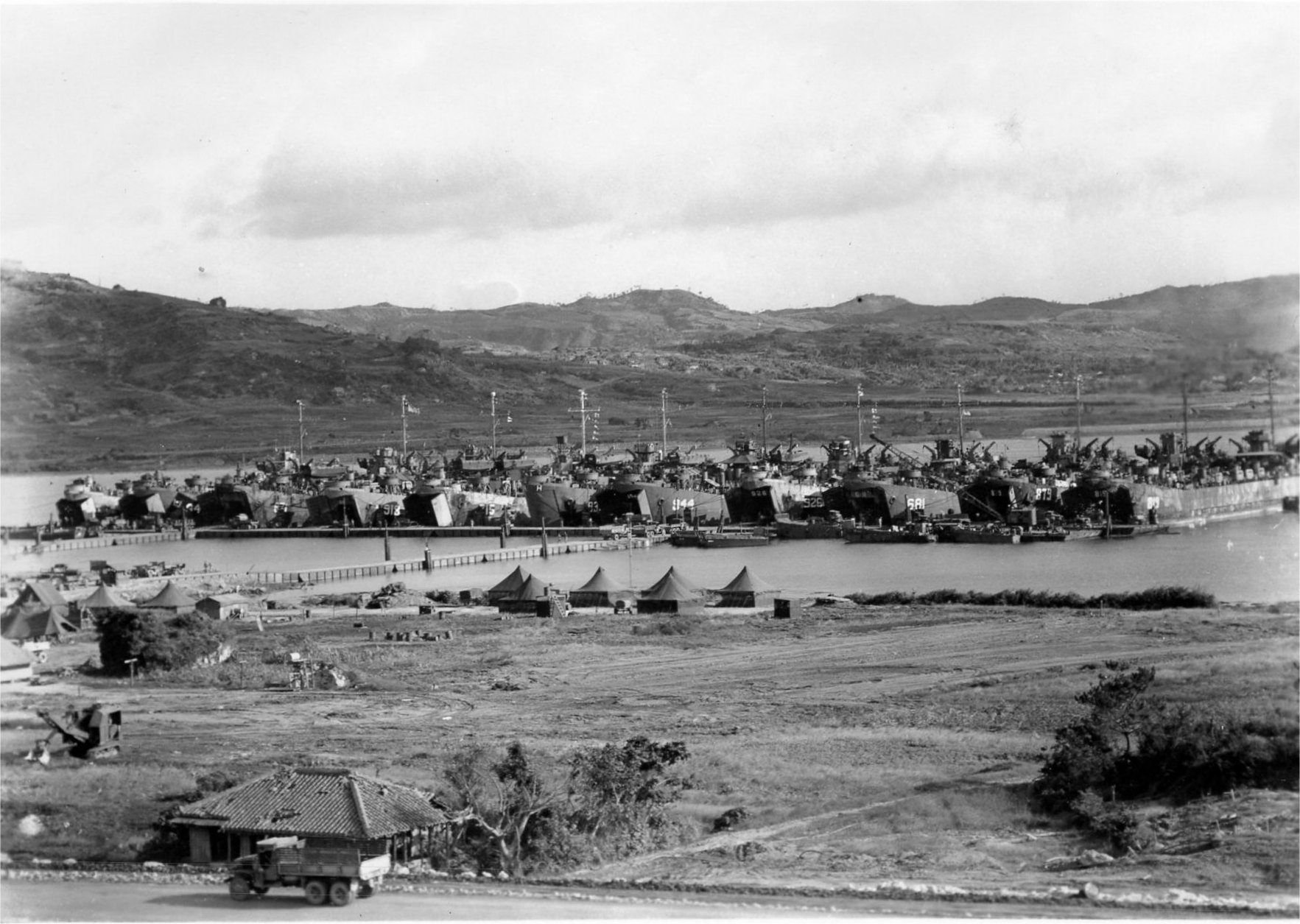
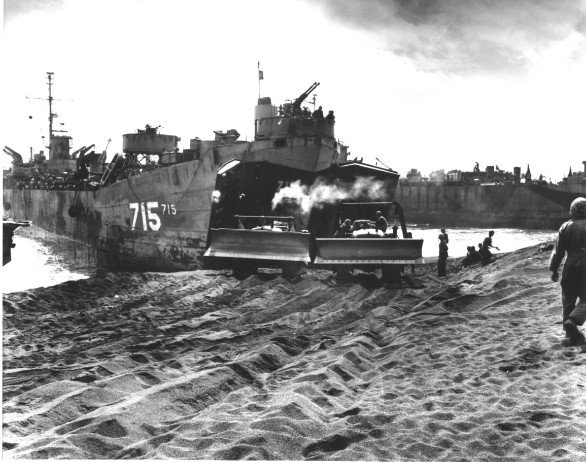
Two World War II battle stars. The first is the Iwo Jima assault and occupation, 19 February to 3 March 1945. A Navy photograph, now in the National Archives, shows her on Green Beach on 25 February, ramp down, the hull number 715 on the bow. NavSource also credits a Combat Action Ribbon, awarded later, for that operation. The second star is Okinawa Gunto, 1 May to 7 June 1945. On 23 July 1945 she was at the Yonabaru pier. The Navy caption reads, from right to left, LST-819, LST-879, LST-681, LST-926, LST-944, an unnamed hull, this ship, LST-918, LST-871, and two more unnamed hulls. She was not sunk.
Lieutenant (junior grade) Robert C. Duell of the Naval Reserve relieved Trapp on 12 March 1946. She was decommissioned on 17 April 1946 at Manicani Island in the Philippines. The Army took her on 28 June 1946, and she was commissioned as the Army transport USAT LST-715 the next day. The Navy struck her on 29 September 1947, took her back on 25 July 1950, reinstated her on 10 August, and recommissioned her on 30 August 1950. NavSource credits six Korean battle stars, among them the Inchon landing, dated on that page 13 to 17 September 1950. A Navy photograph shows her at Red Beach on 16 September 1950, the day after the first landings. A separate campaign window on the same page, North Korean Aggression, opens on 18 September. The dated command list has no commanding officer for that commission. It resumes with Lieutenant Clarence Henry Greff Jr. in June 1958, and ends with Lieutenant Ross Wallace Wright from 1960 and no relief date.
On 1 July 1955 she was named De Kalb County. The same page dates a China-service assignment from 8 to 12 February 1955, before the naming. The second decommissioning has no date on the page. In December 1965 she was assigned to the Military Sea Transportation Service as USNS De Kalb County (T-LST-715). She went out of service and was struck on 1 November 1973, then laid up in the National Defense Reserve Fleet at Suisun Bay. The Maritime Administration disposed of her on 30 April 1984 to Jon M. Associates, at Suisun Bay, for scrapping. NavSource spells the California town Benecia. She was not lost in the war.
A note on sources. NavSource, last updated 27 September 2024, gives the Jeffersonville dates, the two World War II stars and six Korean stars, the Manicani decommissioning, the Army transfer, the 1950 recommissioning, the naming, the China-service dates, the Military Sea Transportation Service assignment, the 1 November 1973 strike, and the 30 April 1984 disposal. The command list, credited there to Wolfgang Hechler and Ron Reeves, stops after Trapp and Duell until June 1958. The Green Beach photograph is a Navy photograph in the National Archives, with no separate negative number printed on the NavSource copy. The pier photograph is 21st Naval Construction Battalion negative 204.