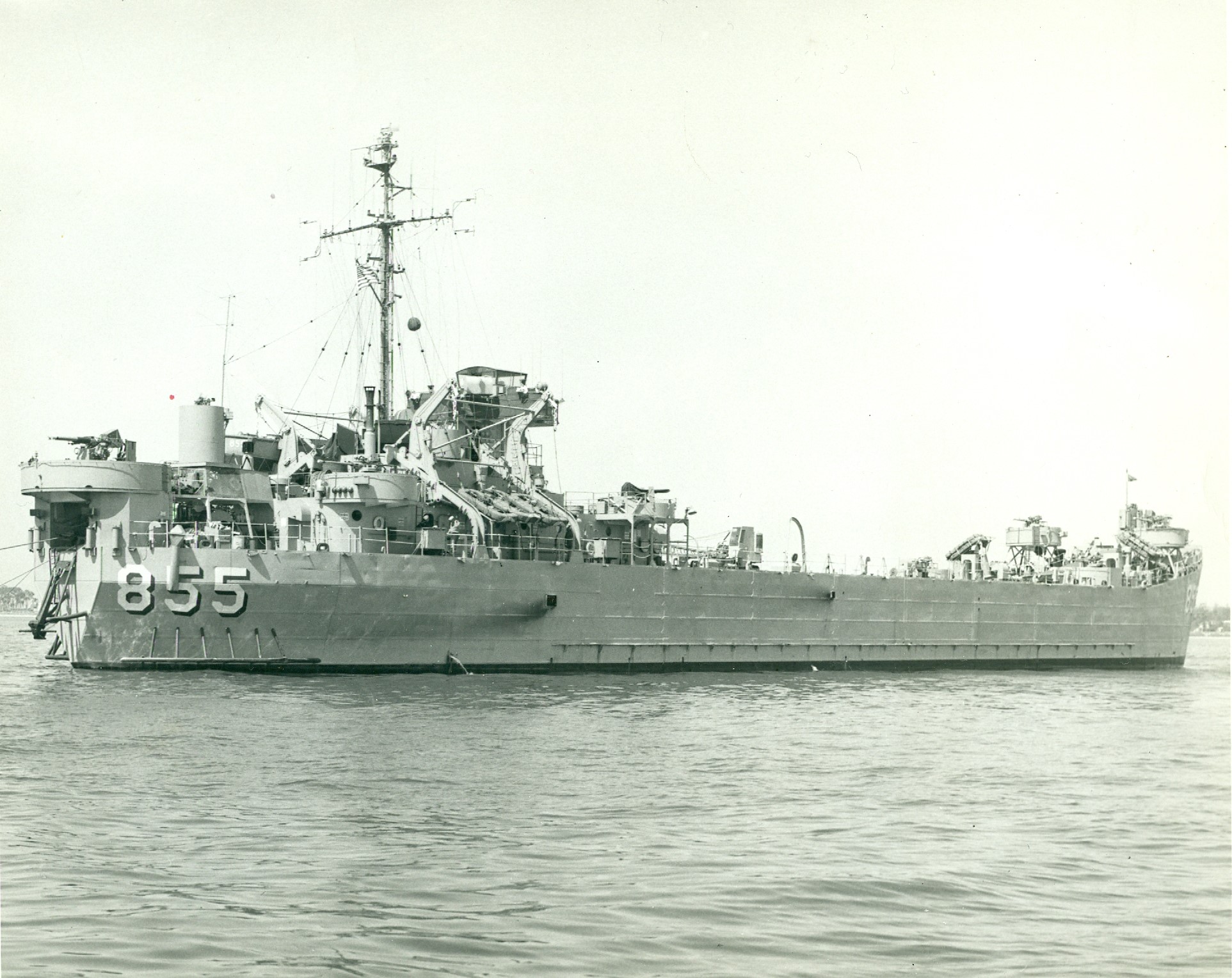
LST-855 was a tank landing ship, built late in the war to put vehicles and men on a beach. Chicago Bridge and Iron, at Seneca, Illinois, laid her down on 6 September 1944 and launched her on 27 November 1944. Mrs. Jean Henning Hoerner sponsored the launch. Another reading of the sponsor's name is Mrs. Jeanne H. Hoerner. The Navy commissioned her on 21 December 1944. Lieutenant (junior grade) Thomas P. Kierl, USNR, had her from that day through December 1945. The command list also calls him a lieutenant. The day in December when he was relieved is not known.
One account has her shake down off Florida and leave New Orleans on 25 January 1945. Another has her leaving New Orleans on 31 December 1944. She went to the Asiatic-Pacific theater with LST Flotilla 31, in Group 91 and Division 181.
A 1945 photograph taken from LCT-1195, by Donald Berton Dale, a radioman on that craft, shows her beached at Okinawa, with LCT-841 also in the picture. That is the wartime landing the record places her on. Lieutenant Hugo Deitenbeck, USNR, who had her in March 1946, later said that on one supply trip to Okinawa a kamikaze fighter came at her, that the cargo was cement, and that the ship took no damage and lost no one. That is his account.
After the fighting she stayed in the Far East. The occupation-service dates credited to her are 28 September to 18 October 1945, 30 May 1946 to 10 January 1947, 24 May to 4 June 1949, and 16 June to 2 July 1949. The China-service dates on the same list run 30 May 1946 to 10 January 1947, 11 January to 4 September 1947, 1 December 1947 to 17 January 1948, 25 February to 8 March 1948, 26 March 1948 to 21 May 1949, 5 to 15 June 1949, and 6 to 11 February 1955. Lieutenant Charles W. Rowland, USNR, had her from December 1945 to March 1946. Lieutenant Hugo Deitenbeck, USNR, had her in March 1946. Lieutenant (junior grade) John K. Taylor had her in 1946. Lieutenant Dick Weidemeyer, USN, had her from 1949 until the decommissioning.
A postwar account has her on the West Coast, then on cargo work in the North Pacific, with a trip to Alaska early in September, and back at Seattle on 15 November. The decommissioning the following February puts that November in 1949. She was decommissioned on 15 February 1950 at the Puget Sound Naval Shipyard in Bremerton and laid up with the Pacific Reserve Fleet, in the Columbia River Group.
She was recommissioned on 3 November 1950. Lieutenant Lloyd J. Parsons, USNR, had her from that day into 1952. One account shortens him to L. J. Parsons. The Korean War was this commission. Kierl had left in December 1945. The Navy awarded six battle stars: the Communist China Spring Offensive, 22 April to 8 July 1951; the United Nations summer-fall offensive, 9 July to 27 November 1951; the Second Korean Winter, 28 November 1951 to 30 April 1952; Korean defense, summer-fall 1952, 1 May to 30 November 1952; the Third Korean Winter, 1 December 1952 to 30 April 1953; and Korea, summer-fall 1953, 1 May to 27 July 1953.
Photographs of the crew place her at Mokpo, Korea, in 1951, with Korean refugees going ashore; at Koje-do on 19 October 1951; at Paengnyong-do on 22 December 1951 and in February 1953; iced in at Cho-do in February 1953; beached with LST-1096 at Paengnyong-do in December 1953; and in dry dock at Yokosuka in 1951. One account has her at Pusan on 23 May 1951. In February 1955 she was with Seventh Fleet ships taking refugees and Nationalist Chinese troops off the Tachen Islands.
Lieutenant Lawrence Herman Baker Jr., USN, had her from 1952 into January 1955. Lieutenant Richard Rodman Justice, USN, had her from January 1955 to 3 August 1956. On 1 July 1955 the Navy named her Kent County, for counties of that name in Delaware, Maryland, Michigan, Rhode Island, and Texas. One account dates the naming 15 July 1955. A landing-ship list from the same source says 1 July. The photograph from about 1955, with 855 on the bow, is from Justice's years in command. Lieutenant Frank Ernest Johnson Jr., USN, had her from 3 August 1956 to 16 October 1957. He is also listed as a lieutenant commander. Lieutenant (junior grade) Richard B. Bennett, USNR, had her from 16 October 1957 until 22 January 1958, when she was decommissioned.
Her last cruise to the western Pacific began in August 1956. She was back in the United States on 14 May 1957, and she worked amphibious exercises off the West Coast and Hawaii. After the decommissioning she was used as a target. She was destroyed on 19 March 1958. One account strikes her name that same day. Another leaves the strike date blank.