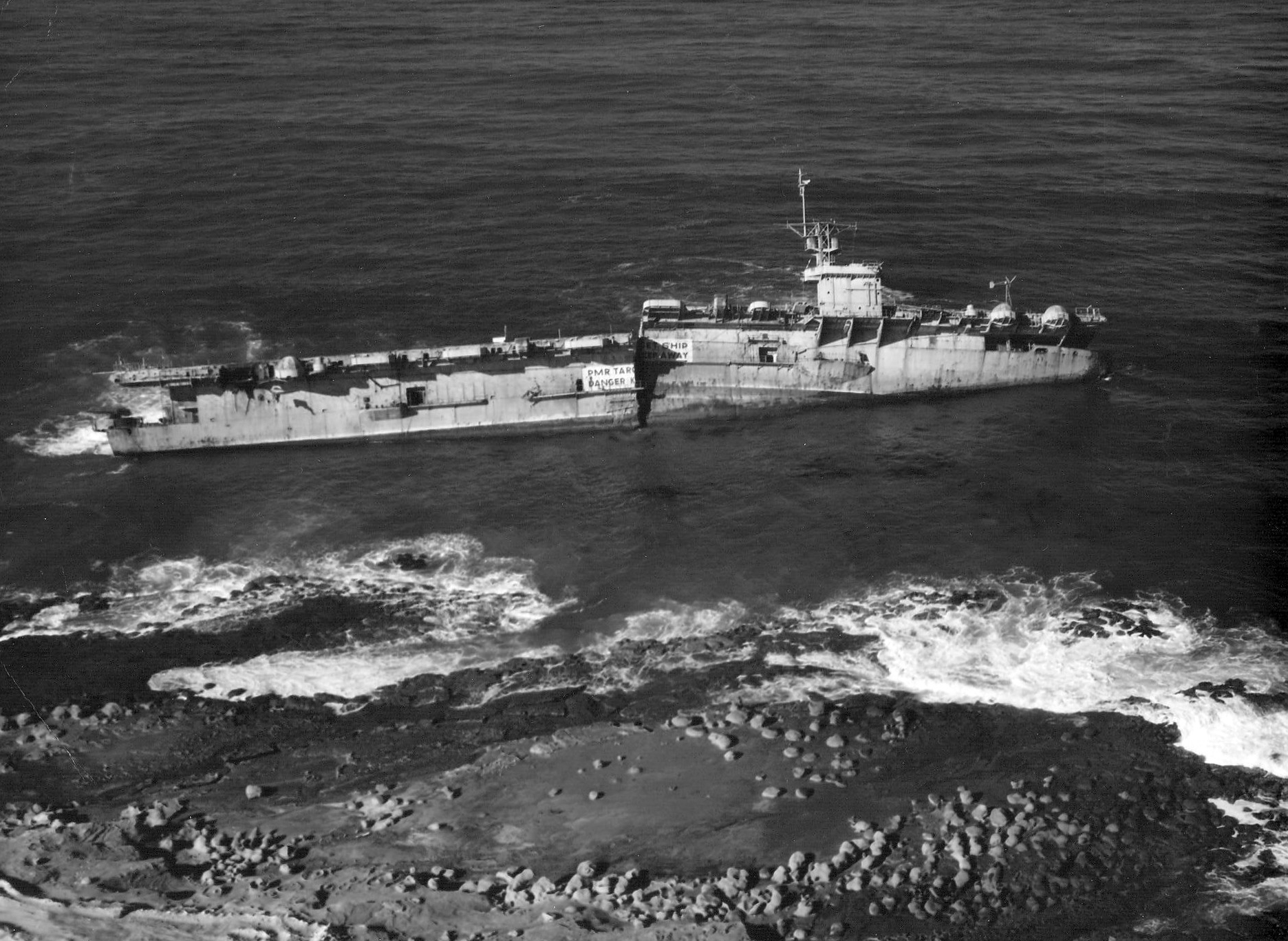
Makassar Strait runs between Borneo and Celebes. The escort carrier named for it was first called Ulitaka Bay. Kaiser at Vancouver laid her down on 29 December 1943, launched her on 22 March 1944, and Mrs. Truman J. Hedding sponsored her. Captain Warren K. Berner commissioned her at Astoria on 27 April 1944.
After shakedown she left San Diego on 6 June with replacement aircraft and passengers, by way of Pearl Harbor to the Marshalls, and brought casualties back, reaching San Diego on 13 July. She trained pilots off southern California, and between 25 September and 15 October ferried 129 planes to Hawaii and Manus. On 26 October she was at Pearl Harbor with seventy damaged Wildcats, and she resumed pilot training there. Over the next three months, pilots from a dozen air groups made more than 6,700 landings. She flew combat-air-patrol and hunter-killer exercises, night carrier operations, and defense against simulated bomb and torpedo attacks.
With Composite Squadron 97 she left Pearl Harbor on 29 January 1945 and, by way of Eniwetok, joined Task Group 50.8. From 9 February to 8 April she protected the logistics ships that supported the fast carriers from the Bonins to the Ryukyus. On 8 April she joined a support-carrier group and began air operations over Okinawa. For four weeks her planes flew close support and struck gun positions, ground installations, and airfields. They also shot down four Japanese aircraft. On 7 May she transferred the squadron to Shipley Bay (CVE-85) at Kerama Retto and left the same day for Guam.
She then refreshed carrier pilots between Guam and Saipan until 19 July, loaded fifty planes at Kwajalein, reached Pearl Harbor on 29 July, and sailed on 14 August with 387 passengers. She arrived at San Diego on 21 August. By then she had steamed more than 91,000 miles. Landings on her deck since commissioning passed 15,500 by the end of October. On Magic Carpet duty she embarked 1,092 veterans at Kwajalein and was back at San Diego on 29 November, then took 1,123 officers and men home from Guam by 3 January 1946. She reached Tacoma on 12 January and was decommissioned on 9 August 1946. She received two battle stars. Redesignated CVU-91 on 12 June 1955, she was authorized on 28 August 1958 for use as a target, and her name was struck on 1 September 1958.