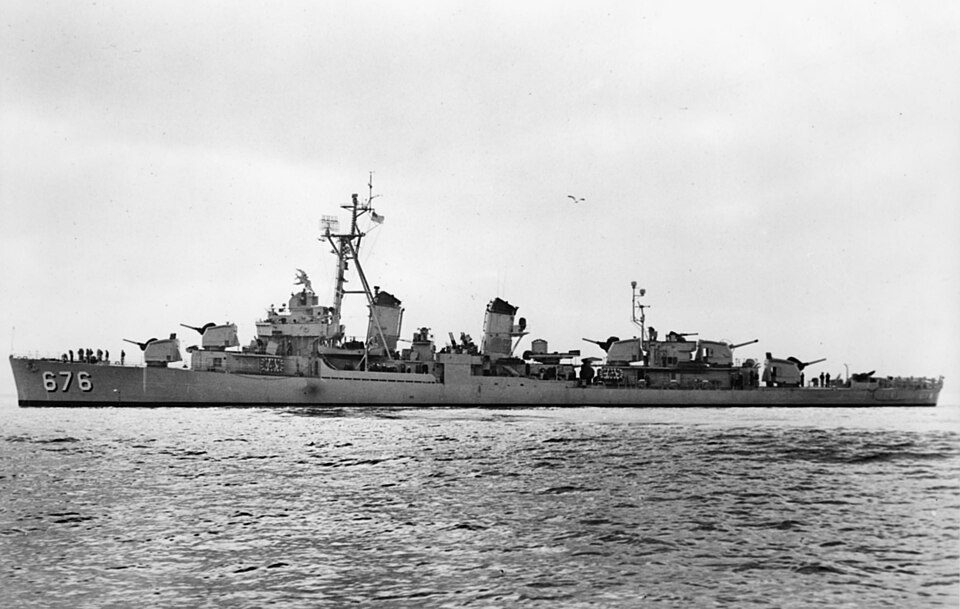
USS Marshall (DD-676) was a Fletcher-class destroyer. She was launched on 29 August 1943 and commissioned on 16 October 1943, with Sinclair Best Wright in command. Shakedown training was held off Bermuda, and her first large job arrived before that work ended. She left those waters in a hurry, met Iowa in the middle of the Atlantic on 13 December 1943, and helped see President Franklin D. Roosevelt home from the Allied conference at Tehran, which had met from 28 November to 1 December.
On 6 January 1944 Marshall sailed from New York and entered Pearl Harbor on the 28th. She remained there until mid-March, training and escorting ships that battle had damaged and that were coming in for repair. On 14 March Joseph Dwight McKinney relieved Wright. With Task Group 58.2 the destroyer then shaped a course for Majuro and arrived on the 20th. On 22 March the fast carrier force stood out to sea. It was the Fifth Fleet's Task Force 58, later the Third Fleet's Task Force 38, and Marshall's place was in the screen against submarines. Planes from the carriers hit Palau on 30 March and Woleai on 1 April. From 21 to 27 April they struck the bases at Wakde and Hollandia along the New Guinea coast. On 29 April Truk was the target. On the 30th, battleships with the force opened fire on Ponape, and cruisers fired on Satawan. During May the carriers moved against Wake and Marcus Islands, and Marshall was given a sweep for enemy shipping north of Marcus.
In June the force was called on to back the amphibious attack in the Marianas. On the 17th it steamed west to intercept a Japanese fleet reported on the way to aid garrisons still fighting at Saipan, Tinian, Guam, Rota, and Pagan. The Battle of the Philippine Sea began on the 19th. In the two days that followed, Japan lost three carriers and 395 aircraft that had flown from carriers, about 92 percent of the carrier-borne planes committed to the battle. Marshall was credited with a share in downing two of them. Over the six weeks that followed she stayed on that southern Marianas duty, breaking off for raids on Chichi Jima and Iwo Jima on 4 July and for attacks on Palau, Ulithi, and Yap from 23 to 27 July. Mid-August brought her into Eniwetok for repairs and upkeep between voyages. She sailed on the 23rd. From 6 to 24 September, in Task Force 38, she shared the work around Palau and in Philippine waters. On 12 September her men took aboard 44 Japanese sailors from Natori, which Hardhead had sunk on 18 August.
After further repair and a fresh load of supplies at Ulithi, the anchorage just taken, her task group sailed on 6 October. Air attacks fell on Okinawa on the 10th and on Formosa from the 12th to the 14th. Marshall was ordered to furnish antiaircraft protection for Canberra while aircraft struck Japanese strongholds throughout the Philippines. On the 22nd she rejoined the group for a hunt through the Sibuyan Sea and Mindoro Strait. On the 25th the carrier force set a course north for Cape Engaño. Marshall went with Task Group 34.5 toward San Bernardino Strait to cut off Japanese ships retiring from Leyte Gulf. Shortly after midnight on the 26th, Nowaki was seen and the group sank her. Marshall was back among the fast carriers on the 31st and kept on in Philippine waters through the end of the year. The new year opened with more strikes on the Philippines and, during a sweep of the South China Sea, on Formosa and the coast of China.
On 10 February 1945 Marshall sailed with Task Group 58.2 toward the Japanese home islands. On the 16th and 17th, carrier aircraft attacked Tokyo. The ships then ran southeast to cover the landing at Iwo Jima, and on the 25th they were off Honshu again for further raids. By 1 March the task force was off Okinawa, starting the air attacks that prepared the campaign there. On the 15th those attacks shifted to Kyushu. On the 19th Franklin received a direct hit. Marshall took part in the rescue and brought 212 of Franklin's crew aboard, then on the 20th accompanied the listing ship on the passage back to Ulithi. Between 8 April and 9 May, still in the Okinawa campaign, she took the forward radar-picket station for her group and shepherded damaged ships clear of the fighting. On 9 May Charles Holovak relieved McKinney. That day Marshall departed for Ulithi, continued to Leyte, and on 6 July arrived at San Francisco for overhaul.
The overhaul was still underway when the war ended, and the ship was inactivated. Decommissioned in December 1945, she joined the laid-up ships at San Diego. Holovak's tour ended on 15 December. On 27 April 1951 Marshall returned to commissioned service. On 22 August she reported to Task Force 77 for duty in the Sea of Japan, screening carriers whose planes were striking Communist targets in Korea. On the same Far East deployment she patrolled the Formosa Strait, served with the United Nations force charged with blockade and escort along the eastern shore of Korea, and screened carriers in the Yellow Sea. March 1952 found her at San Diego again for overhaul. She sailed on 4 October, reached the western Pacific on 28 October, and once more screened carriers during the Korean fighting. Detached in mid-November, she spent two weeks in hunter-killer work, then on 10 December joined Task Force 95 for the shelling of Wonsan. On 7 January 1953 she went south to patrol the Formosa Strait. Mid-February put her back with Task Force 77. Two months later that western Pacific cruise ended, and on 6 May she was home at San Diego.
Through the next eleven years Marshall remained a Pacific Fleet destroyer, with San Diego as home port and regular cruises out to the Seventh Fleet, usually inside Task Force 77. In 1960 she formed part of a carrier group that waited in South China Sea waters while the Pathet Lao, the Communist movement in Laos, rose in revolt. Off Taiwan she operated with the carrier Lexington (CVA-16) and a supply ship. On 1 September 1964 her home port became Tacoma, Washington, where she replaced Watts as training ship for Naval Reserve sailors of the Thirteenth Naval District. On 21 October 1964 a small fire broke out beneath the far end of Repair Pier 7 at Todd Pacific Shipyards. Creosote and wood soaked with oil fed the blaze until the pier was consumed and the flames ran onto the eastern wing wall of Drydock No. 2. Marshall was docked there, hull clear of the water, partway through an overhaul estimated at $300,000. She had survived the war. In July 1970 she was sold for scrap.