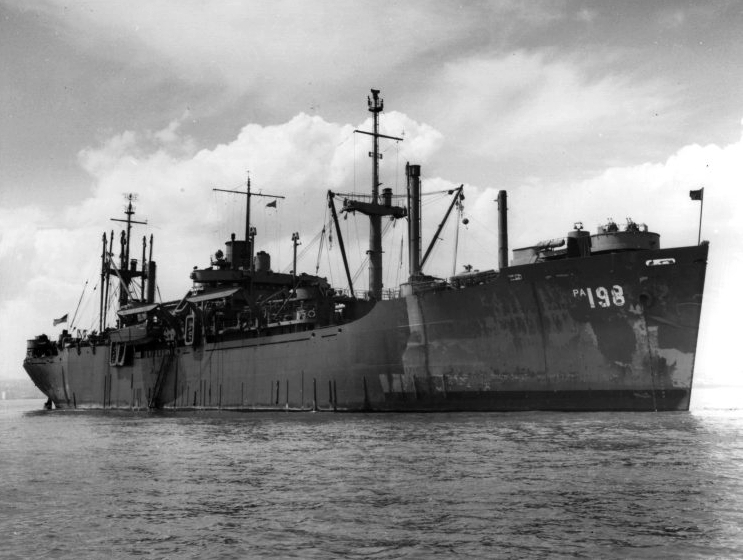
Western Kentucky is the county behind the name. Mrs. Albert Bauer sponsored her. Kaiser Co., Inc., at Vancouver, Washington, started the hull on 8 June 1944 for the Maritime Commission and launched her on 20 September 1944. The Navy acquired the Haskell attack transport on 21 October and commissioned her at Astoria that same day, Commander Brainerd N. Bock in command.
Shakedown and training ran along the west coast. Troops embarked at San Pedro, she sailed for Pearl Harbor on 27 December, and she arrived on 2 January 1945. A South Pacific departure on 10 January, still with troops and cargo, brought her to Noumea in New Caledonia on 20 January. Between 26 and 31 January she passed the Russell Islands and reached Guadalcanal, then trained hard for six weeks. TransDiv 52 was the assignment. She left Guadalcanal on 15 March for the Okinawa invasion, touched Ulithi in the Carolines, and early on 1 April closed the beaches. Assault troops went ashore shortly after sunrise. Cargo kept moving that day even while enemy aircraft attacked. Heavy weather then stopped any further landing of men or cargo, and she was still in the anchorage as late as 6 April. The run to Saipan, from that date through the 10th, put the remaining troops ashore. She left on 11 April and made Pearl Harbor on the 22nd.
San Francisco was the destination when she sailed on 5 May. Troops and cargo came aboard, and Pearl Harbor saw her again on 26 May. Three days later the westward track carried Navy Seabees and Army engineers. Buckner Bay, on Okinawa, received her on 5 July. Once men and supplies were off, Hagashu on 9 July furnished elements of the 6th Marine Division. Guam was where they went, across the span from 10 to 16 July. The west-coast return began on 17 July and ended at San Francisco on the 30th.
Dry provisions loaded at San Francisco. More than 1,400 Army troops joined at San Pedro, and she left on 16 August, debarking them at Manila on 12 September. A week later, at Lingayen Gulf, men of the 25th Infantry Division began to embark. The convoy that sailed on 1 October was taking occupation troops to Japan. At Nagoya, on Honshu, they landed on 28 October. Between 4 and 8 November she went by way of Yokosuka to Sasebo, on Kyushu, and embarked 760 sailors. Nagasaki added 737 more Navy veterans. She departed for the United States on 13 November and reached San Pedro on 1 December.
Magic Carpet called her out again on 12 December. Veteran troops boarded in Manila Bay on 2 January 1946; she sailed on 6 January and reached Los Angeles on the 25th. San Francisco on 10 March led to an inactivation overhaul at Mare Island beginning 2 April. Stockton was where she decommissioned on 10 October 1946 and entered the Pacific Reserve Fleet. The Mare Island Group took her on 17 June 1949, the Stockton Group on 28 November 1950, and the San Diego Group on 30 March 1958. Authority to transfer her to the Maritime Administration was given on 5 September 1958, and her name was struck on 1 October 1958. Into 1969 she still lay at Suisun Bay with the National Defense Reserve Fleet. One battle star was credited for the war.