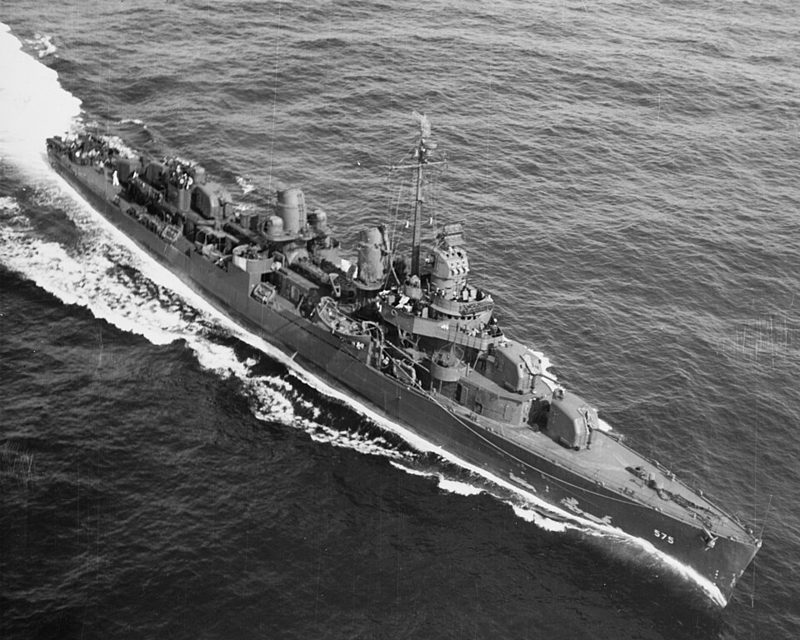
USS McKee (DD-575) was a Fletcher-class destroyer of the United States Navy. She was launched on 2 August 1942 and commissioned on 31 March 1943, when John Joseph Greytak took command.
Shakedown was carried out off Guantanamo Bay. On 6 July 1943 she left Norfolk, Virginia, alongside Yorktown, passed through the Panama Canal, and on 24 July entered Hawaiian waters for three months of further training. Orders carried her into Task Force 53 for southern duty. She reached the New Hebrides on 4 November and was turned aside to shield a convoy leaving the fresh landing on Bougainville in the Solomons. In the heavy air attack on the night of 8 November, her 20 mm guns brought down two aircraft. The second plane had released a torpedo that ran underneath the hull. After taking fuel at Florida Island on 10 November, she screened carriers in an attack on the main Japanese base at Rabaul, New Britain. Next afternoon upwards of fifty enemy aircraft were lost while striking back at the withdrawing ships, and one Mitsubishi G4M Betty was credited to McKee. She finally joined Task Force 53 on 12 November, with that force already headed for the Gilbert Islands assault, and from 19 November through 7 December screened the heavier ships off Tarawa before going on to the Ellice Islands.
On 1 January 1944 she entered Pearl Harbor to prepare for the Kwajalein landing set for 31 January. On that date she shelled neighboring Enubuj and stood by with close fire for the troops. Screening and gunfire work continued until 3 February, after which she ran two escorts to Guadalcanal, both ending at Efate in the New Hebrides. On 15 March she put to sea with Task Force 37, and five days later joined its battleships for a diversionary bombardment of Kavieng on New Ireland. On 23 April she covered troops going ashore at Humboldt Bay in New Guinea, then guarded resupply shipping to the Hollandia beachheads. May and June went to getting ready, partly in the Solomons and partly in the Marshalls, for the Marianas operation. Russell Bowes Allen relieved Greytak in command on 19 May 1944. From Eniwetok on 17 July she sailed in Task Group 53.18. Planned gunfire opened in Agana Bay on 21 July as Marines of the 3rd Division landed on Guam. From a position near enough to distinguish pillboxes and trench lines, she provided support fire until 4 August, when she left for the New Hebrides in company with carriers.
Retaking the Philippines required a stepping-stone airfield, and on 15 September her force opened the shelling and capture of Morotai, in the Moluccas. Opposition was light, and the ships were soon back in Humboldt Bay, the port from which Leyte would be staged. Around mid-October, upward of 700 vessels were moving so the Sixth Army could land safely. On 20 October, while McKee closed her station in Leyte Gulf, two local men came out by canoe from Samar. What they told the crew led her to wreck two concealed landing barges, a tug, and a store of ammunition. That night she departed escorting LSDs bound once more for Humboldt Bay. Further convoy duty brought her to San Francisco on 15 November.
On 10 January 1945 she headed for Ulithi, and on 7 February she joined the Fast Carrier Task Force, at that date designated Task Force 58, to raid the Japanese home islands. Planes from the carriers bombed Tokyo on three days in February, the 16th, the 17th, and the 25th, and they hit Iwo Jima in between those strikes. The carriers and the ships of the screen were left untouched by any reply. The force returned a month later and, starting 18 March, attacked Kyushu to weaken air power ahead of the Okinawa landing on 1 April. The enemy fought back hard. Kamikaze planes penetrated fighter cover and antiaircraft fire and got into the formation. There were pilots for McKee to rescue, plenty of aircraft for her gunners, and two submarine contacts on which she made depth-charge attacks. From 6 April the aerial assault intensified as this Fifth Fleet contingent worked to shield the invasion shipping off Okinawa. On 14 April, while she patrolled as a picket, four aircraft made attacks on her. One was splashed and a second was badly hurt. The third struck the sea about fifteen meters off the starboard bow, and Hunt was hit by the fourth, which had passed McKee by. On 17 April an A6M Zero tried to ram her and was destroyed. Her bombardment of Manimi Daito Shima came on 21 April.
Near the end of April, Task Group 58.1 withdrew to Ulithi for nine days of rest and upkeep. At sea once more, carriers in her care struck at Kyushu on 13 May, then alternated their blows between Japan proper and Okinawa. She entered the Third Fleet under Admiral William Halsey on 28 May. Eight days afterward a typhoon, its winds at 110 knots, threatened worse harm than the Japanese forces had managed. Skilled shiphandling saw her through that storm with minor damage. After repairs and overhaul at Leyte, she reported on 9 July to Task Group 38.1 along the coast of Japan. On 30 July she and six other destroyers carried out the closest push into Japanese home waters made to that point, entering Suruga Wan to shell a plant that refined aluminum and the rail yards of Shimizu on Honshu.
Raids on the Tokyo area kept going until 0900 on 15 August, when Japan surrendered. Atomic bombs had struck Hiroshima and Nagasaki before that morning, and rumors of peace were already abroad. The day prior to the ceremony of surrender on Missouri, McKee set a course home. On 4 September 1945 Victor Bernard Graff became captain, succeeding Russell Bowes Allen. She brought Wasp to Eniwetok, went on to Pearl Harbor, and there joined Task Group 11.6, which was bound east. Charleston, South Carolina, saw her arrival on 16 October. Her active career ended with decommissioning on 25 February 1946, when she passed into the Atlantic Reserve Fleet. Removal from the Naval Vessel Register came on 1 October 1970. On 2 January 1974 she was sold to be scrapped, and the hull was broken up. Eleven battle stars were awarded for service in the Second World War. She survived the war.