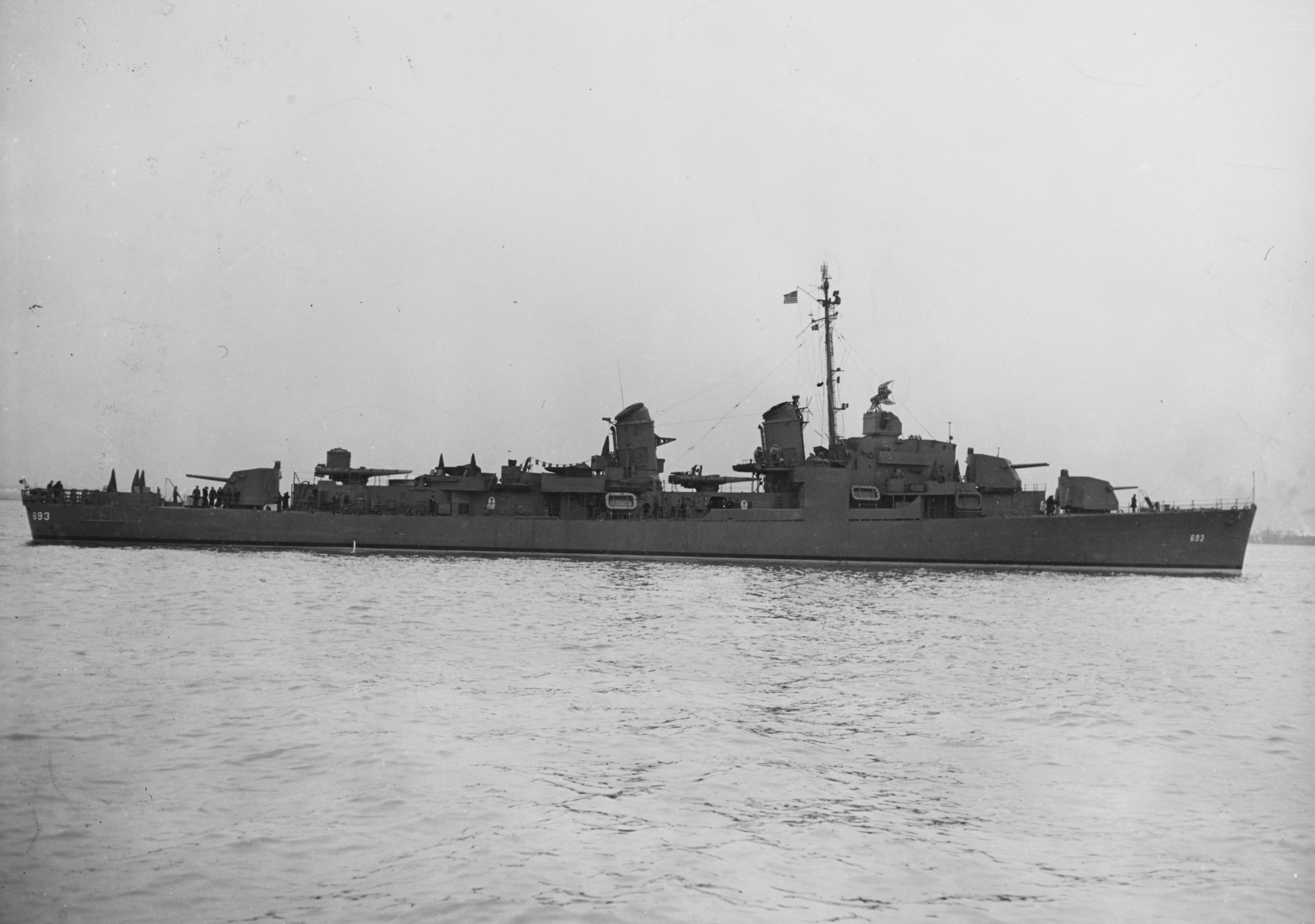
The ship
USS Moale (DD-693) was an Allen M. Sumner-class destroyer, built by the Federal Shipbuilding and Dry Dock Company at Kearny, New Jersey. DANFS gives her 2,200 tons, a length of 376 feet 6 inches, a beam of 40 feet 10 inches, a draft of 15 feet 8 inches, 34 knots, and a complement of 335. The same line lists six 5-inch guns, twelve 40 mm guns, ten 21-inch torpedo tubes, six depth-charge projectors, and two depth-charge tracks. The armament picture kept with the class is the class drawing.
She was laid down on 5 August 1943, launched on 16 January 1944, and sponsored by Mrs. Edward S. Moale, daughter-in-law of the late Lieutenant Edward Moale, Jr. The namesake was born at Little Rock, Arkansas, on 10 September 1866, appointed a naval cadet in 1882, and commissioned an ensign on 1 July 1889. The sketch in DANFS ends with that commissioning. She was commissioned on 28 February 1944. Commander Walter M. Foster had her. DANFS gives the initial M. NavSource prints the middle name Manly, and uboat.net prints Manley. The two spellings are left as they stand. DANFS names him at the commissioning. NavSource and uboat.net carry the tour through 8 May 1945, and therefore through Ormoc Bay and Mindoro. Neither account says he was killed.
Across the Pacific
After a Bermuda shakedown she stayed on the Atlantic coast for experimental tests and for training precommissioning destroyer crews. On 21 August 1944 she got underway with Destroyer Division 120 for the British West Indies, then the Panama Canal, and into the Pacific. She reported at Pearl Harbor on 15 September to Commander Destroyers Pacific. She exercised at carrier screening, night firing, and shore bombardment until 23 October, then left for the Western Carolines with Destroyer Squadron 60. She arrived at Ulithi on 5 November 1944 and joined Task Force 38 the same day. She screened carriers striking Luzon and Mindoro, was back at Ulithi on 22 November, and was underway on 27 November for the Seventh Fleet.
Ormoc Bay
She joined Task Group 77.2 on 29 November 1944 in San Pedro Bay. She patrolled Leyte Gulf and took part in strikes against enemy forces in Ormoc Bay. The DANFS entry for Moale does not describe gunfire damage there.
The Navy chronology for the night of 2 December says three destroyers under Commander J. C. Zahm entered Ormoc Bay and were engaged by Japanese aircraft, destroyers, and shore batteries into the first two hours of 3 December. It records Cooper (DD-695) sunk by a torpedo from an undetermined source, and Moale damaged by naval gunfire, both at 10°54' N, 124°36' E. It records Allen M. Sumner (DD-692) damaged by a horizontal bomber, and it gives that ship the wrong hull number in the entry. Kuwa was sunk by naval gunfire at 10°50' N, 124°35' E. Those positions are the chronology's places for the action. They are not a surveyed wreck. The chronology gives no count of Moale's dead or wounded.
Cooper's history says that at 1829 on 2 December, Cooper, Allen M. Sumner, and Moale were ordered into Ormoc Bay, Destroyer Division 120 less Ingraham (DD-694), against a reported reinforcement convoy. About 0013 on 3 December, after Cooper had cleared Moale from her line of fire, an enemy torpedo hit Cooper amidships to starboard. She broke in two and sank in less than a minute. Observers in Moale saw the explosion. Commander John C. Zahm, in Allen M. Sumner, did not know for nearly twenty minutes and did not stay to rescue. Cooper's history counts 10 officers and 158 enlisted saved, from 20 officers and 339 enlisted. She was struck on 20 January 1945.
H-Gram 040 puts Allen M. Sumner, with Zahm embarked, Moale, and Cooper in the bay under a continuous night air attack, with near misses. It says Sumner and Cooper fired on Kuwa and sank her, and that Moale engaged Take with guns until the others joined. It says one of Take's four torpedoes broke Cooper in two in less than thirty seconds, and it counts 10 officers and 181 enlisted lost, with PBYs later taking off 56 and then 48. Those lost and saved figures do not match Cooper's own history. H-Gram once prints Moale with Sumner's hull number. Moale is DD-693.
Mindoro
On 12 December she shifted to Task Group 77.3 and screened the Mindoro assault force. On the 15th she gave fire support for the troops and antiaircraft protection for the ships in the transport area. Samuel J. Cox, in H-Gram 040, says she shot down a kamikaze and then came alongside LST-738 to fight the fire. An explosion on the LST holed Moale, killing one of her men and wounding ten. She took off 88 of LST-738's crew. The guns of other ships of the invasion fleet then sank the LST. She left for Leyte on 17 December, arrived on the 18th, and made a high-speed cargo run to Ulithi and back before the end of the year.
February 1945
On 10 February 1945 the force sortied from Ulithi. On 16 and 17 February the carriers struck the Japanese capital to keep aid from Iwo Jima. Barton (DD-722) and Ingraham (DD-694) collided on the 16th while screening the carriers. On the 17th Moale was detached to escort them back to Saipan.
Her deck and her forward twin 5-inch mount were then extensively damaged, in heavy seas with 40-foot swells. That was the weather, and a different hurt from the explosion off Mindoro. She left the Volcanoes on 25 February 1945 for repairs at Pearl Harbor. She was back at Ulithi on 3 June and underway for the combat area the next day.
Okinawa and the surrender
She arrived at Hagushi Anchorage, Okinawa, on 7 June and reported to the commander of Task Group 31.5 for antiaircraft defense. Through the 27th she was on radar picket. On the 28th she left for Leyte, joined Task Group 32.12, and returned to Okinawa as a covering force for minesweepers in Operation Juneau. At the end of the month she anchored in San Pedro Bay, Leyte. There, on 15 August 1945, she received word of the surrender.
DANFS gives her five battle stars for World War II and one for Korea. It records her stricken from the Naval Vessel Register on 1 July 1973 and disposed of by Navy sale on 1 December 1974. Other compilations print 2 July 1973 and a sale on 13 November 1974. The dates used here are the DANFS dates.
The photograph is Naval History and Heritage Command NH 45927, via NavSource. NavSource places it in 1944, probably soon after completion, location unknown, and says she had not yet been painted in camouflage. The bow and the stern both read 693.