Building
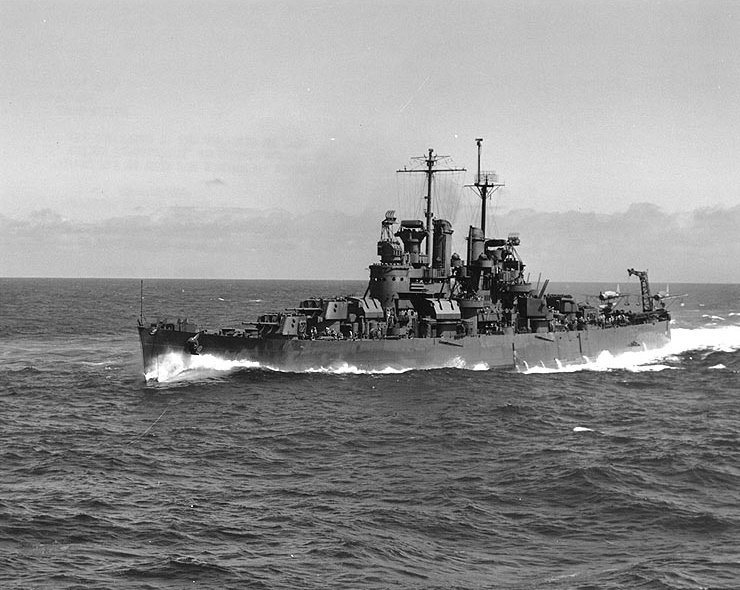
Mobile was a Cleveland-class light cruiser named for the city of Mobile, Alabama. The class used an enlarged version of the treaty-limited Brooklyn hull and carried twelve 6-inch guns in four triple turrets and twelve 5-inch dual-purpose guns, with a top speed of 32.5 knots. Newport News Shipbuilding and Dry Dock Company laid her down on 14 April 1941. She was launched on 15 May 1942 and commissioned in March 1943.
The Central Pacific, 1943–44
She joined the fast carriers as an antiaircraft screen ship. She covered the Marcus Island raid on 31 August 1943 and the Tarawa strikes on 18 September, supported the Bougainville landings with Task Group 50.3 from 21 October, and gave gunfire support to the Marines on Tarawa and Betio from 20 to 28 November. On 29 January 1944 her division bombarded Wotje while the fleet moved on Kwajalein. She screened the carriers during Operation Hailstone against Truk on 16–17 February and the Marianas strikes of 21–22 February. She covered the Palau, Yap and Woleai raids from 29 March to 3 April, and then the Hollandia landings at Aitape, Humboldt Bay and Tanahmerah Bay.
From 6 June she screened the Marianas strikes, and she fought in the Battle of the Philippine Sea from 19 June, when the American carriers sank Hiyō. After the battle she took part in the raid on Pagan on 24 June. On 4 August, after the strikes on Iwo Jima, Chichi Jima and Haha Jima, she and Cruiser Division 13 swept off Chichi Jima for shipping. They sank a large cargo ship and bombarded the island the next day. She screened the Palau strikes from 6 to 8 September, the Formosa Air Battle in October, in which her sister Houston and Canberra were torpedoed, and the Philippine strikes from 20 October.
Leyte Gulf
On 25 October 1944, at Cape Engaño, her task group came under attack from Ozawa's Northern Force. She was then sent with other surface ships to hunt down the crippled Japanese ships, and she helped sink the light carrier Chiyoda and the destroyer Hatsuzuki.
Okinawa and the end of the war
She returned to Ulithi on 29 March 1945 and reached Okinawa on 3 April, two days after the landings, where she was assigned to Task Force 51. When the war ended she sailed from San Pedro Bay in the Philippines on 20 August for occupation duty. In September she shuttled between Okinawa and Japan carrying liberated prisoners of war, and in October she operated off Sasebo. On 18 November she left Japan with sailors and Marines bound for San Diego, the first of her two Magic Carpet voyages. She earned eleven battle stars.
Fate
She was decommissioned on 9 May 1947 and laid up at Bremerton. She was struck on 1 March 1959 and sold for scrap on 16 December 1959, and she was towed to the breakers on 19 January 1960.
Sources
Wikipedia, "USS Mobile (CL-63)" (citing Friedman, U.S. Cruisers; DANFS; Morison).
NHHC/DANFS, "Mobile III."