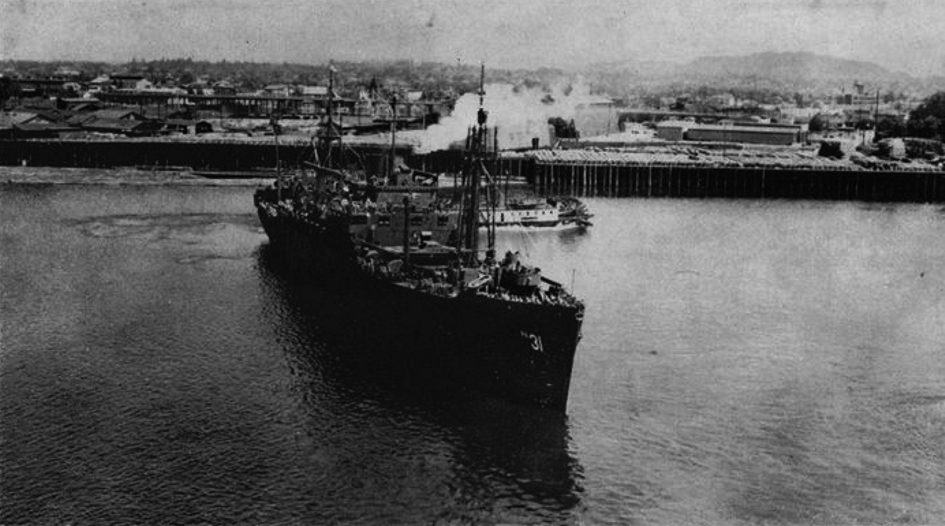
Monrovia, APA-31, was a Crescent City-class attack transport built on a C3-Delta merchant hull. Bethlehem Steel laid her down at Sparrows Point, Maryland, on 26 March 1942 as the merchant ship Del Argentino, Maritime Commission hull 152. She was launched on 19 September 1942 and commissioned as the transport Monrovia (AP-64) on 1 December 1942, Captain C. D. Leffler in command. She became APA-31 on 1 February 1943. She was named for the Virginia birthplace of President James Monroe.
She started in the Mediterranean. After a quick conversion at Mers el Kebir she became a flagship. Vice Admiral Hewitt came on board at Algiers on 20 June 1943, and Lieutenant General George S. Patton joined her ten days later. She was the command ship of the Western Task Force off Sicily on 10 July and was slightly damaged in the engine room on 11 July by two near misses from a Stuka. She then went to the Pacific.
She was flagship of Transport Division 18 at Tarawa on 20 November 1943 and took part in the assault at Kwajalein on 31 January 1944, returning casualties and prisoners to Pearl Harbor in February. She landed 2nd Marine Division troops at Saipan in June 1944, landed troops at Guam from 22 July, and was off Leyte at dawn on 20 October. She was in Lingayen Gulf on 9 January 1945, where on 10 January she endured a suicide swimmer attack. As flagship of Transport Division 36 she landed her Marines at Okinawa on 1 April 1945 and finished unloading on 5 April. She carried occupation troops and veterans after the war.
She went into the Atlantic Reserve Fleet in 1946 and was decommissioned at Norfolk on 26 February 1947. She was recommissioned on 30 November 1950 and made annual Mediterranean deployments with the Sixth Fleet until 1967. She was decommissioned on 31 October 1968 and struck on 1 November 1968, and was sold for scrapping on 25 August 1969. She earned seven battle stars for World War II.