Building
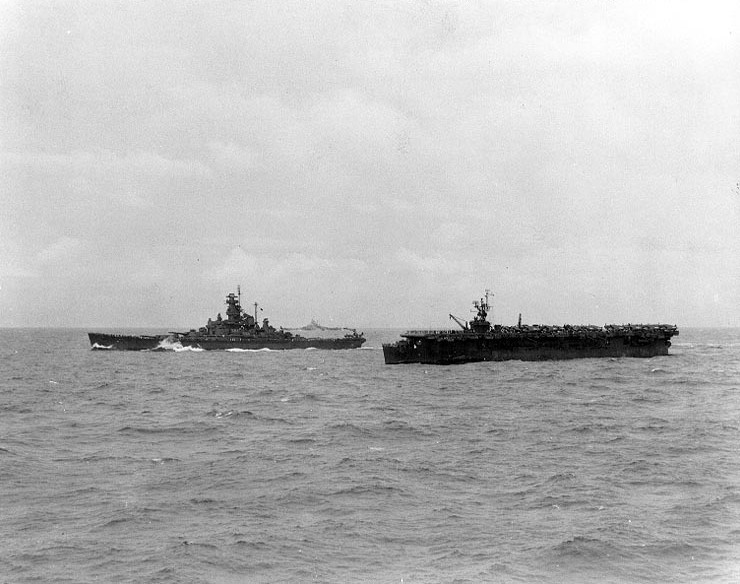
Monterey was the third Navy ship named for the 1846 Battle of Monterrey in the Mexican War. New York Shipbuilding at Camden, New Jersey, laid her down on 29 December 1941 as the Cleveland-class light cruiser Dayton (CL-78). As the Navy rushed to get more flight decks, she was reordered as a carrier (CV-26) on 27 March 1942 and renamed Monterey four days later. She was launched on 28 February 1943, sponsored by the wife of Patrick N. L. Bellinger, then an admiral. She was commissioned on 17 June 1943, Captain Lester T. Hundt in command, and reclassified as a light carrier, CVL-26, on 15 July 1943.
The Central Pacific
She reached the Gilberts on 19 November 1943 in time to help secure Makin. She struck Kavieng on 25 December with Task Group 37.2 and supported the Kwajalein and Eniwetok landings until 8 February 1944. With Task Force 58 from February to July 1944 she raided the Carolines, Marianas, northern New Guinea and the Bonins, and she fought in the Battle of the Philippine Sea on 19–20 June. She struck Wake on 3 September, then joined Task Force 38 for the southern Philippines and Ryukyus strikes. From October to December she supported the Leyte and Mindoro landings.
Typhoon Cobra
In December 1944 the Third Fleet steamed into Typhoon Cobra, with winds over 100 knots. In the two-day storm several of Monterey's planes broke loose from their lashings and started fires on the hangar deck. Lieutenant Gerald R. Ford, the future President, was her general-quarters officer of the deck and was nearly swept overboard. He was sent below to assess the blaze. The crew contained the fire and got the ship underway again.
1945 and after
After overhaul at Bremerton in early 1945 she rejoined Task Force 58 and struck the Nansei Shotō and Kyūshū for the Okinawa campaign from 9 May to 1 June, then joined the final raids on Japan. Her planes sank five enemy warships during the war, and she earned 11 battle stars. She made Magic Carpet voyages between Naples and Norfolk and was decommissioned on 11 February 1947. When the Korean War broke out she was recommissioned on 15 September 1950. For four years from January 1951 she trained thousands of aviation cadets, student pilots and helicopter trainees at Pensacola, until Saipan relieved her. She left Pensacola on 9 June 1955, was decommissioned on 16 January 1956, reclassified AVT-2 on 15 May 1959, and sold for scrap in May 1971.
Sources
Wikipedia, "USS Monterey (CVL-26)" (citing DANFS); Gerald R. Ford Presidential Library on Ford's service in Monterey.
NHHC/DANFS, "Monterey IV."