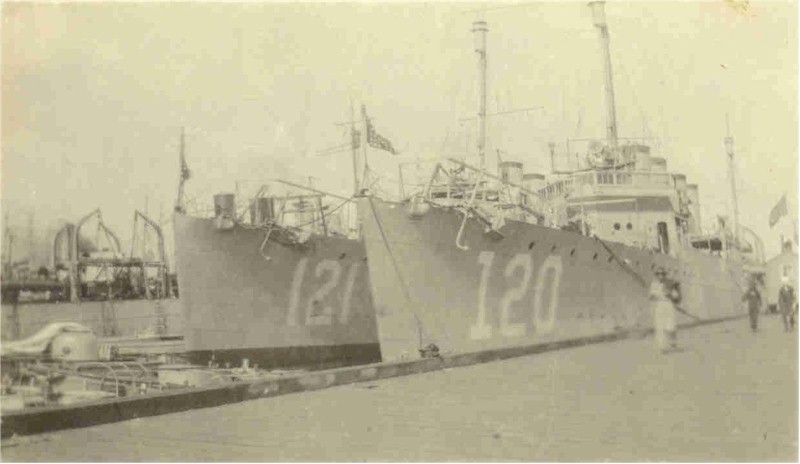
Montgomery was a Wickes-class destroyer, the fifth Navy ship of the name. She was named for Rear Admiral John Berrien Montgomery, 1794 to 1873, not the Revolutionary War general. Newport News Shipbuilding laid her down on 2 October 1917, launched her on 23 March 1918, and commissioned her on 26 July 1918. Mrs. Andrew Jones, a descendant of the admiral, sponsored the launch. Lieutenant Commander William R. Purnell had her at commissioning. No relief date is given for him. As a destroyer she displaced about 1,060 to 1,090 tons, was 314 feet long, and was designed for about 35 knots, with four 4-inch guns, twelve 21-inch torpedo tubes, and depth charges. Her crew was about 110. The hull number DD-121 was assigned on 17 July 1920. On 5 January 1931 she was redesignated a light minelayer, DM-17.
After an East Coast shakedown she left Hampton Roads on 25 August 1918 for anti-submarine patrols and coastal escort until the Armistice. She then trained from Maine to Cuba. On 19 July 1919 she sailed for the Pacific, reached San Diego on 7 August, and joined Destroyer Squadron 4. For three and a half years she operated from Alaska to Panama. Inactivation began on 17 March 1922. She decommissioned at San Diego on 6 June 1922.
She was converted to a minelayer and recommissioned on 20 August 1931. That December she moved to Pearl Harbor and stayed based there until 14 June 1937. She decommissioned at San Diego on 7 December 1937. She recommissioned on 25 September 1939, trained and towed on the West Coast, and sailed for Pearl Harbor again on 3 December 1940.
She was in port on 7 December 1941 and was not hit. She went on anti-submarine patrols in the approaches and on inter-island convoys. On 11 April 1942 she left Hawaii for Suva. For about sixteen months she worked from Suva, Espiritu Santo, and Noumea, escorting and laying mines in the Solomons. From 22 September to 12 November 1942 she went north and laid mines in the Aleutians, ahead of the later recapture of Attu and Kiska.
On the night of 24–25 August 1943, laying a field off Guadalcanal, she collided with the minelayer Preble and lost about 20 feet of bow. Temporary repairs were made at Tulagi and Espiritu Santo. On 15 September she was still in those waters, with Saufley, escorting a convoy at the south end of Indispensable Strait when RO-101 attacked. Her sound gear was out, so Saufley ran the search. Saufley and a Catalina sank the submarine. That sinking is not credited to Montgomery. She reached San Francisco on 19 October for a full repair of the bow.
From 8 December 1943 to 5 February 1944 she escorted two convoys between San Francisco and Hawaii. She laid defensive mines around Kwajalein from 17 March to 4 April, escorted to Majuro in May, and ran local Hawaiian convoys. On 25 June 1944 she attacked a submarine contact. No sinking is confirmed. After an Eniwetok escort, 28 June to 16 July, she prepared at Guadalcanal for the Palau invasion.
She sailed on 6 September 1944 and arrived off Peleliu on 12 September to destroy mines swept from Japanese fields. She screened the Angaur landings on 17 September, then patrolled and cleared mines at Ulithi until 14 October. On 15 October she bombarded Ngulu and acted as mother ship for small minelayers during the capture of that atoll.
On 17 October 1944 she was anchored off Ngulu with her engines secured. A mine was sighted close to port. The wind set her down on it before she could get underway or destroy it. The blast flooded both engine rooms and one fireroom, ruptured fuel tanks, and killed four of the crew. She was kept afloat and towed to Ulithi. She was under her own power from 12 January 1945 and reached San Francisco on 14 February. A survey recommended decommissioning. She was decommissioned on 23 April 1945, struck on 28 April, and sold for scrap on 11 March 1946. She earned four World War II battle stars: Pearl Harbor, Guadalcanal, New Georgia, and the Western Carolines.