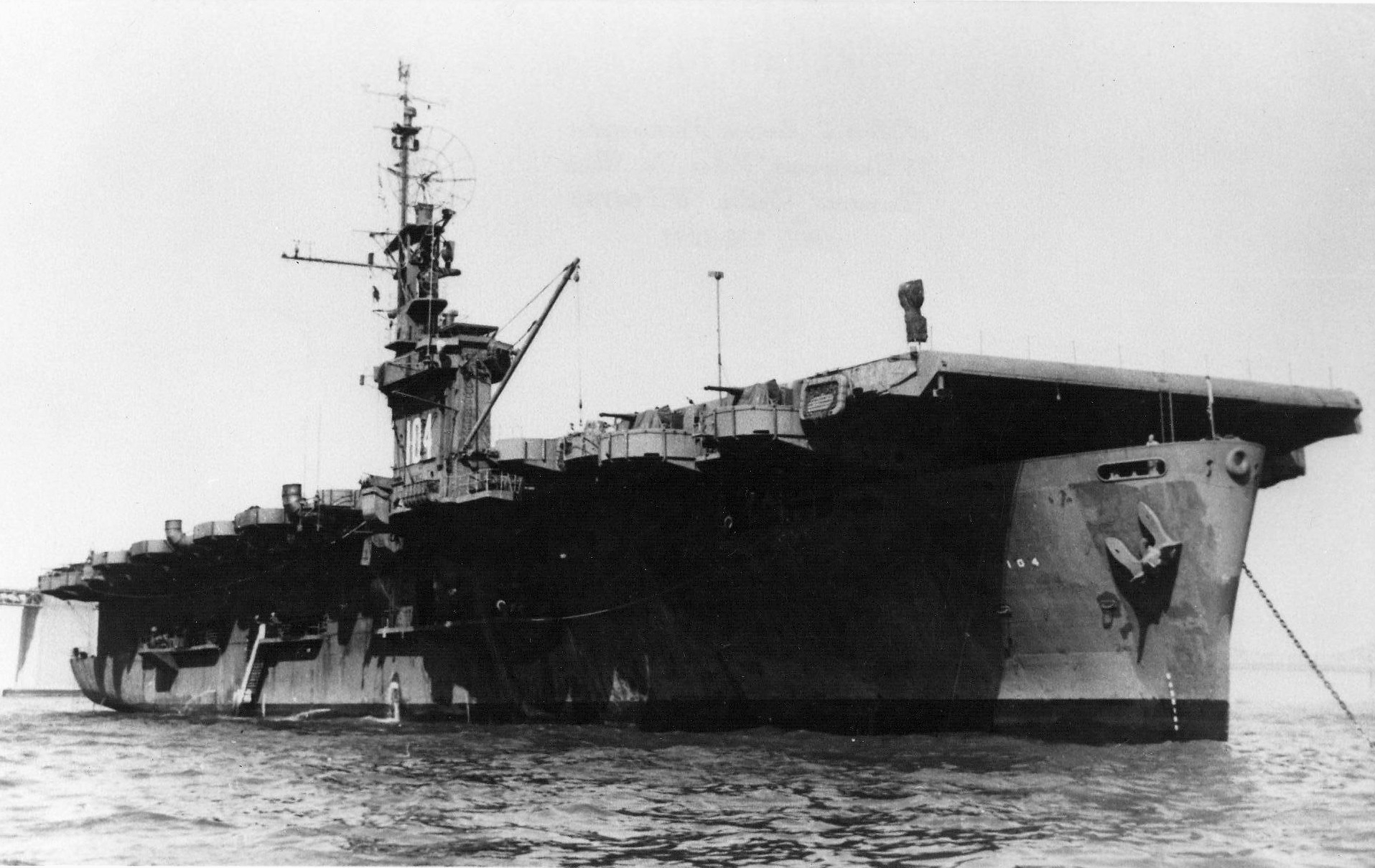
Munda, on New Georgia, was a Japanese airfield on the route from Rabaul down to Tulagi and Guadalcanal. American troops took it on 5 August 1943. Kaiser at Vancouver laid the escort carrier down on 29 March 1944 as Maritime Commission hull 1141. She was named Tonowek Bay on 23 September 1943 and Munda on 6 November 1943, and she was launched on 27 May 1944. Mrs. James E. Dyer sponsored her. Captain L. A. Pope accepted her and commissioned her on 8 July 1944.
After a west-coast shakedown she was assigned to the Carrier Transport Squadron. On 16 August she sailed on her own with 71 planes and 202 passengers and reached Espiritu Santo on 1 September. She went on to Finschhafen and Manus, returned to Alameda, and then made further replacement runs. She was home from the second on 5 December and underway again on the 12th. Three more runs to Pacific islands followed before the middle of 1945.
On 3 July she sailed for Eniwetok, joined Task Group 30.8, and began supplying planes, pilots, and aviation stores to the fast carriers of Task Force 38. She met that force on 20 July, as it struck the home islands, and stayed through the 26th, then returned to Guam to replenish. At sea again by the end of the month, she rejoined Task Force 38 on 3 August and resupplied the carriers that day and again on the 7th and the 11th. On 13 August she left the formation. She was on the way back to Guam when word came of the surrender. She rejoined the replenishment group, stayed off Japan through the first week of the occupation, and steamed into Tokyo Bay on 10 September.
She left Tokyo on 2 October and ferried servicemen home into the next year. That duty ended on 18 January 1946. She prepared for inactivation at Port Angeles and was decommissioned on 13 September 1946, joining the reserve fleet at Tacoma. She received one battle star. Redesignated CVU-104 on 12 June 1955, she shifted to Bremerton on 29 April 1958, was struck on 1 September 1958, and was sold on 17 June 1960.