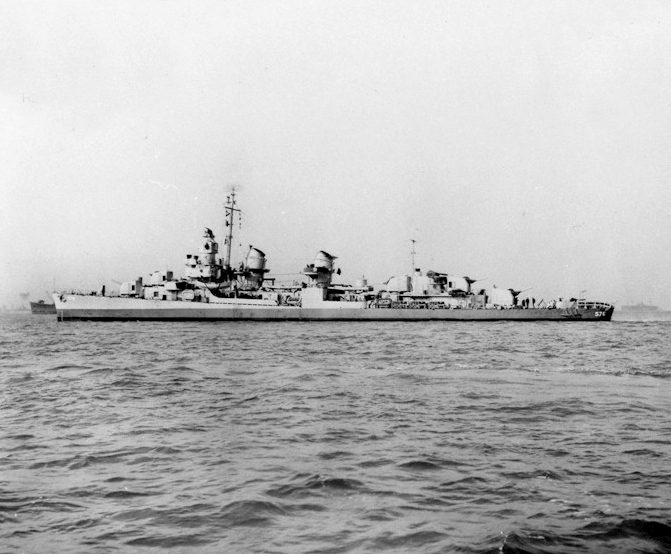
USS Murray (DD-576) was a Fletcher-class destroyer. Launched on 16 August 1942, she entered commission on 20 April 1943, and Richard F. Stout was her captain from that day.
A Caribbean shakedown came first, then a spell of escort duty in the Atlantic. In September 1943 she reached Pearl Harbor and reported to Destroyer Squadron 25. With a carrier task force she shared the strikes on Wake Island on 5 and 6 October, and she then moved into the South Pacific. As troops went ashore on Bougainville on 8 and 9 November, her guns brought down three aircraft. Two days later she was covering Third Fleet carriers in a strike at Rabaul when about 150 enemy planes attacked the formation, and she destroyed two of them.
From 20 November to 8 December she hunted submarines in the Gilberts while Tarawa and Abemama were occupied, and she spent the next month watching shipping into the islands just taken. In January 1944 her gunfire support for the capture of Kwajalein was outstanding, and she screened the transports that carried the invasion force on to Eniwetok. Escort work along the western routes filled the two months after that. On 20 March she helped shell Kavieng on New Ireland. With the Seventh Fleet she joined the assault at Aitape, New Guinea, from 23 to 28 April, and during a torpedo attack from the air she brought down another aircraft.
In June she was back with the Sixth Fleet. She screened amphibious craft for the Saipan assault, then went to Guam, where from 20 July to the 26th she gave close gunfire support and screened transports. Patrol and escort duty while the Marianas were consolidated lasted until late August. She returned to the operations around New Guinea, shelled Wewak on 30 August as cover for British minelaying, and in September covered the landing at Morotai. From Hollandia she prepared for the Philippine invasion and sailed as escort with the transports for Leyte. On 20 and 21 October she bombarded the shore, closing until the reefs stopped her so her shells could pass over the troops on the beach into positions inland, and she helped beat off air attacks. She left as soon as the landings ended and overhauled at San Francisco. In January 1945, bound for Task Force 58, she escorted a division of battleships to Pearl Harbor.
In that force she screened the carriers and took a picket station for their first raid on Tokyo on 16 February, then for the strikes against Iwo Jima and the Ryukyus from 26 February to 1 March. On 26 February, some 200 miles off Japan, she sank a Japanese picket vessel. For Okinawa she screened battleships against submarines during the bombardment before the landings. A Japanese bomb hit her on 27 March, and she went to Pearl Harbor for repairs. On the way forward again, by way of Eniwetok, she was ordered on 2 July to find the Japanese hospital ship Takasago Maru, go aboard, and inspect her. The ship was headed for Wake and was suspected of hauling arms or other cargo barred to a hospital ship. Murray found her the next day. The inspection showed that she met international law, and she was cleared to continue to Wake and take on Japanese sick and wounded.
Murray rejoined the fast carriers, the force now called Task Force 38, and guarded them in the strikes on Honshu, Hokkaido, and Kyushu through the last two months of the war. On 30 July she and others of her squadron entered Suruga Bay on Honshu and shelled Shimizu. The raid stands among the boldest surface thrusts of the war, and it may have taken surface ships deeper into Japanese waters than any other. She was among the first occupation ships, and she was the first in those waters to take over a Japanese submarine as the undersea fleet began to surrender. On 27 August, aircraft of Task Force 38 patrolling off Honshu sighted a submarine showing the black flag that served as the surrender signal. Murray was sent to intercept her and bring her into Tokyo Bay for internment. That day the boarding party received the swords of the officers from I-14, and the submarine was taken to the entrance of Sagami Bay. Murray was in Tokyo Bay for the formal surrender on 2 September and sailed for the United States three days later.
Inactivation was carried out at the Philadelphia Naval Shipyard. She decommissioned on 27 March 1946 and joined the reserve fleet at Charleston, South Carolina. On 2 January 1951 she was designated the escort destroyer DDE-576, and conversion began in June. Frank L. Fullaway became her captain on 15 October 1951, and she recommissioned at Charleston the next day. Early in 1952, with Norfolk as home port, she trained on the East Coast and in the Caribbean, and she periodically served as plane guard off Pensacola while aviation cadets qualified aboard carriers. In June 1953 she made her first Mediterranean deployment, in the Sixth Fleet force that hunted submarines. Her 1954 tour reached ports in northern Europe. In 1956 she operated with Nautilus and joined a NATO exercise in European waters that practiced escort of convoys, and a yard overhaul took much of the year. In 1957, after the Suez Canal had closed the previous autumn, she rounded the Cape of Good Hope for patrol in the Persian Gulf. The canal was open again later that spring, and she served with the Sixth Fleet in the Mediterranean through August.
From March 1958 until May 1961 she served in Task Group Alfa, an experimental group developing antisubmarine warfare. The group usually kept to the waters off the Virginia Capes, and in the summers of 1959 and 1960 it made the yearly NROTC midshipmen cruises, calling at Canadian ports and Bermuda. Late in May 1961 she was one of the rescue ships placed along the course of President John F. Kennedy's flight to Paris, and she then joined that summer's midshipmen cruise. On 30 June 1962 she was designated DD-576 once more and returned to Alfa's development work. The work paused for the Cuban Quarantine in October and November 1962, which forced the Soviet missiles to leave Cuba and averted a grave international crisis. At 1633 on 27 October 1962 her deck log noted a sonar contact on bearing 212 at 2,000 yards. She survived the war, and on 16 August 1966 she was sold for scrap.