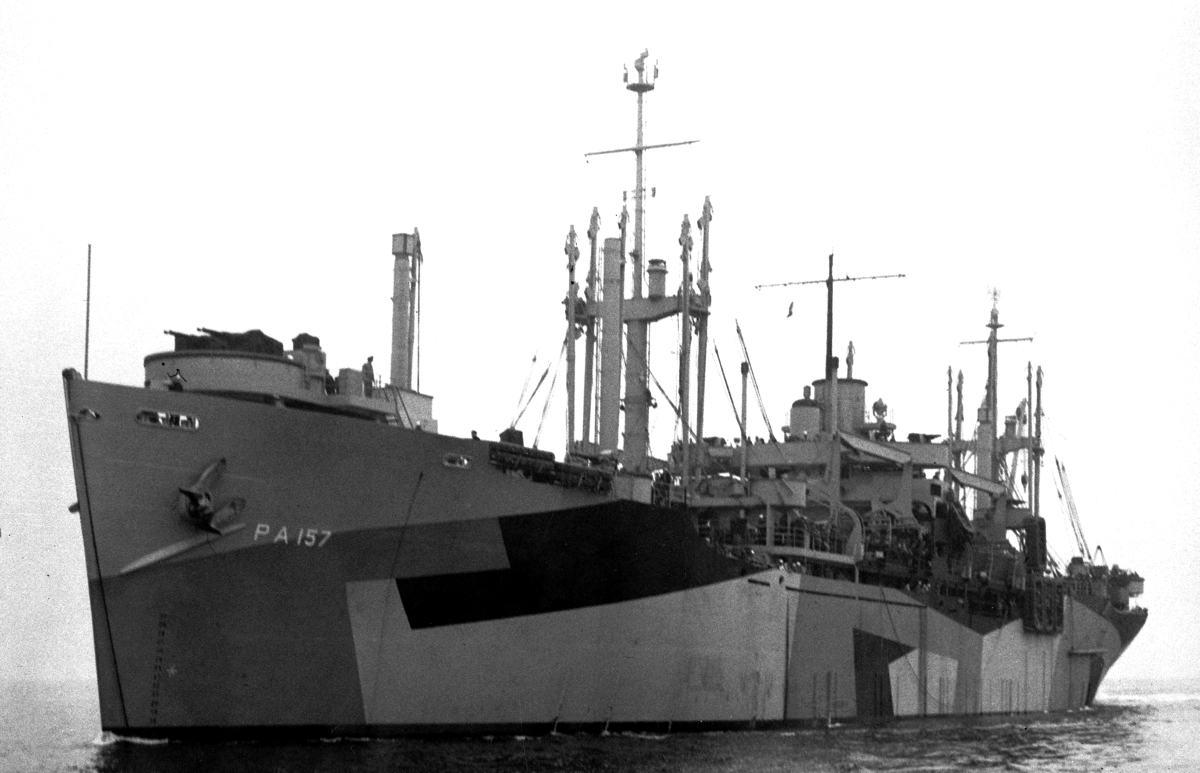
The second Napa was named for a county in California. Oregon Shipbuilding at Portland laid her down on 7 June 1944, Maritime Commission hull 123, and launched her on 12 August. Mrs. Cranston Williams sponsored the ship. Taken over on loan charter, she was commissioned on 1 October 1944 with Captain Francis J. Firth in command.
California coast drills came first. Seabee units loaded at Port Hueneme, and on 25 November she sailed for Hawaii, arriving at Pearl Harbor on 2 December. Transport Division 44 of the Amphibious Forces, Pacific Fleet, was her assignment. For the next month she trained with the 4th Marine Division for the Iwo Jima landing. Task Force 51 got underway on 27 January 1945. Tinian was a last practice ground from 11 through 15 February, and on the 16th she headed for the Volcano Islands. Dawn on the 19th found her eight miles off Iwo Jima. Boats were in the water at 0641. They had until the 0900 H-hour to reach the Blue Beaches along the southeastern shore. LVTs of the first waves touched on schedule, then slowed at the first terrace of volcanic ground. Pillboxes, guns, and mortars sat on higher ground north of the sand. Nothing but a hit square on those positions would quiet them, and Marines caught in the open suffered for it. Transports closed to collect the wounded. She left the line of departure before noon so she could embark wounded. She hauled off that night and was back early on the 20th, still landing troops and cargo and still taking wounded aboard.
She returned again on the morning of 21 February. About 0445 Logan (APA-196) rammed her. Between frames 88 and 102 the opening was fifteen feet long and ran to a point ten feet below the curve of the bilge. The crew, and Marines who had not yet gone ashore, moved fast enough that no one was hurt, wounded passengers included. Water was held to number 4 hold, and no fire started among the high-octane gasoline stowed there. With the other holds tight, she went back to unloading and embarking wounded and remained in the area until the 24th. Guam was the repair stop. On 25 March she sailed for Pearl Harbor and arrived early in April. Captain F. Kent Loomis assumed command on 14 April.
A month after that change she headed for Seattle, and on 20 June left Seattle for Okinawa with Army units embarked. Machinato anchorage was reached on 5 August. Cargo and passengers went ashore, and she started back across the ocean, entering Saipan on 14 August to hear that Japan had surrendered and that she was wanted in the Philippines. Mid-September found her there, lifting occupation troops. Parts of the 8th Army went to Yokohama. Personnel of the 6th Marine Division went to Tsingtao. She then crossed to French Indochina and ferried units of the 62nd Chinese Army. They boarded at Haiphong and landed at Takao, on Formosa.
Magic Carpet duty under the Philippine Sea Frontier began with a report on 24 November. On the 27th she sailed for California carrying Army passengers, and on 16 December she anchored in San Francisco Bay. A further China voyage started on 4 January 1946 and brought her back to the United States on 24 February. San Diego was left on 1 March for the east coast. Norfolk came on 16 March, and Baltimore decommissioned her on 24 May. The Maritime Commission received the ship on 30 May. Into 1970 she was still laid up in the reserve fleet at James River. One battle star was credited for her wartime service.