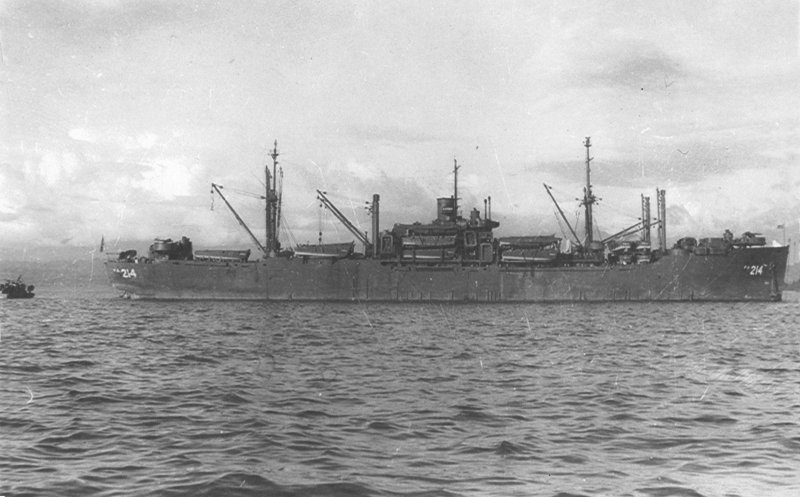
A county in Wyoming gave Natrona (APA-214) her name. Permanente Metals at Richmond laid the keel on 30 June 1944 under a Maritime Commission contract. Mrs. Anna Louise Spigler sponsored the 27 September launch. The Navy took the ship over and commissioned her on 8 November 1944, with Captain Eric E. Winquist in command.
Shakedown kept her off southern California. On 3 January 1945 she sailed for Hawaii with Transport Squadron 17. At Pearl Harbor the marines already aboard went off, and the 806th Engineering Battalion embarked with its gear. She was westbound again on 16 January, made Saipan by 1 February, emptied that load, and continued to Ulithi. Marine night fighters came aboard there for Leyte, where the work ahead was operation Iceberg, the attack on the Ryukyus.
Dulag dropped astern on 21 March. She was in TG 51.1, still carrying those fighters and the men and gear of the 77th Infantry Division. Before daylight on 26 March Kerama Retto was ahead. She stood into area Jig and at 0339 lowered nine boats that were to lead the waves. Transport Area Fox came next. At 0705 Japanese kamikazes appeared, her first meeting with that kind of attack. She moved into the inner transport area called George and began sending fuel and ammunition out by small craft. At 1951 she joined the night retirement. Through 30 March the days were for filling boats in George, and the nights were for hauling clear.
Okinawa itself was invaded on 1 April. The next day suicide aircraft, swimmers, and small boats kept the Kerama anchorage in a fight that ran thirteen hours. On 6 April that anchorage took its worst kamikaze blow, and her gunners claimed a plane with no other ship helping, the first kill she could count alone. Cargo for the 77th was clear on 7 April. On 8 April she crossed to the Hagushi beaches, put the marine night fighters ashore, went back to Kerama Retto, and brought General Bruce, the division's commanding officer, and his staff across to that same shore.
From 14 April to 10 July she stayed at the Kerama anchorage. The force used her as station ship and receiving ship, and as a fleet post office. ComDesRon 2 and ComRepDesPac kept headquarters on board. She also ran a replacement center, issued fog oil, and fed men whose own ships had been hit or sunk. Buckner Bay was the berth on 10 July. On 15 July she headed for home after sixteen weeks in those waters, with 208 air attacks on the tally. San Francisco took her in on 5 August.
She was still there when the fighting ended. On 20 August she started the first of two long Pacific crossings, moving replacements toward the front, carrying occupation troops to Japan, and bringing veterans back. The second crossing ended at San Pedro on 13 January 1946. Mare Island then overhauled her for layup. On 29 July she left commission and joined the reserve fleet at Stockton. That berth lasted until 1 October 1958, when her name was struck and the Maritime Administration accepted the hull. Suisun Bay held her afterward, in the National Defense Reserve Fleet. One battle star was entered for the war.