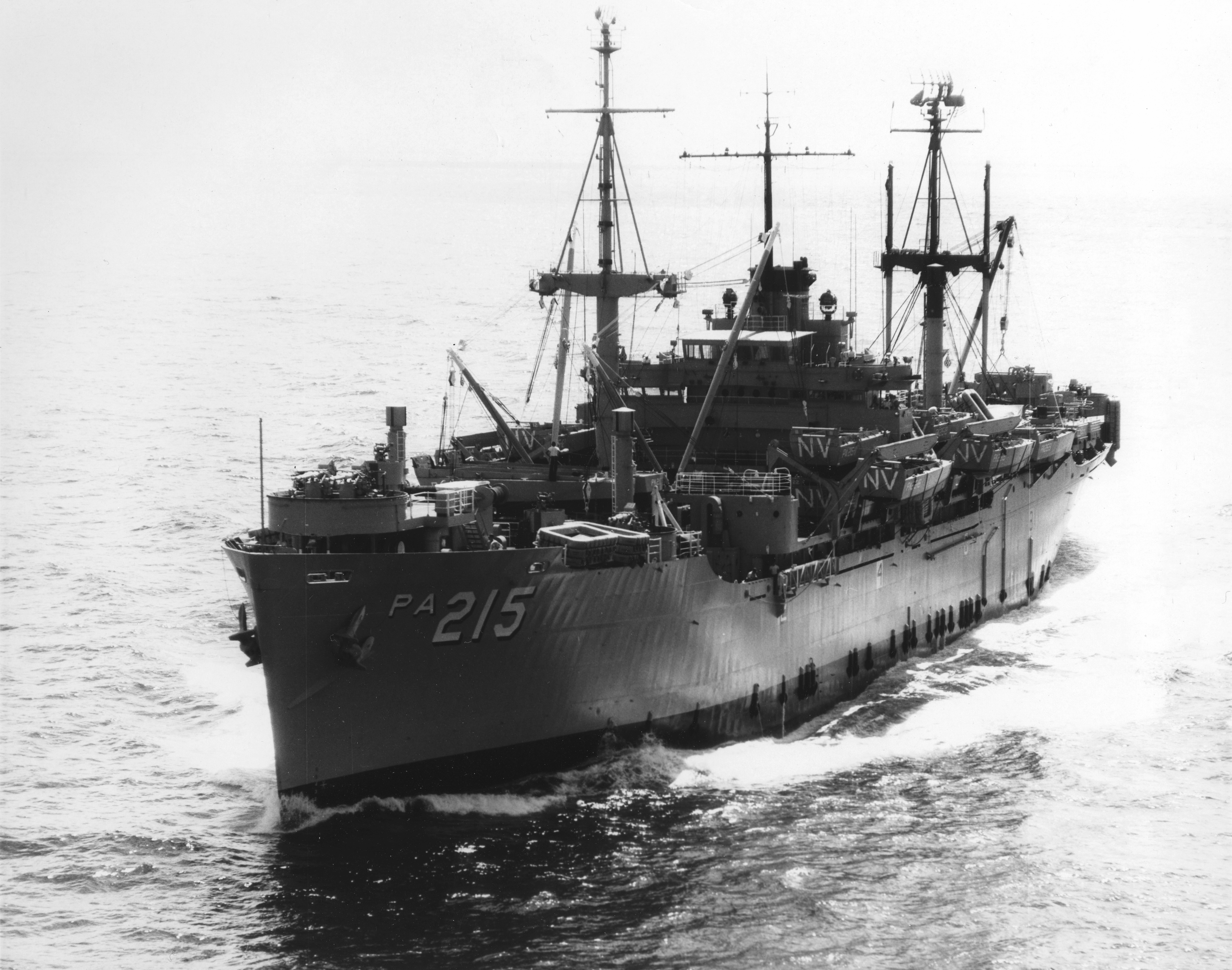
Northeast Texas supplied the county name for Navarro (APA-215). Permanente Metals at Richmond laid her down on 27 June 1944 as a Maritime Commission hull and launched her on 3 October, Mrs. Anne Jones sponsoring. Commissioning came on 15 November, Commander F.E. Angrick in command. She then moved to the Naval Supply Depot at San Francisco for stores, took ammunition aboard during a series of shifts around the bay, and was degaussed.
Shakedown started on 1 December with a twelve-day run to San Pedro. On 16 December a week of amphibious drills began at San Diego. On New Year's Day 1945 she headed for Seattle to load troops and equipment for the South Pacific. She sailed from Seattle on 12 January, called in Hawaii on 20 January, and reached Guadalcanal on 10 February, where that cargo and those troops went off. Sunlight Channel, in the Russell Islands, was the next anchorage. There she joined a hard rehearsal for the Okinawa attack.
She arrived off Okinawa on Easter Sunday 1945, the morning American forces invaded the island. Troops and cargo were off within the next two days, and the ship counted it record time. Screens and fighters were tight enough that, despite several air alerts, her gunners opened on hostile aircraft only three times. Once that week off the island ended, Guam was the next stop. On the morning of 12 April she left for the United States by way of Pearl Harbor and reached San Francisco on 30 May, then carried troops and equipment up to Seattle.
Seattle sailed her again on 21 June, bound for Ulithi by way of Eniwetok, but she went on to Okinawa and started unloading on 24 July amid repeated calls to general quarters. That July unloading was a later delivery, not the invasion-morning call. She then anchored in Ulithi lagoon and was still there when Japan surrendered. A planned trip home was dropped. She was sent to the Philippines instead and entered Leyte on 23 August. A few days later she sailed for Yokohama with occupation troops for that district. Magic Carpet followed, lifting American troops home. She decommissioned on 15 March 1946 and lay in reserve at Stockton. One battle star was credited for the war.
The Korean crisis brought her back. She recommissioned on 2 December 1950 with Captain R.E. Westbrook in command, passed the Panama Canal, and joined the Atlantic amphibious force. For four years she worked from Norfolk on Mediterranean and Caribbean cruises. From 1955 she was with the Pacific Fleet again and made regular Western Pacific deployments. The 1956 cruise included amphibious demonstrations at Chihae, Korea, for Korean Marines and midshipmen. In the summer of 1958 she supported atomic tests at Eniwetok. In 1960 she put 1,200 Marines onto Formosan beaches in a mock landing. While she was in Hawaii, plans for the 1st Battalion, 4th Marines changed because of Laos. A practice landing in California was cancelled, and sealed orders took those Marines to Okinawa.
In January 1962 she took part in large amphibious demonstrations for the President, then on 22 January left for seven months with the 7th Fleet. On 12 May, with Laos looking worse, the President sent a task force toward Indochina, and she carried part of the 1,800 Marines in that force. Valley Forge and Point Defiance were among the ships that reached the Gulf of Siam. Helicopters lifted the battalion landing team from the gulf to Bangkok to stiffen Thailand against a possible attack by Laotian Communists. She left Okinawa on 11 August and reached Long Beach on 25 August. Home from the 1964 Western Pacific cruise, she was modernized at San Francisco by Pacific Ship Repair. Silver Lance, off southern California, ran 25 February to 9 March 1965, and on 27 April she sailed west once more. Between 27 January and 16 February 1966 her boats and support went to 1,200 Marines landing in southern Quang Ngai during Double Eagle. Upward of a dozen ships and 5,000 Marines made that landing the biggest of its kind since the Korean fighting. Long Beach had her again on 16 March. Ten months and 27 days had passed off Vietnam with the 7th Fleet's landing force. The Secretary of the Navy awarded a Meritorious Unit Commendation for support rendered from 1 January through 23 March 1968. In November 1967 she helped pull Clarke County (LST-601) off the Vietnamese coast, working where enemy rifles and artillery could reach the crews. A typhoon also put the British freighter Habib Marikar aground, and forty-three of that crew were taken off. The grounding was on a reef well out in the South China Sea. Redesignated LPA-215 on 1 January 1969, she later left commission at San Diego. On 20 August 1970 the Maritime Administration laid her up in the Suisun Bay reserve.