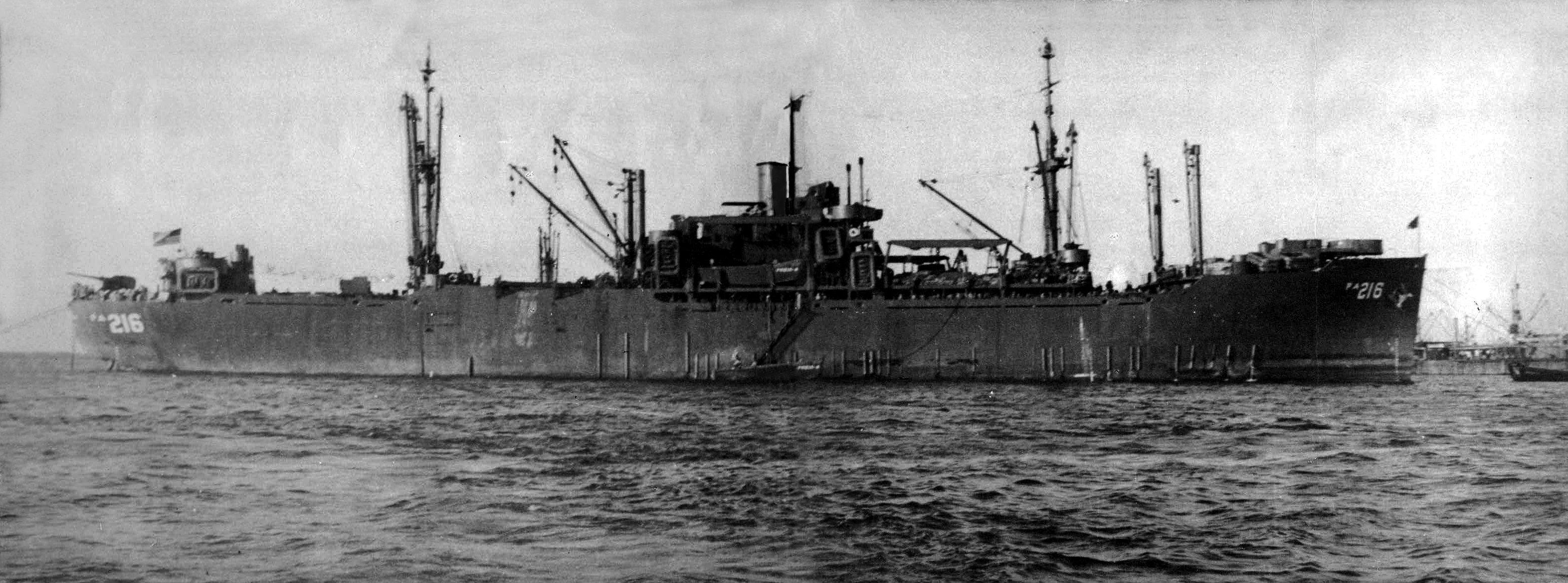
A Mississippi county is the namesake of Neshoba (APA-216). Permanente Metals at Richmond built her under a Maritime Commission contract. She went down the ways on 7 October 1944 with Mrs. Wendall E. Adams as sponsor. The Navy acquired her and commissioned her on 16 November 1944, Commander Martin J. Drury in command.
Shakedown was along the southern California shore. This Victory-type transport left San Francisco on 7 January 1945 for Pearl Harbor. Food already in her holds went off there, and SeaBees, troops, and materiel for the Philippines came aboard. She entered Leyte Gulf on 20 February, landed those passengers and their equipment at Guiuan on Samar, and moved into San Pedro Bay. On 2 March she became flagship of TransDiv 42 and started drills beside the 96th Infantry Division, getting ready for Iceberg and the Ryukyus landing.
On 27 March she cleared Leyte Gulf with TF 55, the Southern Attack Force, and steamed north. Hagushi was ahead before dawn on 1 April. At 0615 her boats dropped for six opening waves, sent against beaches White and Brown on the southern shore. H-hour followed at 0830. She stayed in the anchorage offshore, and cargo started over the side at 1653. For three days after that, unloading ran in daylight and the ship hauled out each night. Japanese resistance ashore was slight. On 5 April she headed east for Hawaii.
The track ran by Guam, where Japanese prisoners came aboard. Pearl Harbor received her on 22 April. The prisoners went off, and she trained off Maui. In mid-May orders sent her to San Francisco to embark a naval repair unit bound for Okinawa. She sailed on 7 June, was held at Guam for three weeks, and entered Buckner Bay on 24 July. Kamikaze attacks made this July defense much harder than the one she had seen on 1 April. She stayed only five days and left for Saipan on 29 July. Passengers boarded there for the United States. Seattle was the arrival on 24 August. While she was on that passage the fighting stopped, on 14 August.
Occupation duty came next. On 10 September she sailed with a detachment of the 97th Infantry Division and was in Tokyo Bay early in October. Task Group 16.12, the Magic Carpet lift, then used her to shuttle veterans home through March 1946. The next month she reported to the 19th Fleet to be laid up. Decommissioning at Stockton came on 4 December. The Pacific Reserve Fleet kept her until 4 September 1958, when the Maritime Administration took custody. She was struck on 1 October 1958. Into 1970 she remained at Suisun Bay with the National Defense Reserve Fleet. One battle star marked the war.