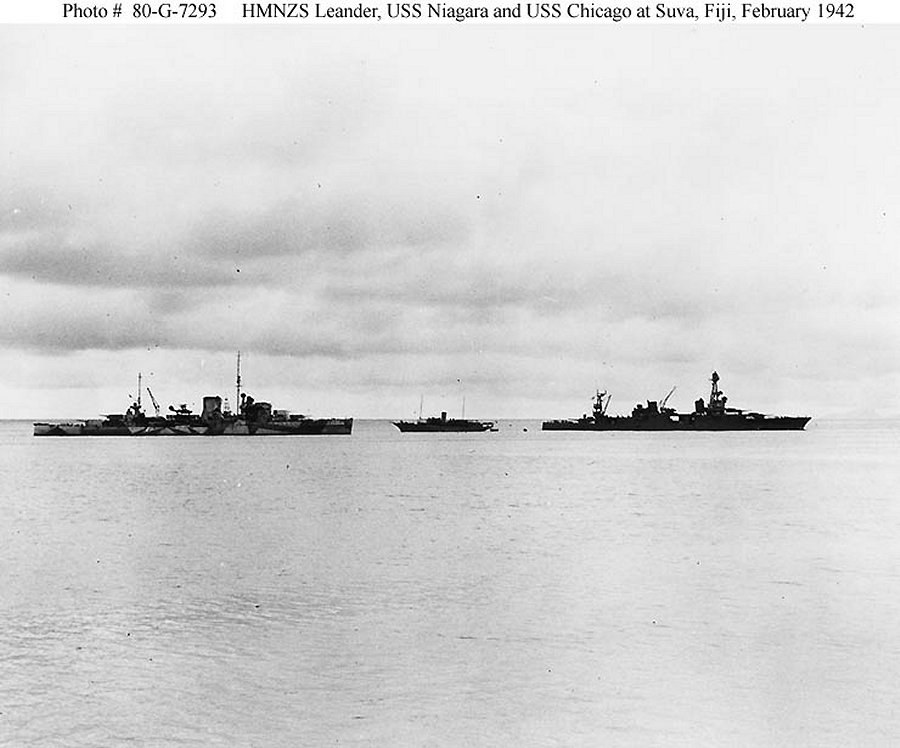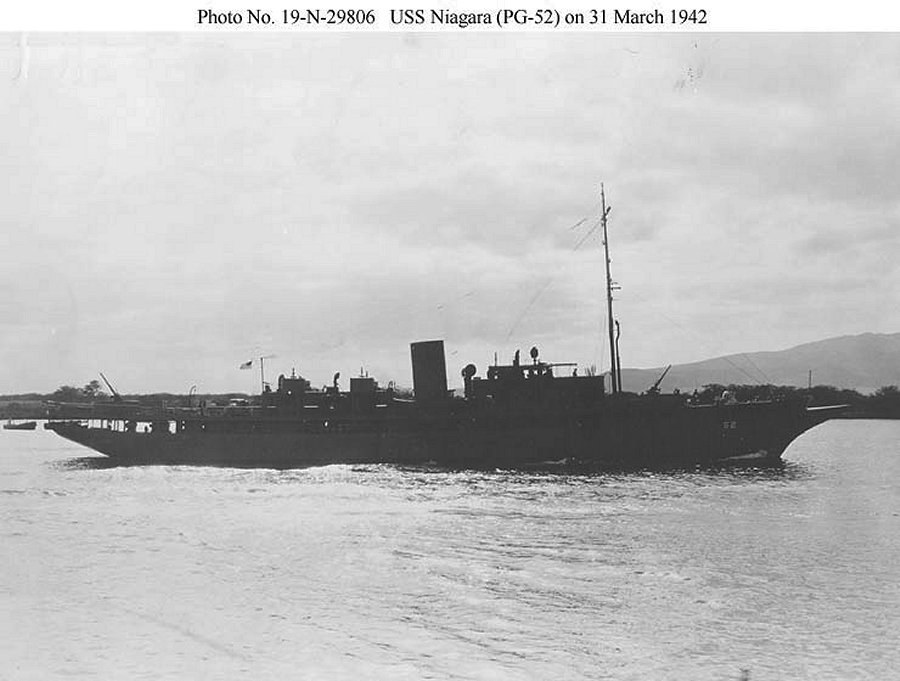
Niagara (PG-52) was the seventh ship of the name. Bath Iron Works of Bath, Maine, built her as the steel yacht Hi-Esmaro for Hiram Edward Manville, to a design by Henry Gielow. The yard laid her down on 14 November 1928, launched her on 7 June 1929, and delivered her on 20 August 1929. In July 1929 she collided with a tanker off Newport, Rhode Island, and went back to Bath for repairs. As a yacht she was about 1,062 tons light and 266 feet on the overall length. The Navy's later full-load figures were 1,922 tons, 267 feet, a beam of 35 feet 4 inches, and a draft of 17 feet, with a complement of 139 and two 3-inch guns.
The Navy bought her on 16 October 1940 from Mrs. H. Edward Manville of New York City and converted her to a gunboat at the New York Navy Yard. She was classified the coastal minelayer CMc-2 on 31 October 1940, renamed Niagara on 12 November 1940, and reclassified the patrol gunboat PG-52 on 15 November 1940. She was commissioned at New York on 20 January 1941. Lieutenant Edwin W. Herron was her first commanding officer.
On 4 February 1941 she left New York to tend boats of Motor Torpedo Boat Squadron 2 between Miami, Key West, and Guantanamo. She left Key West on 20 March for repairs at New York and spent the summer at the Naval Torpedo Station, Newport. On 30 August she stood out of New York for Hawaii by way of Guantanamo, the Panama Canal, and San Diego, and she arrived at Pearl Harbor on 9 October to patrol on the Hawaiian Sea Frontier. Herron was relieved on 27 November 1941. Lieutenant David Buncombe Coleman took command that day and had her until she was lost. On 29 November she sailed as part of the escort of a convoy bound for the Fiji Islands. She was at sea with that convoy when Japanese aircraft attacked Pearl Harbor. She returned to Pearl Harbor on 15 December and tended boats of Motor Torpedo Boat Squadron 1 until 1 April 1942. She then escorted a convoy to San Diego on the way to Coco Solo, in the Canal Zone, where she tended torpedo boats and helped guard the approaches to the canal.
In the summer of 1942 she was overhauled at the New York Navy Yard and fitted out as a school ship for a training squadron of motor torpedo boats at Newport. She headed for the Southwest Pacific on 27 November, by the Panama Canal and the Society Islands. On 13 January 1943, still on the way, she was reclassified as the Navy's first motor torpedo boat tender and redesignated AGP-1. She reached Noumea on 17 January and began tending Motor Torpedo Boat Division 23 of Squadron 8. She sailed with the division on 27 January and reached Tulagi on 17 February. Through the months after that she tended the boats that ran security patrols off Guadalcanal.
On 7 April 1943 the Japanese raided the Guadalcanal-Tulagi area with 177 planes. About 25 were shot down. Two bombs put the New Zealand corvette Moa down. Niagara was north of the harbor, moored to the west bank of the Maliali River, heading downstream, with the minesweeper Rail (AM-26) tied up outboard and well aft. Nine planes came up the river, none of them more than 150 feet above the water, and Niagara and Rail took them under fire. The first plane was already burning and crashed into trees about 1,000 yards astern of Niagara. The next two got away. The fourth lost altitude in a stream of white smoke and exploded behind the hills to the north. The next two passed within 150 yards and tried to strafe. Their fire was erratic. They wobbled as they went through the ships' fire and crashed into the woods off Niagara's port quarter. The last two sheared up and to the right when the guns found them. One trailed light brown smoke and disappeared close over the hilltops abaft the port beam. The other passed to starboard and crashed in the hills on the starboard quarter.
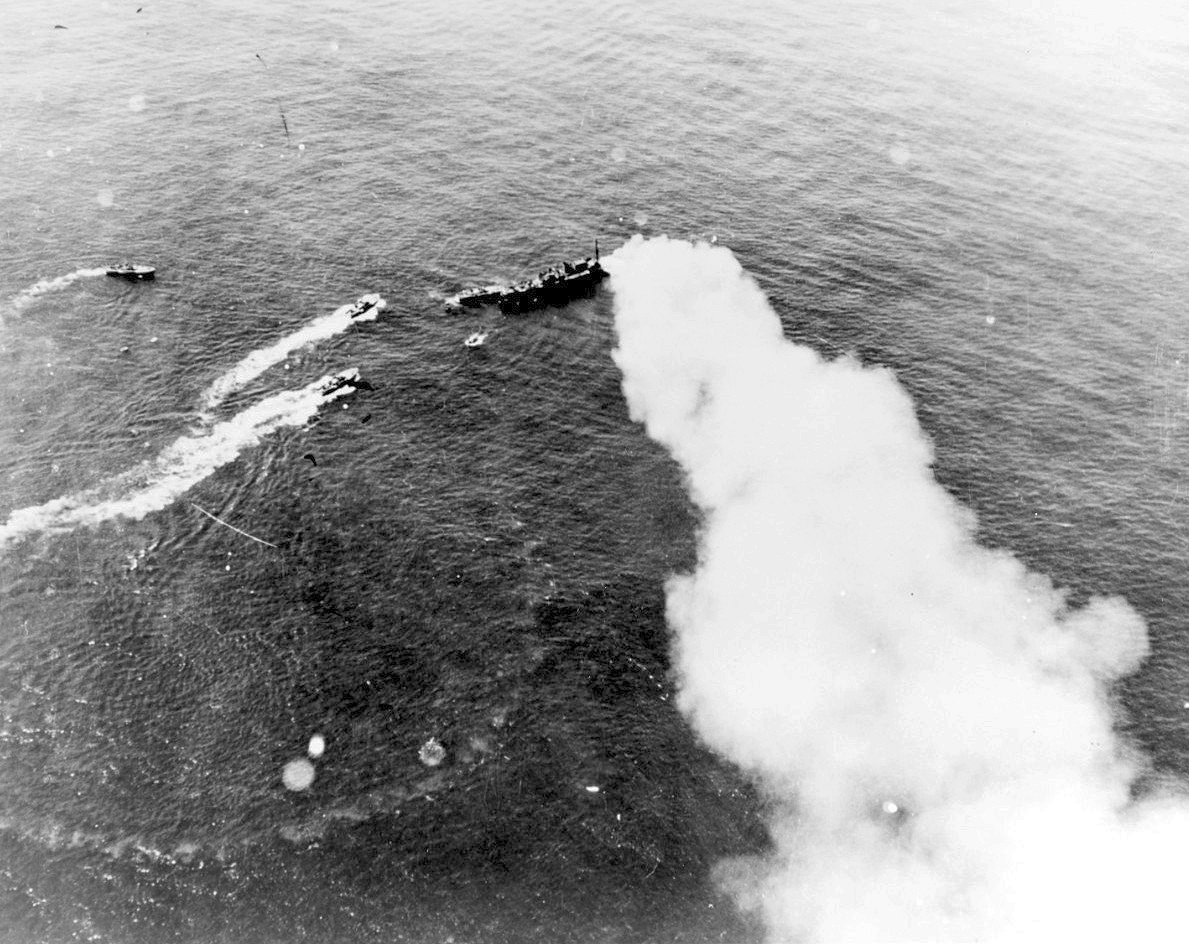
On 22 May Niagara and Motor Torpedo Boat Division 23 left Tulagi, headed toward New Guinea. The next morning, 23 May, one high-flying Japanese twin-engine plane dropped four bombs. She turned hard to starboard at full speed until the bombs were released, then swung hard to port. Three near misses to starboard and one to port damaged the sound gear and the training gear of one 3-inch gun, and steering was out for a time. Half an hour later, with steering back, six more twin-engine planes dropped a pattern of more than a dozen bombs. One hit the forecastle. Others were damaging near misses. Water came through a 14-inch hole six feet below the waterline and flooded two storerooms, a passageway, and the engine room. Power, lighting, and the main engines failed. Fire below decks forward got out of control, and she listed rapidly to port. Engines and steering were restored seven minutes after the attack. The list, and the gasoline tanks, made abandonment the order. PT-146 and PT-147 came alongside the stern and took off some of the crew. Others went over the side into rafts and boats and were picked up by other motor torpedo boats. She was then burning from bow to bridge. Flame was moving aft, and ammunition was going off on deck. None of the 136 officers and men was killed or seriously wounded. PT-147 fired a torpedo into the gasoline tanks. Flame went up about 300 feet, and she went down in less than a minute. The boats landed her crew at Tulagi early the next morning. She received one battle star. Coleman was in command when she was lost.
A note on sources. The wartime narrative is the Dictionary of American Naval Fighting Ships, volume V, page 80, read from a transcription that prints the ship's name as Niagra, the yacht as Hi-Esmare, the New Zealand corvette as Moe, and the river as Maliali. The yacht name in the story is Hi-Esmaro, from NavSource and from Stephen S. Roberts's ship card. The corvette is HMNZS Moa. Roberts's card gives Bath hull 123, the Gielow design, Hiram Edward Manville as owner, the July 1929 collision, delivery on 20 August 1929, a light displacement of 1,333 tons in Navy service, 3-inch/23 guns through April 1942 and 3-inch/50 guns from June 1942 with eight 20 mm guns from November 1942, a speed of 12.5 knots against the 16 knots of the Dictionary and of NavSource, the loss on 23 May 1943, and a strike date of 2 June 1943. NavSource's page header dates the loss 22 May 1943. The Dictionary, the photograph 80-G-68537, Roberts, and Coleman's relief date put the bombing and the loss on the morning of 23 May, after she had sailed on 22 May. The place is east of Cape Surville, San Cristobal, in the caption of 80-G-68537. The Dictionary does not name the battle star's campaign. Commanding officers are NavSource: Herron from commissioning to 27 November 1941, Coleman from that day to 23 May 1943. NavSource ranks both men lieutenant for the whole of each tour, records a Bronze Star for Coleman in 1943, and states that both retired as rear admirals. Herron was promoted to lieutenant commander on 1 August 1941, during the Niagara tour. A secondary account calls Coleman a lieutenant commander in May 1943. Coleman is called lieutenant here, the rank NavSource gives him. She was at sea with the Fiji convoy on 7 December 1941 and back at Pearl Harbor on 15 December. She reached Tulagi on 17 February 1943. The 7 April raid and the 23 May loss are in her Dictionary entry.