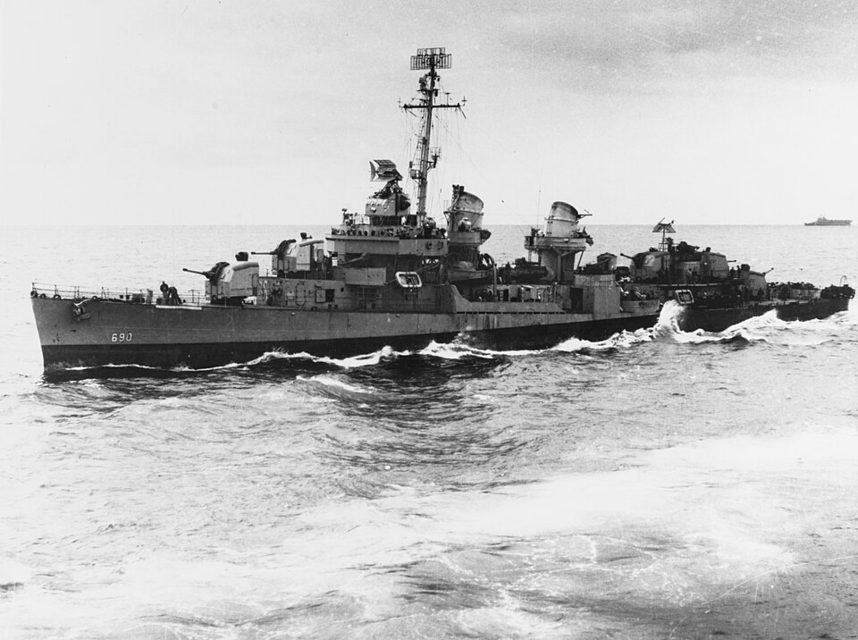
USS Norman Scott (DD-690) was a Fletcher-class destroyer of the United States Navy. She was named for Rear Admiral Norman Scott, who was killed in 1942 and awarded the Medal of Honor.
Her keel was laid on 26 April 1943. She was launched on 28 August 1943, sponsored by Mrs. Norman Scott, the admiral's widow. The ship was commissioned on 5 November 1943, and Seymour D. Owens became her captain that day.
On 14 January 1944 she left Boston escorting the cruiser Canberra and reached Pearl Harbor on 1 February. On 28 July she sailed for Pearl Harbor and the yard at Mare Island, where lasting repairs were finished on 21 October 1944. That October, RKO-Pathé filmed her for a This Is America short titled Navy Yard, about the time in the yard. She departed Mare Island the day the work ended, exercised in Hawaiian waters, and continued to Manus. Until 9 February 1945 she screened transports on the run from Manus to the Philippines, then served in the western Pacific with carrier forces of the Fifth Fleet and the Third Fleet. She afterward supported the occupation at the Yokosuka naval base, paused at Okinawa, and was at Tacoma, Washington, for Navy Day on 27 October.
Norman Scott survived the war. She worked from San Francisco until she was decommissioned on 30 April 1946 and laid up in reserve at San Diego. In 1947 that reserve berth moved to Mare Island. She was stricken on 15 April 1973 and sold for scrap on 3 December 1973.