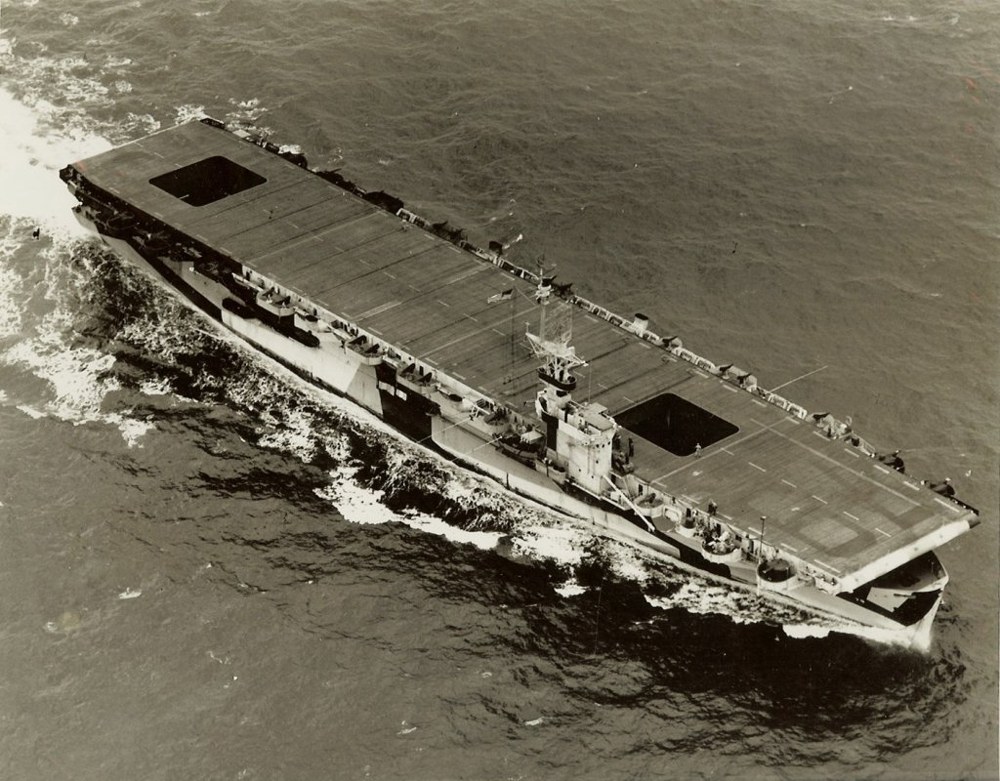
Ommaney Bay (CVE-79), formerly MC hull 1116, was laid down under a Maritime Commission contract 6 October 1943 by Kaiser Company, Inc., Vancouver, Washington; launched 29 December 1943, sponsored by Mrs. P.K. Robottom; acquired by the Navy 11 February 1944; and commissioned the same day, Captain Howard L. Young in command.
After commissioning and fitting out at Astoria, Oregon, and conducting shakedown in Puget Sound, Ommaney Bay sailed 19 March from Oakland, California, with passengers and a cargo of supplies and aircraft for Brisbane, Australia. By 27 April, she had completed her mission and was back in San Diego, where she began a rigorous ten days of carrier qualification landings, drills and tests. Then, after minor alterations and repairs, the ship sailed 10 June for Pearl Harbor. Until 12 August she trained air groups and squadrons there in the art of operating from baby flattops, then she sailed to Tulagi to rehearse for the invasion of the Palau Islands. From 11 September until the beginning of October, Ommaney Bay stood off Peleliu and Anguar Islands and provided air cover for the fleet and close support strikes for the forces ashore.
Ommaney Bay sailed to Manus to renew her depleted stock of fuel and ammunition, then joined Rear Admiral Stump's "Taffy 2" for the invasion of Leyte. At the beginning of the Battle off Samar on 25 October, the escort carriers began launching air strikes in an effort to cripple as many of the approaching enemy force as possible. In the ensuing battle, Ommaney Bay's planes contributed the sinking of one Japanese cruiser and helped to damage a number of other warships. Ommaney Bay launched some 6 strikes that day, and helped to turn threatened defeat into victory.
The carrier spent the month of November at Manus and Kossol Passage for availability and replenishment, then, from 12 to 17 December, operated in the Mindanao and Sulu Seas in support of operations on the island of Mindoro. On the 15th, a day of heavy enemy air attacks, she splashed an enemy bomber as it dived for the ship from the port bow. On 19 December, she returned to Kossol Passage to prepare for the landings in Lingayen Gulf.
Ommaney Bay left on New Year's Day 1945 and transited Surigao Strait 2 days later. The next afternoon, while in the Sulu Sea, a twin-engine Japanese suicide plane penetrated the screen undetected and made for Ommaney Bay. The plane nicked her island, then crashed her starboard side. Two bombs were released, one of them penetrated the flight deck and detonated below, setting off a series of explosions among the fully-gassed planes on the forward third of the hanger deck. The second bomb passed through the hanger deck, ruptured the fire main on the second deck, and exploded near the starboard side.
Water pressure forward was lost immediately, along with power and bridge communications. Men struggling with the terrific blazes on the hangar deck soon had to abandon it because of the heavy black smoke from the burning planes and ricocheting .50 caliber ammunition. Escorts could not lend their power to the fight because of the exploding ammunition and intense heat from the fires. By 1750, the entire topside area had become untenable, and the stored torpedo warheads threatened to go off at any time. The order to abandon ship was given.
At 1945, the veteran was sunk by a torpedo from the destroyer Burns (DD-588). A total of 95 Navy men were lost, including 2 killed on an assisting destroyer when torpedo warheads on the carrier's hangar deck finally went off.
Ommaney Bay received 2 battle stars for World War II service.
Her wartime commanding officers, from NavSource: Captain Howard Leyland Young, 11 February 1944 to 4 January 1945.
Sources: Dictionary of American Naval Fighting Ships (DANFS), Wikipedia, NavSource Online (commanding officers) and Wikimedia Commons (photograph records).