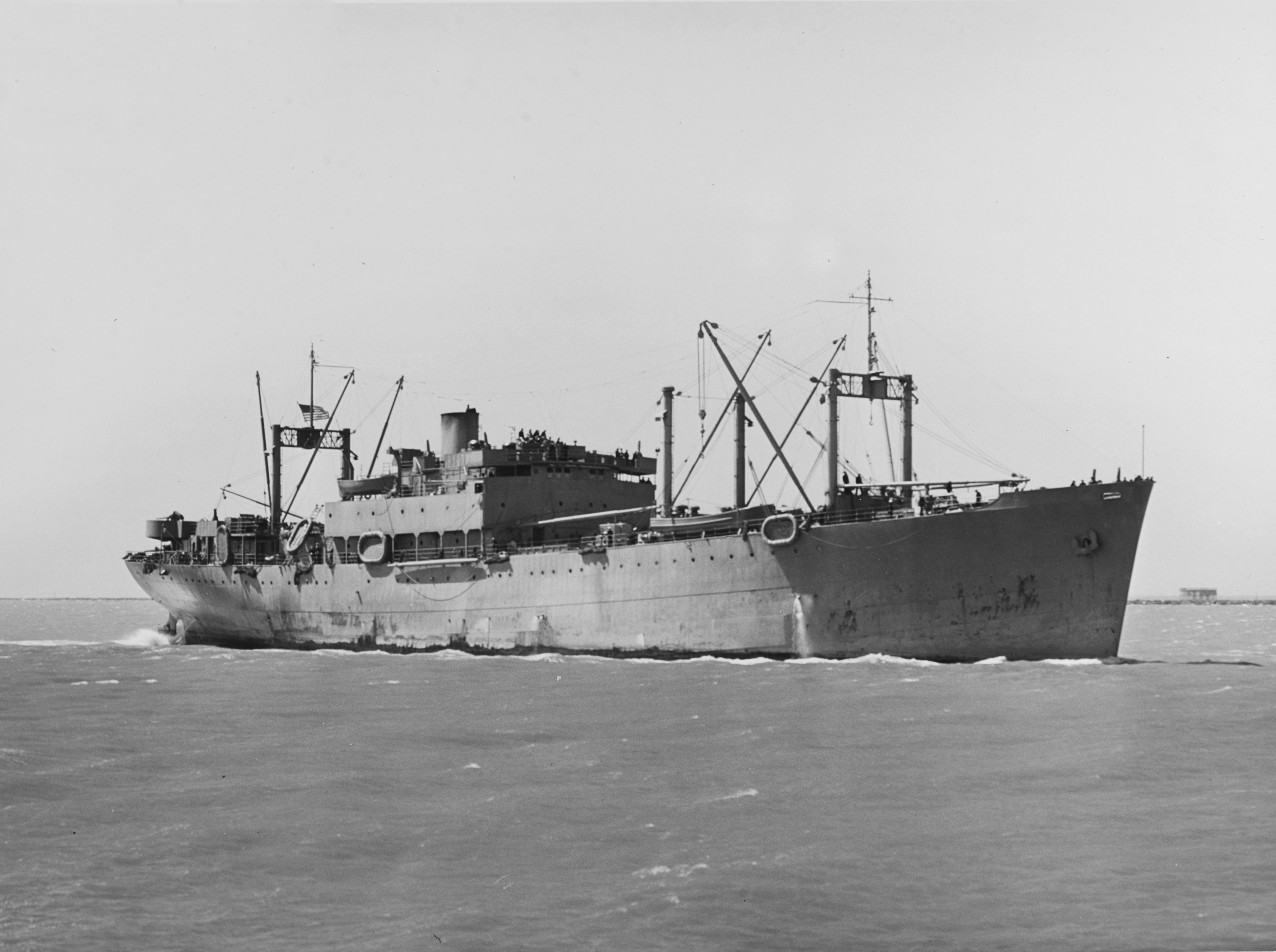
Otus (AS-20) was a submarine tender, built on a Maritime Commission C1-B hull. Federal Shipbuilding and Drydock at Kearny, New Jersey, laid her down on 3 June 1940. She was launched on 2 November 1940 as the freighter Fred Morris. Mrs. Fred Allain Morris sponsored her. The Navy took her over on 1 March 1941 and commissioned her on 19 March 1941, with Commander Joel Newsom in command.
She was 417 feet 9 inches long, with a beam of 60 feet and a draft of 20 feet 2 inches. She was given as 3,600 tons, with a speed of 15 knots, a complement of 644, and a battery of one 5-inch gun and four 3-inch guns. On 25 June 1945 she was reclassified ARG-20, a repair ship for internal-combustion engines.
She went out to the Asiatic Fleet as a submarine tender. On 7 December 1941 she lay at anchor in Mariveles Harbor. On 10 December, during the air raid on the Cavite Navy Yard, bombs fell near her starboard side and damaged her slightly. Admiral Hart, who did not want to lose one of the few tenders he had, ordered her out of the Philippines that day. She reached Port Darwin on 28 December and stayed through January 1942. She had no shop facilities of the kind Canopus and Holland carried.
In February and the first part of March 1942 she went to Java and to Trincomalee, in Ceylon, and she was back in Australia on 10 March. She tended submarines at Fremantle until she left for the United States on 25 July. She reached the Mare Island Navy Yard on 24 August and remained in overhaul until 23 January 1943. After a short stop at Pearl Harbor she returned to Australia on 22 February and moved from port to port until 1 September.
From September 1943 until December 1944 she worked at four places in New Guinea, tending escorts, mine craft, amphibious ships, and submarines. She left Hollandia Bay on 25 December 1944 and reached San Pedro Bay, in Leyte Gulf, on 6 January 1945. There she did routine upkeep and emergency repairs for ships of the Southwest Pacific. She left San Pedro Bay on 1 December 1945 and reached Portland, Oregon, on 2 January 1946. She helped take other ships out of commission at Portland and at Astoria until 29 June 1946, then went to Seattle for her own inactivation. She was decommissioned on 20 August 1946 and struck on 25 September 1946. She earned one battle star.
A note on sources. The career, the 3,600-ton figures, the sponsor, the acquisition on 1 March 1941, Mariveles on 7 December 1941, and the slight damage on 10 December are the Dictionary of American Naval Fighting Ships. That history says she was sold the day after she was decommissioned, and it also says that in 1970 she was berthed at Olympia, Washington, in the National Defense Reserve Fleet. NavSource dates the acquisition 21 December 1940, puts her at the Cavite Navy Yard when the war opened, and dates the Philippine Islands operation from 8 to 28 December 1941. NavSource gives 2,930 tons on trial and 9,225 tons at a limiting draft of 20 feet 6 inches, 14.7 knots on trial, 45 officers and 599 men, and one 5-inch 38-caliber gun with four 3-inch 50-caliber guns. NavSource lays her up at Olympia on 21 August 1946 and sells her for scrap on 2 November 1970 to Zidell Explorations of Portland. Both endings are left as dated. NavSource names Lieutenant Commander John Renwick Hume between two tours of Joel Newsom. uboat.net gives Newsom one span, 19 March 1941 to 27 September 1943, and does not name Hume. The combat narrative calls her commanding officer in December Commander Joel Newsom, which fits the second of the two tours, and it is the narrative that says she had no shop facilities. The class name Otus, the C1-B hull, and Maritime Commission hull 70 are NavSource. The Dictionary does not name a class.