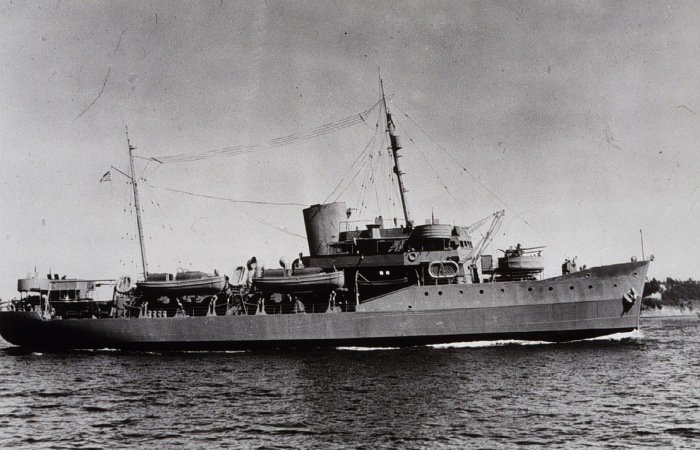
Pathfinder (AGS-1) was a survey ship. The Coast and Geodetic Survey ordered her from the Lake Washington Shipyard. The Navy commissioned her and sent her to sound the anchorages the fleet was about to use. She is not the survey ship of 1898 that carried the same name, and she is not the later oceanographic ship T-AGS-60.
A ship card dates the order 25 September 1940 and the keel 20 February 1941. The launch is given as January 1942. One account names 11 January 1942 and Eleanor Roosevelt Boettiger as sponsor. The Navy commissioned her on 31 August 1942. Captain Bascom H. Thomas, of the Naval Reserve, was in command. The Dictionary's line that she was built in 1929 is the older ship of the name.
She was fitted to put sounding boats in the water. The Dictionary gives 2,175 tons, a length of 229 feet 4 inches, a beam of 39 feet, a draft of 16 feet, 14 knots, a complement of 158, two 3-inch guns, two depth-charge tracks, and two projectors. A ship card gives 1,422 tons light and 2,175 at the maximum, four 30-foot diesel sounding launches, two 24-foot whaleboats, and several 16-foot skiffs. She reached Funafuti on 26 December 1942.
On 2 February 1943 she sailed as escort for a resupply of Guadalcanal. On 7 April she was on the Guadalcanal side of the sound, with five boats sounding in Lunga Roads, off Berande Point, when the raid of Operation I-Go came over. Thomas had her. She left the boats, and about a quarter of the crew with them, and went to flank speed. Her gunners claimed two dive bombers. Near misses damaged the rudder. The boats took wounded men off the destroyer Aaron Ward (DD-483), which went down that evening. The men were landed the next morning, and the survey resumed at 0700 on 8 April. Admiral Nimitz commended her. She worked under air attack for a long stretch of the Solomons campaign. Two battle stars are recorded: the southern Solomons on 7 April 1943, and Okinawa Gunto from 1 May to 30 June 1945. The Okinawa star does not place her in a named action on the landing day.
A book of recollections by the men who surveyed from her says she left the San Francisco yard on 18 December 1944 under Commander Francis L. DuBois, of the Naval Reserve, and also that Thomas was relieved by DuBois on 16 January 1945. The command filed here starts DuBois on 16 January. She left Yokosuka on 5 December 1945, Pearl Harbor on 16 December, and Seattle on 24 December. She was decommissioned on 31 January 1946, turned over to the Commerce Department on 22 August 1946, and returned to the Coast and Geodetic Survey on 1 October 1946 as the survey ship OSS-30. One card says she was recommissioned in the Survey on 23 August 1946. She was struck from the Navy list on 13 November 1946. She was laid up in 1971. One date is about 10 September and another is 23 December. She was scrapped by General Auto Wrecking at Ballard, Washington, in 1972. A ship card dates the sale 9 August 1972.
A note on sources. The 7 April action is the Dictionary of American Naval Fighting Ships, read against the harbor paragraph in Morison and against the recollections published by Hydro International. Morison puts five of her boats in Lunga Roads. The Dictionary says her gunners bagged two dive bombers. A Nimitz letter says two were shot down while she maneuvered close aboard Aaron Ward. The recollections add two aircraft assisted, two near misses, and a rudder repair, and they name the boats' work with the destroyer's wounded. Those men include William Gibson, Junius Jarman, and the boat officers. Harry A. Mason was executive officer. None of them is filed as commanding officer. Thomas's own report covers service through 22 September 1944. The December 1944 and 16 January 1945 sentences are both in the recollections, and both are kept. The 1929 build date in the Dictionary, and a wrecks page that calls her a Coast Guard hull, are the wrong ship. Shipscribe is the hull card used for the order, the keel, the light displacement, and the boats. The photograph is NOAA library theb2941, captioned shortly after launching, in Washington state, before the Pacific. It is this hull, not T-AGS-60.