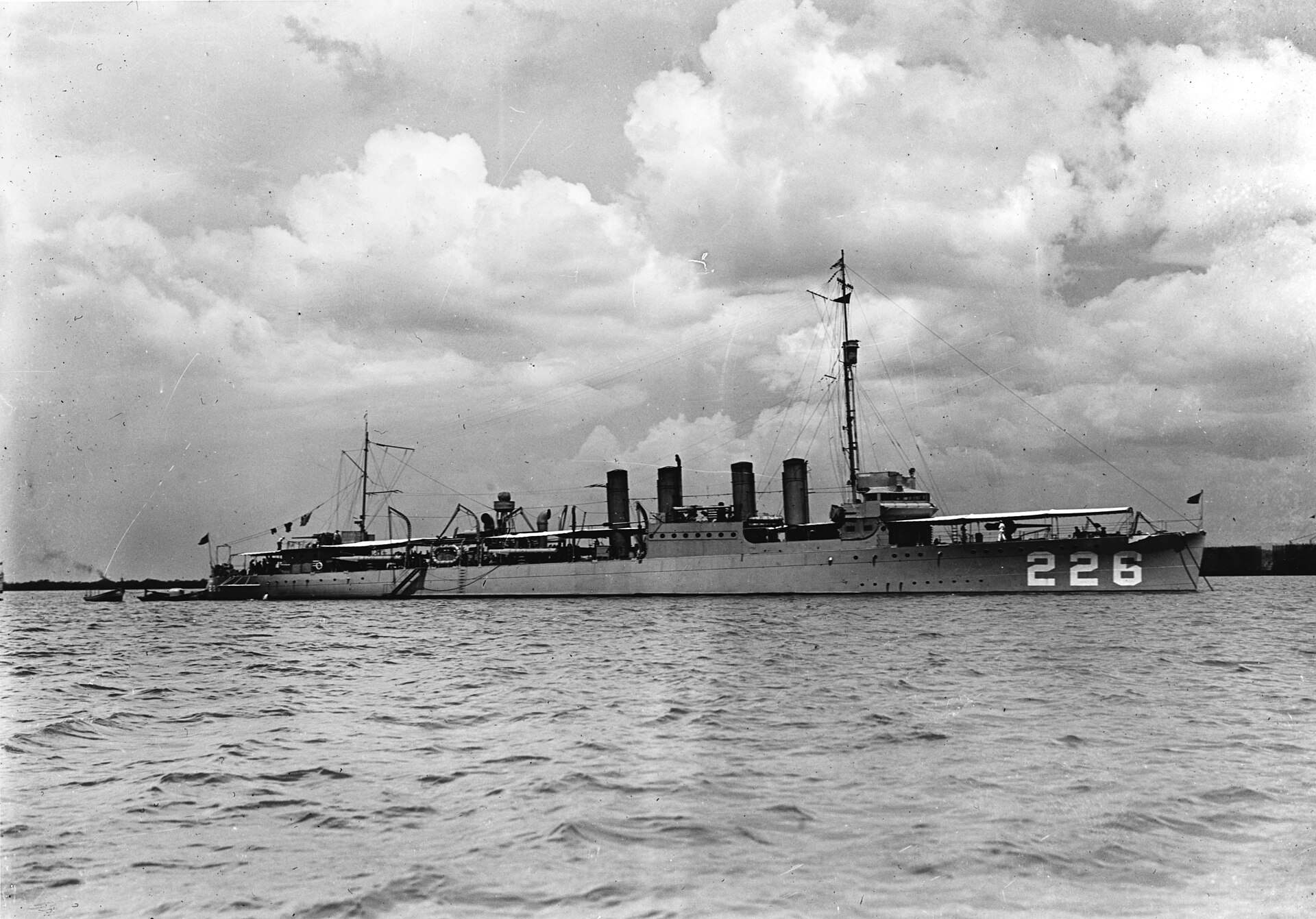
Peary was a Clemson-class destroyer, DD-226, named for Rear Admiral Robert Edwin Peary. William Cramp and Sons laid her down at Philadelphia on 9 September 1919, launched her on 6 April 1920, and commissioned her on 22 October 1920. Mrs. Edward Stafford, Peary's daughter, sponsored the launch. She went out to the Asiatic Fleet in 1922 and stayed with that fleet.
On the night of 16 October 1939, in exercises in Manila Bay, she collided with Pillsbury. Both ships came out of it.
She was in overhaul at Cavite when the war opened. On 10 December 1941 Japanese aircraft bombed the yard. Lieutenant Commander Harry H. Keith was wounded and was relieved. Lieutenant John Michael Bermingham took the ship. Further air attacks came on 26, 27, and 28 December. Off Kema, in the Celebes, Hudsons of 2 Squadron, Royal Australian Air Force, attacked her in error. She reached Darwin.
On 15 February 1942 she sailed with Houston and a convoy bound for Timor. Aircraft found them. The convoy turned back. She returned to Darwin to take fuel.
On the morning of 19 February the carrier force that had struck Pearl Harbor bombed Darwin. The aircraft came from Akagi, Kaga, Hiryu, and Soryu. The sinking is not credited to one of them. About five bombs found her. One hit the fantail. An incendiary hit the galley deckhouse. One did not explode. A hit forward set off the magazines. Another reached the after engine room. She went down by the stern around 1300, and her machine guns were still firing as she sank. Bermingham was lost with her. Lieutenant W. J. Catlett was ashore and wrote the report.
The counts of her dead do not agree. One Navy history says 80 killed and 13 wounded. Another account says 93 lost and 49 rescued. An Australian account says 91 killed and 52 survived. She was struck on 8 May 1942. She received one battle star, for the Asiatic Fleet from 8 December 1941 to the morning she was lost.