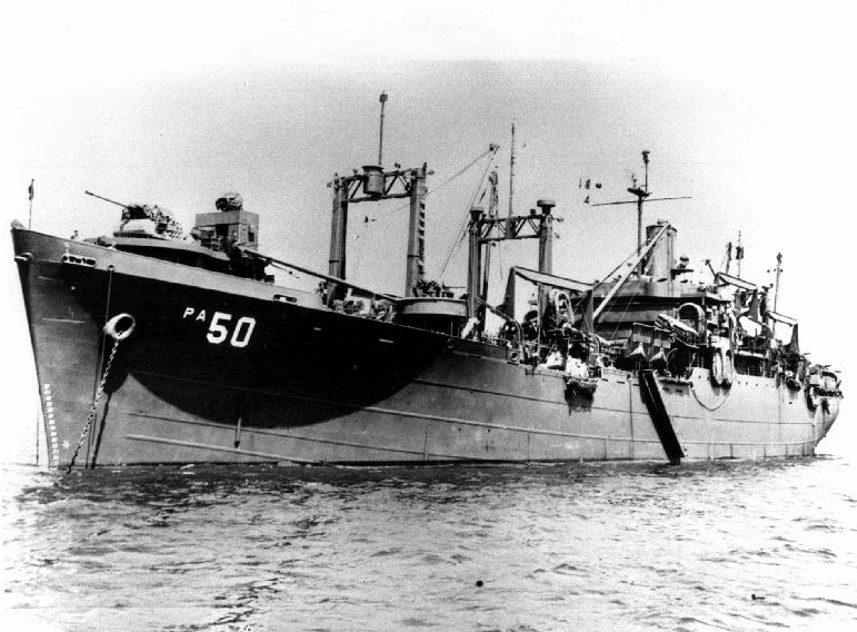
Pierce, APA-50, was an Ormsby-class attack transport. Moore Dry Dock at Oakland laid her down on 22 July 1942 as the merchant ship Northern Light, a C2 hull, Maritime Commission hull 289. She was assigned to the Navy as the transport Pierce (AP-95), launched on 10 October 1942, became APA-50 on 1 February 1943, and was commissioned on 30 June 1943, Commander Arthur R. Ponto in command.
She made her first assault landing at the west end of Makin on 20 November 1943. On the morning of 24 November she was nearby when the escort carrier Liscome Bay was torpedoed. She trained some 4,000 Army and Marine troops off Maui, then sailed on 22 January 1944 with the 7th Infantry Division for Kwajalein. On the night of 3 February she sent five boats under fire to one of the smaller islands to take off about 150 Army troops trapped by the enemy. She left on 8 February. DANFS places her in a Transport Division 18 formation in the Marshalls, while NavSource lists Transport Division 37, so the division is given differently in the two sources.
At Saipan on 15 June 1944 she landed troops near Charan Kanoa, took on 249 casualties in under three hours, and fired 48 rounds of 5-inch at two mortar positions. She made a feint against Babelthuap on 15 September and landed troops at Angaur two days later. She reached Leyte on 20 October with the 1st Cavalry Division and took part in the Lingayen landings on 9 January 1945, where NavSource records two killed. She was at Okinawa from 1 to 5 April 1945.
She was decommissioned at Mobile on 11 March 1946, struck on 17 April 1946, and returned to the Maritime Commission on 2 May 1946. She went into commercial service in 1947, was bought for scrapping by National Metal and Steel on 3 March 1969, and was scrapped at Terminal Island in May 1969. She earned eight battle stars.