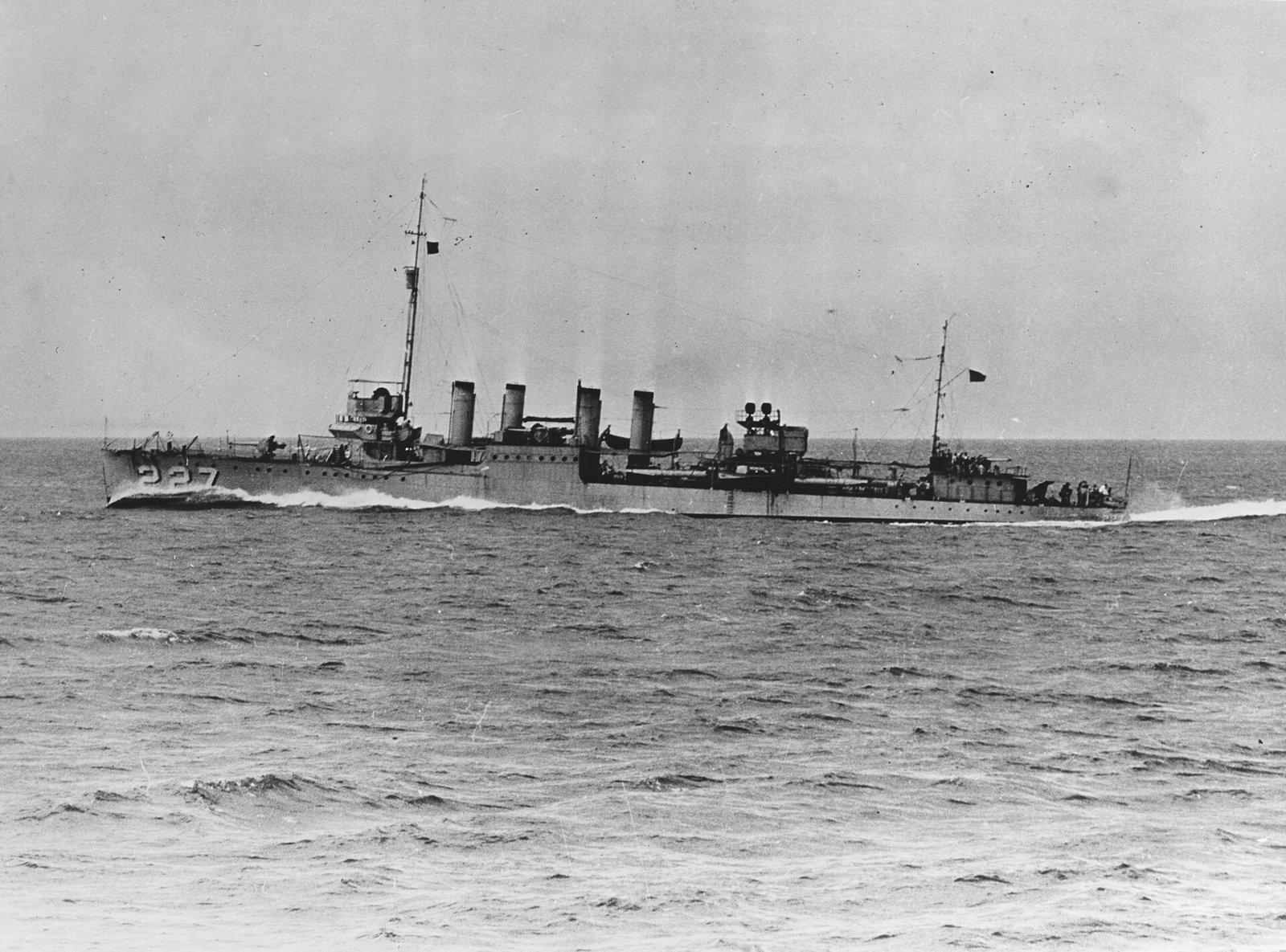
Pillsbury was a Clemson-class destroyer, DD-227, the first ship of the name. She was named for Rear Admiral John Elliott Pillsbury, born in Lowell, Massachusetts, on 15 December 1846. He commanded the survey steamer Blake from 1884 to 1891 and worked on the Gulf Stream with instruments of his own making. In the Spanish-American War he had the dynamite cruiser Vesuvius off Cuba. In 1905 he was Chief of Staff of the North Atlantic Fleet, and in 1908 and 1909 he was Chief of the Bureau of Navigation. He died on 30 December 1919, president of the National Geographic Society. William Cramp and Sons of Philadelphia had laid her down on 23 October 1919, while he was still living. Miss Helen Langdon Richardson sponsored the launch on 3 August 1920. The navy commissioned her on 15 December 1920, with Lieutenant H. W. Barnes in command.
She spent her peacetime years with the Asiatic Fleet. On 27 November 1941, on the order of Admiral Thomas C. Hart, she left Manila with other ships of that fleet. She was near Borneo when the Japanese attacked Pearl Harbor. She then worked out of Balikpapan with American, Dutch, and Australian ships, on reconnaissance and anti-submarine patrol, and from Surabaya she made night patrols with Houston and Marblehead and the destroyers of Division 58.
Harold Clay Pound had her from 31 July 1940. On the night of 19–20 February 1942 she was in the second Allied wave in Badung Strait, with Tromp, Stewart, Parrott, and John D. Edwards. The Japanese had been putting troops ashore on Bali. She fired three torpedoes at a Japanese ship. None hit. A searchlight found her and shots were fired at her. She turned to starboard, made smoke, and got out of the light. She was not sunk there.
At 0210 she sighted a ship dead ahead and opened fire. Her spotters reported hits on the bridge, amidships, and the fantail, and they reported that the Japanese destroyer caught fire and stopped shooting. One shell that turned that destroyer is also given to the destroyer in the other column. That damage is not credited to one ship. She and Parrott were sent on to Tjilatjap. The ships were short of torpedoes and needed overhaul.
No American log or battle report of her last fight survived. She was lost with every man aboard, south of Java. The night is given as 1 March and as 2 March. An interrogation of Japanese officers said three cruisers of Cruiser Division 4 and two destroyers of Destroyer Squadron 4 sank her by combined fire, and placed the action in Bali Strait. The same account put the loss about 200 miles east of Christmas Island, south of Java. Bali Strait is not that place. A later reading of the Japanese reports names Atago and Takao on the night of 2 March, and says they took her for a light cruiser. No survivors were recovered. The loss is not credited to one ship. Pound was lost with her. She received two battle stars.
A later destroyer escort, hull DE-133, carried the same name. She is not this hull. She stayed in the Atlantic and escorted the escort carrier Guadalcanal, CVE-60. That carrier was named for the island. Her work with this escort was on the Atlantic hunter-killer routes. On 4 June 1944 her boarding party captured the German submarine U-505, the first enemy warship taken at sea by the United States Navy since the War of 1812, and U-505 is a museum ship in Chicago today, at the Griffin Museum of Science and Industry.