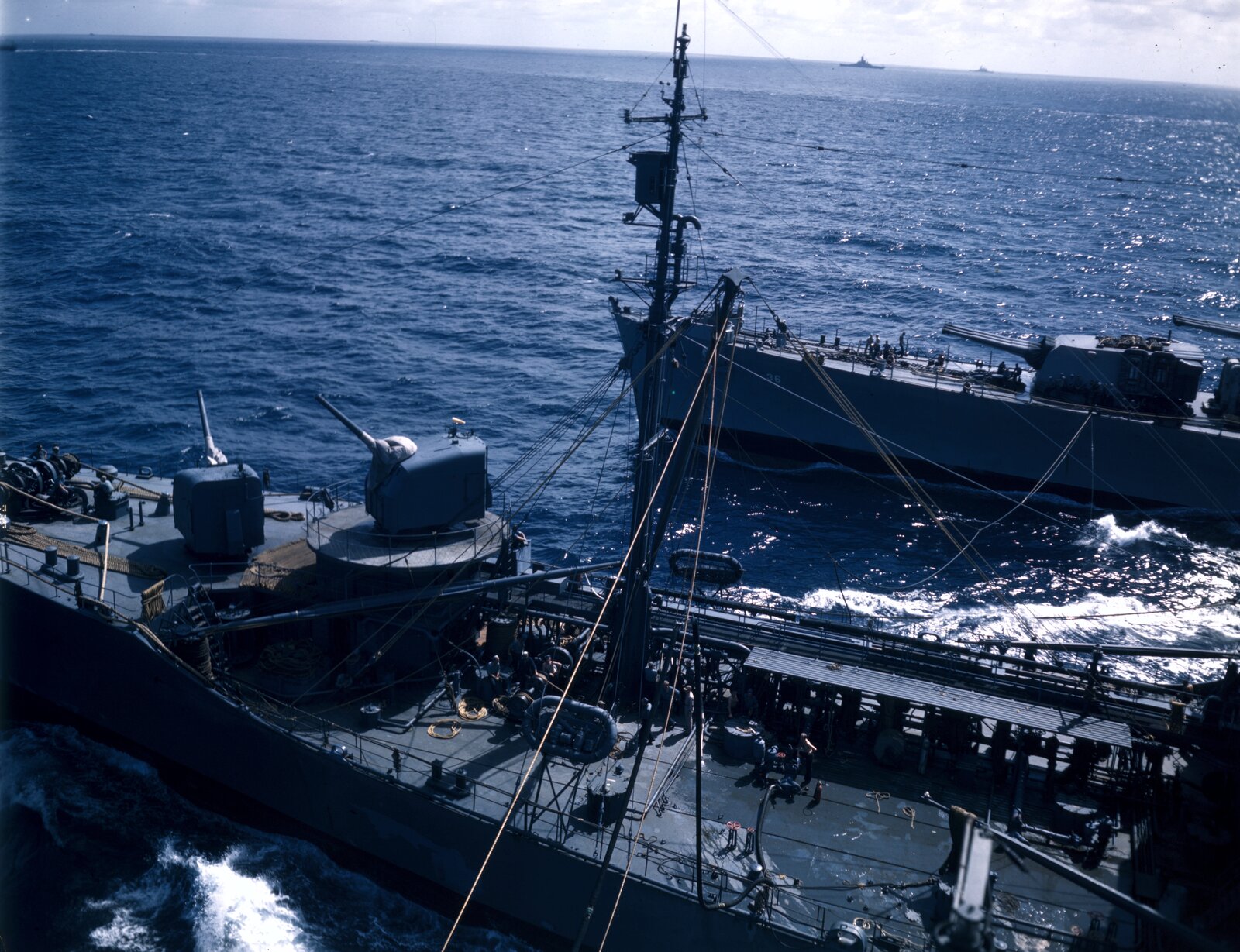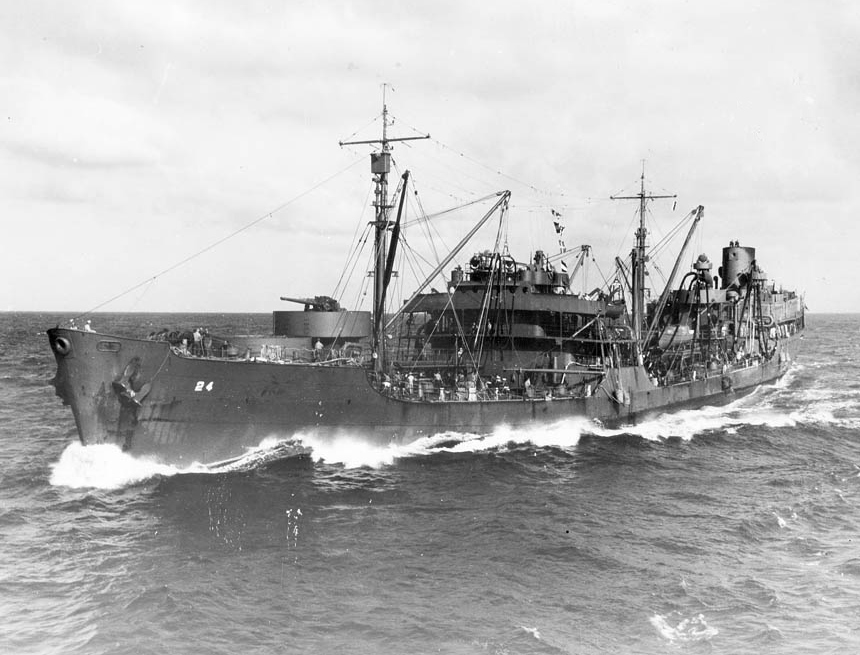
Platte, AO-24, was named for a river in Nebraska. She was a Cimarron-class fleet oiler, built as a Maritime Commission T3-S2-A1 tanker, hull 8, by the Bethlehem Steel Company at Baltimore for the Standard Oil Company of New Jersey. She was launched on 8 July 1939. Mrs. Harold R. Stark was her sponsor. The Navy commissioned her at Norfolk on 1 December 1939, with Commander Pal Lamar Meadows, Naval Academy class of 1918, in command. She displaced 7,470 tons light and 25,440 fully loaded, on a length of 553 feet and a beam of 75 feet. Her draft was 32 feet 4 inches, her speed 18 knots, and her complement 276. She carried four 5-inch guns. Twin 40-millimeter mounts were added during the war.
After fitting out at the Philadelphia Navy Yard she left Norfolk on 27 March 1940, made two voyages to the oil docks at Houston, and supported the fleet operating from the Panama Canal Zone. Over the next forty-five days she replenished the fleet tugs Capella and Navajo while they towed the floating drydock YFD-2 to Pearl Harbor. She reached her new base at San Pedro on 4 September 1940. For the next fourteen months she carried liquid cargo, passengers, and freight to Pearl Harbor. Her last voyage to Hawaii before the war ended at San Diego on 26 November 1941. She was in that port when the Japanese attacked Pearl Harbor.
Captain Ralph Harold Henkle, Naval Academy class of 1918, had relieved Meadows on 9 November 1940. On 17 December 1941 Platte put to sea with a convoy for Pearl Harbor. On 11 January 1942 she was underway with Enterprise, flagship of Admiral William F. Halsey, Jr., commander of Task Force 8, and she refueled that force while it guarded the lanes for the ships reinforcing Samoa. Through the months that followed she refueled task forces on offensive patrol in the Coral Sea. She fueled the Australian Squadron and the Lexington and Yorktown carrier task forces before the strikes on Salamaua and Lae. On 28 May she stood out with Enterprise as the fleet prepared for Midway, and she fueled the Enterprise task force and the Yorktown task force just before the battle.
She then supported the Solomon operations. For the Guadalcanal and Tulagi landings of 7 August 1942, Samuel Eliot Morison's task organization places her in the Fueling Group of Task Force 61, with Cimarron, Kaskaskia, Sabine, and Kanawha. Captain Henkle is named as her commanding officer. The Office of Naval Intelligence combat narrative of the landing lists the same five oilers and the same officer. On the morning of 10 August she was in the ocean approaches to the Solomons, delivering fuel to the Enterprise carrier task group, and two days later she fueled the Saratoga group. She returned to Noumea on 14 August and filled her cargo tanks from chartered tankers. She subsequently fueled the Saratoga, Wasp, and Enterprise carrier task groups. A photograph shows her coming alongside Wasp on 24 August 1942, the hull number 24 on the bow. After a return to the West Coast she resumed support of the ships engaged for Guadalcanal and the other Solomon islands. Henkle was relieved on 17 December 1942.
Commander Harry Keeler, Jr., Naval Academy class of 1922, had her from that day until 30 August 1943. On 9 April 1943 she left San Pedro for the campaign to retake the western Aleutians and served as station tanker in Kulak Bay, at Adak. Several runs between the West Coast and Pearl Harbor followed. She then served with twelve other fleet oilers of Service Squadron 8 as one of a roving fueling group for some 200 ships that stayed at sea for thirty days in the Gilberts campaign. Commander Clinton Henry Sigel, USNR, Naval Academy class of 1925, relieved Keeler on 30 August 1943 and had her until 9 March 1944. The Gilbert Islands operation fell on 21 to 24 November 1943, and the Marshalls operation, at Kwajalein and Majuro, on 29 January to 8 February 1944. On the afternoon of 31 January she was underway for the Marshalls, fueling Pennsylvania and six destroyers, and she stood out on 11 February. Eniwetok followed, from 17 February to 2 March. The February carrier raids on Truk and the Marianas came as Sigel's tour was ending.
Captain Francis Stephenson Gibson had her from 9 March 1944 to 18 June 1945. On 6 June 1944 she cleared Majuro with the fast carrier task forces for the Marianas. She fueled the Yorktown carrier task group on 14 June in sight of Tinian and finished her third replenishment cruise for the Marianas on 14 August. She loaded at Eniwetok and went to Seeadler Harbor, at Manus, the base for Palau, Ulithi, and Leyte and Samar. She cleared Manus on 4 September and was off Palau fueling ships. On 20 October she left Manus with five other oilers and their escorts for the liberation of the Philippines. After an overhaul in the United States she fueled carriers, cruisers, battleships, and destroyers northeast of the Marianas for Iwo Jima and the carrier strikes on Tokyo. She stood out on 13 March 1945 for the fast carrier forces at Okinawa and ended that support at Ulithi on 14 June. Gibson was relieved four days later.
Captain Louis Martin Fabian, Naval Academy class of 1925, had her from 18 June 1945 into December 1945. On 3 July she left Ulithi with the logistic force of Fast Carrier Task Force 38 for the strikes on Honshu. On 15 August word came that President Truman had announced Japan's agreement to surrender. She entered Tokyo Bay on 10 September as station tanker and left on 29 September for the United States. Her occupation service in those weeks ran from 2 to 29 September 1945. Captain Robert DeVore McGinnis took command in December 1945, after the surrender.
She arrived at Yokohama on 4 February 1946. For the next twelve months she shuttled from the oil docks at Bahrein, in Saudi Arabia, to the principal ports of Japan, Korea, and the Philippines, and then to Buckner Bay and Tsingtao. Fleet tactics off Southern California and upkeep at Long Beach and Mare Island followed, and then another cruise to the Far East. On 22 February 1951 she left Hawaii, by way of the Marshalls and Okinawa, for Sasebo, arriving on 2 April. On 4 April she was off Songjin, Korea, fueling Saint Paul and five destroyers of the United Nations escort and blockade force. She also fueled Boxer, Philippine Sea, and Bon Homme Richard, served as station tanker at Keelung from 17 May, and resumed replenishment off Korea from Sasebo on 30 June. A second tour began on 3 January 1952. She reached Sasebo on 3 May 1953 for a third, stayed in the East China Sea and off Inchon after the truce, and left Yokosuka on 24 October for Long Beach on 10 November. From San Diego on 17 March 1954 she went to Yokosuka, Subic Bay, Formosa, Hong Kong, and Sasebo, and was back at Long Beach on 2 October. Six similar Seventh Fleet tours were complete by 28 June 1960. Overseas she worked under Service Squadron 3, and on the coast under Service Squadron 1.
From 1960 to 1968 she deployed to the western Pacific almost yearly, including long stretches in Vietnamese waters. During the Pueblo crisis she refueled the Enterprise task group off Korea. She was still serving with the Pacific Fleet into 1970. She received eleven battle stars for the Second World War and six for Korea, and later the Armed Forces Expeditionary Medal and the Vietnam Service Medal with seven campaign stars. She was decommissioned in the early 1970s and transferred to the Maritime Commission on 24 March 1971 and sold for scrap on 20 April 1971 to the Levin Metals Corporation for $117,577, under contract PD-X-905. She was withdrawn from the Reserve Fleet on 14 May 1971.
A note on sources. The career follows the Dictionary of American Naval Fighting Ships entry for Platte, on the Naval History and Heritage Command site, and the same text on the HyperWar mirror. The Fueling Group, and Henkle's name in it, are Morison, History of United States Naval Operations in World War II, volume IV, pages 270 to 274, and the Office of Naval Intelligence combat narrative The Landing in the Solomons, chapter 5. Commanding officers, the hull contract, the later armament, the campaign dates, the occupation dates, and the 1971 sale are NavSource's page for AO-24. The 24 August 1942 photograph is the frame of her alongside Wasp, with hull number 24 on the bow. NavSource commissions her on 10 December 1939 and gives Meadows's name in full; the Dictionary commissions her on 1 December 1939 and gives the commanding officer as Commander P. L. Meadows. The Dictionary draft is 32 feet 4 inches and the speed 18 knots; NavSource gives 32 feet 3 inches and 18.3 knots on trial, with a complement of 24 officers and 252 enlisted. NavSource's campaign dates do not include a Guadalcanal or a Midway star. The Dictionary credits eleven World War II stars and ends with her still in service into 1970. NavSource records the early-1970s decommissioning, an unknown striking date, and the sale.