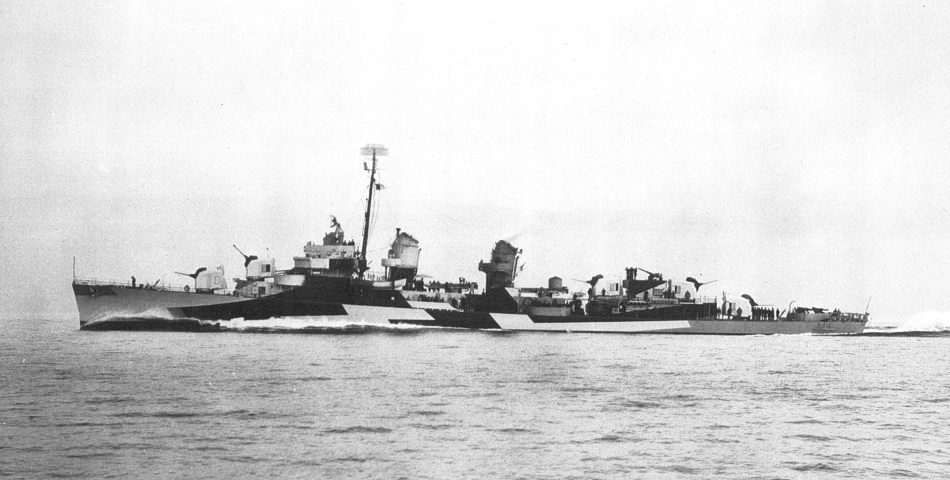
USS Porter (DD-800) was a Fletcher-class destroyer, the fourth United States Navy ship named for Commodore David Porter and his son, Admiral David Dixon Porter. Todd Pacific Shipyards in Seattle laid her keel on 6 July 1943. She entered the water on 13 March 1944 with Miss Georgiana Porter Cusachs as sponsor, and the Navy commissioned her on 24 June 1944. Howard Riche Prince was her captain from that day until 5 December 1945.
Her early work included a shakedown period off San Diego. On 16 September 1944 she sailed north and took up duty off Adak, Alaska. On 21 November 1944, operating with Task Force 92, she joined a strike along the Kurile Islands and fired on military positions at Matsuwa. On 5 January 1945 she pressed another sweep against the naval base at Suribachi Wan on Paramushiru. During the night of 18 February 1945 her guns hit Kurabu Zaki, also on Paramushiru.
On 15 May 1945 Porter joined the first large surface-ship foray into the Sea of Okhotsk, then still held by Japan, and shelled Suribachi Wan again as the force drew off. She returned to Matsuwa across 10 and 11 June and bombarded the island a second time. On 25 June another pass through the Okhotsk brought her onto a small convoy, and her gunfire sank a Japanese merchant ship of about 2,000 tons.
Japan's surrender found her in overhaul at Portland, Oregon, and she stayed there until 1 September. She then took the carrier Enterprise south from Seattle into San Francisco, ran a training refresh at San Diego, and crossed to the Atlantic seaboard. John Haydon Parker succeeded Prince as captain on 5 December 1945. Her active commission ended on 3 July 1946, when she was laid up at Charleston, South Carolina, in the Atlantic Reserve Fleet.
The Navy returned her to service on 9 February 1951. Through the summer of 1952, from mid-June until 14 September, she operated in Korean waters with Task Force 95 on the blockade of the North Korean coast. Along the eastern shore, between Chongjin and Kosong, she shelled troop positions, harbor towns, small craft, and rail lines. On 3 August 1952 she bombarded Wonsan Harbor. On 14 August, after trading fire near Majonchon, she silenced a 105-millimeter North Korean gun battery. Gunnery against rolling stock placed her in the Trainbusters Club, with one train destroyed and two damaged.
She went back into reserve on 10 August 1953, berthed this time at Norfolk, Virginia. Her name left the Naval Vessel Register on 1 October 1972. The hull was sold on 21 March 1974 and cut apart for scrap. The Navy awarded her one battle star for World War II and a second for Korean service.