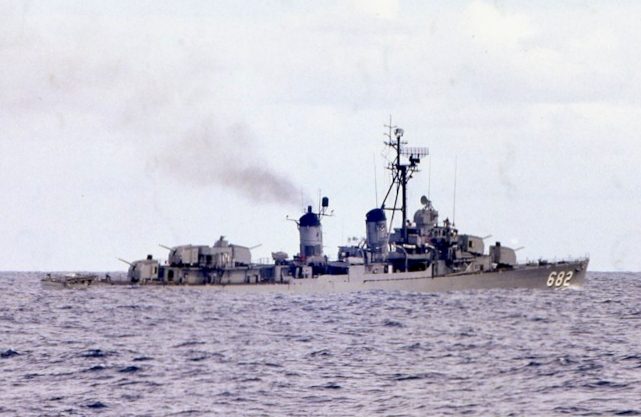
Porterfield, designated DD-682, was a destroyer of the Fletcher class. Bethlehem Shipbuilding laid her down at San Pedro, California, on 12 December 1942. Launching came on 13 June 1943, with Mrs. Lewis B. Porterfield as sponsor, and the Navy commissioned the ship on 30 October 1943.
The name honored Lewis Broughton Porterfield, born in Greenville, Alabama, on 30 October 1879. From Alabama he was appointed a naval cadet on 8 September 1898. Rank came in order: midshipman in July 1902, ensign on 2 May 1904, lieutenant on 2 May 1907, lieutenant commander on 4 March 1915, commander on 1 July 1919, captain on 16 February 1925, and rear admiral on 1 July 1937. At sea he had charge of the patrol boats Albatross and Venetia, the gunboat Wheeling, and Destroyer Squadron 11. His closing post was chief of staff for the Twelfth Naval District. For anti-submarine operations while he commanded Venetia in the First World War, he received the Distinguished Service Medal. On 5 April 1942 he died at Oakland, California.
After shakedown she joined Task Force 53. She got under way on 12 January 1944 and on 31 January raised the Marshalls. Her first gunnery was against shores in the Kwajalein Islands, and she then shelled Roi and Namur. By 4 February matters locally were under control, so she took a convoy of cargo vessels and transports south to Funafuti. There she joined three merchantmen, with the destroyer Fletcher, and the group continued to Majuro. On 20 February she left Majuro beside a division of battleships. For two days the destroyers screened while those battleships shelled shore installations in the Marshalls. Porterfield returned to Pearl Harbor, then screened oilers in the replenishment group of the fast carrier task force. The oiler duty ran to the end of April, when she headed for Pearl Harbor again.
Her following assignment was to screen escort carriers during the move into the Marianas. The group left Pearl Harbor on 30 June. The carriers' planes covered the ships as they moved forward, and the formation arrived off Saipan on 15 June, where enemy aircraft soon attacked. Porterfield remained in company, picked up two pilots, and on 1 July entered dry dock at Eniwetok. Repairs done, she reached Saipan on 11 July for a second stay, kept to the screen around the carriers, and early in August shifted to Guam. Detached on 3 August, she joined the Fast Carrier Task Force, then numbered as the Fifth Fleet's Task Force 58. On 6 August, east of Guam, she rendezvoused with Task Group 58.4 and operated with it through the remainder of the Guam campaign, returning to Eniwetok on the 10th.
On 29 August the force sailed once more, striking Palau and Mindanao while troops went ashore in the Palaus. Through September the ships held the sea that lies between the Philippines and Palau. On 6 October the carriers left Ulithi for Okinawa and Formosa. Enemy air raids were heavier than on earlier trips. Porterfield was credited with bringing down three aircraft and also saved the fliers of a torpedo bomber from Hornet. With the Formosa and Okinawa attacks finished, the formation moved to Philippine waters to look for the Japanese fleet. At first light on 25 October, carrier planes struck that force, left it crippled, and drove it back to Japan. Porterfield was sent with four cruisers to deal with any ships still damaged. They fought one Japanese cruiser, which sank while the destroyers were driving in with torpedoes. On 1 November the formation sailed for the area east of Samar. The morning of the 5th brought a carrier strike on Luzon in bad weather, and Porterfield's boat crew rescued a pilot off Langley. From Ulithi on 22 November she went out to raid Luzon, returned on 3 December to resupply, and a week later sortied toward Luzon again. On the 13th she recovered a second Langley pilot. The strike that followed took the group into the South China Sea by way of the Bashi Channel, the gap dividing Formosa from Luzon.
On 19 January 1945 the ships left the China Sea and sent aircraft against Formosa. Two suicide planes struck the carrier Ticonderoga, and Langley's flight deck took a bomb. More strikes fell on Okinawa before the group made Ulithi on 27 January. Departure on 10 February was in support of the Iwo Jima landings. During the second day of the trip she took aboard a pair of aviators from Cowpens (CVL-25). The fast carrier force came within 60 miles (110 kilometers) of Tokyo. The run drew no attack. The ships then drew away toward Iwo Jima to cover the landings with naval gunfire and were credited with another aircraft destroyed. Shortly before daylight on 26 February, Porterfield's radar found a Japanese picket boat. She sank the boat. Ensign Burton James Brown, one of her officers, received the Navy Cross posthumously for heroism that day. On the 27th the weather was improving. Once fueling was done, Porterfield shaped a course to Ulithi and entered on 1 March.
Ulithi held her for three weeks. She then headed for Okinawa Jima, her guns meant to support the assaults at Kerama Retto and along Okinawa. On 6 April, as ships were forming for the night's retirement, kamikaze aircraft appeared above the fleet and dove on any hull that offered a good target. Porterfield claimed one aircraft shot down, then was called over to help Leutze and Newcomb. Working near the pair while both burned, she rescued the men she could, escorted the hurt ships into Kerama Retto, and passed the injured to a hospital ship. That afternoon she was ordered out in Task Force 54 against Japanese units heading for Okinawa, a group that included the battleship Yamato. She came back to Okinawa for more screening and bombardment, and in that duty claimed two additional Japanese aircraft. On 12 April the fleet met another heavy air attack. Porterfield, holding the leading screen station in her formation, engaged a raid of about ten bombers and torpedo-carrying planes. One of her 5-inch (127 mm) guns was already disabled. She still put out a great weight of fire and claimed four aircraft.
Four captains are recorded for her. John Carl Woelfel commanded from commissioning on 30 October 1943 until 13 May 1944. Donald Wesley Wulzen commanded from 13 May 1944 until 4 July 1945. Arthur Frederick Fischer became captain on 4 July 1945, and Neil Bruce MacIntosh became captain on 17 November 1945. Porterfield survived the war. On 18 July 1982 she was sunk as a target.