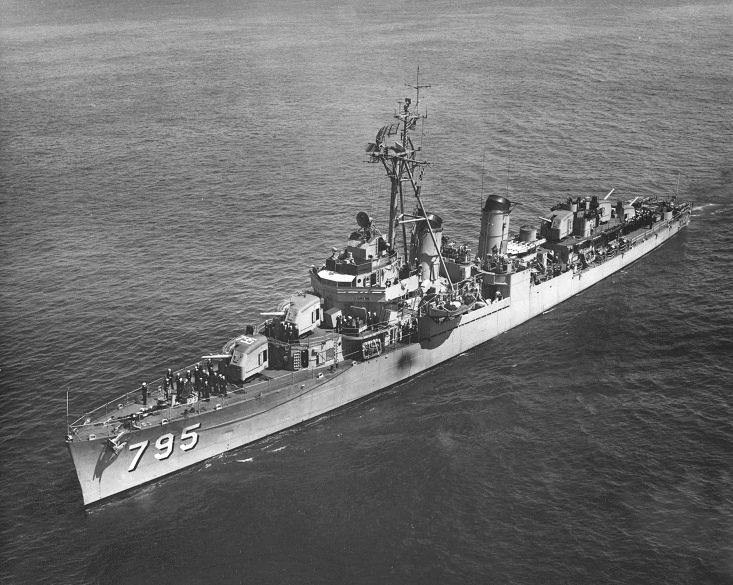
USS Preston (DD-795) was a Fletcher-class destroyer. She was launched on 12 December 1943 and commissioned on 20 March 1944, the day G. S. Patrick became her captain.
A California shakedown and a long run of drills around Hawaii came first. On 1 July 1944 she left Pearl Harbor for the Marianas fighting area. Off Guam from 17 July through 8 August she guarded the transports lying near the assault beaches. Two days in Apra Harbor followed, and she then made for Eniwetok. On 29 August she became part of Task Force 38 and turned west with the carriers. From 6 through 8 September she stayed in the screen while those carriers struck the Palaus, and she held the same station as they hit Japanese positions across the southern and central Philippines. When the runs of the 14th were finished, the force went back to cover the landings at Peleliu and at Angaur, moved toward the Philippines once more, and afterward withdrew to Ulithi.
On 6 October the carriers sortied again, this time to soften targets ahead of the Philippine invasion. Strikes fell on Formosa's air bases, and the force then swung southeast to operate off Luzon for the Leyte landings. On 24 October Japan opened a three-pronged push meant to throw Allied forces out of Leyte Gulf, and Preston's group, Task Group 38.3, met a heavy air attack in the first of those Leyte Gulf fights. Bombers and torpedo planes arrived in successive waves. Many of the attackers were brought down, but the light carrier Princeton (CVL-23) was lost. That night the group was ordered north to meet Task Groups 38.2 and 38.4 and to look for Japanese carriers. Search planes were airborne less than an hour after the midnight junction. With daylight they located the enemy north of Cape Engaño, and the combat squadrons took off. Later that day cruisers and destroyers from the force closed the ships still afloat and struck the final blows. The formation then turned south to join the hunt for vessels trying to escape through San Bernardino Strait. On 27 October planes flew in support of the troops on Leyte, and the ships afterward departed for Ulithi.
Preston was off Luzon again by 5 November as aircraft struck installations ashore. Attacks on Japanese shipping in the central Philippines followed, Ormoc Bay in particular. Luzon was hit hard once more on 12 November, then from 25 November to 2 December, and again from 10 December through the 21st. The force left Ulithi on 30 December and steamed northwest. It greeted 1945 with attacks on Formosa and on the Nansei Shoto, then supported the landings at Lingayen. After the Bashi Channel, the ships passed into the South China Sea and struck Japanese shipping and coastal installations along Indochina. They lay along Formosa's western shore by 15 January, and by the 19th they had moved around to send strikes against Formosa and against Okinawa Gunto from eastern waters.
During February she screened the carriers while their planes tore into industrial centers in the home islands, covered the assault troops at Iwo Jima, returned to Japanese waters for more strikes on Tokyo, Nagoya, Osaka, and Kobe, and then went south for further raids on the next landing objective, Okinawa. At Ulithi she joined Task Force 54 for that invasion. The group sailed for the Ryukyus on 21 March, screening the bombardment ships and the underwater-demolition teams. From 24 March until 1 April her station was off Kerama Retto, and she then took up gunfire support along the Hagushi beaches. That duty ran on into June. She helped the Tenth Army, a force that mixed Army divisions with Marine Corps divisions, during the attack on the Motobu Peninsula, where her gunfire let Marines break a Japanese ring around their position. She also fired in Nago Wan, in Nakagusuku Wan, and near Naha, and at Ie Shima and at Kutaka Shima. Early June brought patrols aimed at suicide boats, after which she returned to bombardment.
July found her on radar-picket patrol off northern Okinawa. In August she shepherded convoys as they entered and left Buckner Bay. Japan surrendered on 14 August, and Preston stayed around Okinawa for air and sea rescue. She sailed for home on 6 September, reached San Pedro, California, on 24 September, and started inactivation. November brought a shift to San Diego. She decommissioned on 24 April 1946 and was berthed in the Pacific Reserve Fleet. The ship had survived the war.
The outbreak of fighting in Korea brought her out of reserve. She recommissioned on 26 January 1951 and in April headed for the Atlantic coast. Modernization at Philadelphia came before a short stay in her home port, Newport. One 5-inch/38 gun, mount number 3, was removed and a new director fitted in its place, and other large changes were made to weapons, radars, and the ship's equipment. On 9 January 1952 she left for the Mediterranean. Home from Sixth Fleet service in May, she took part in fleet and type training that ranged from Labrador to the Caribbean. On 1 April 1953 she quit New England for the Pacific and a second period of Far East combat. In Japan by early May, she ran with the fast carriers of Task Force 77 until June, then transferred to Task Force 95, the United Nations blockade and escort force. The truce was signed on 27 July. Preston then started for Newport by way of Suez and finished a voyage around the world at Boston in October.
Overhaul came next. From May through September 1954 her duty was with Atlantic Fleet hunter-killer groups. A further Mediterranean deployment in 1955 was followed by antisubmarine exercises. On 15 March 1956 she cleared Narragansett Bay and set course for the west coast. With Destroyer Squadron 23, she reached Long Beach on 15 April and operated off California through May. In June she went west on the first of her peacetime Far East tours and began a steady rotation: Seventh Fleet duty in the western Pacific, taking in SEATO work, other Allied drills, and patrol off Taiwan, alternating with First Fleet assignments of west-coast training and cruises toward the Arctic and the central Pacific. On 15 November 1969 she was transferred to Turkey.