Building
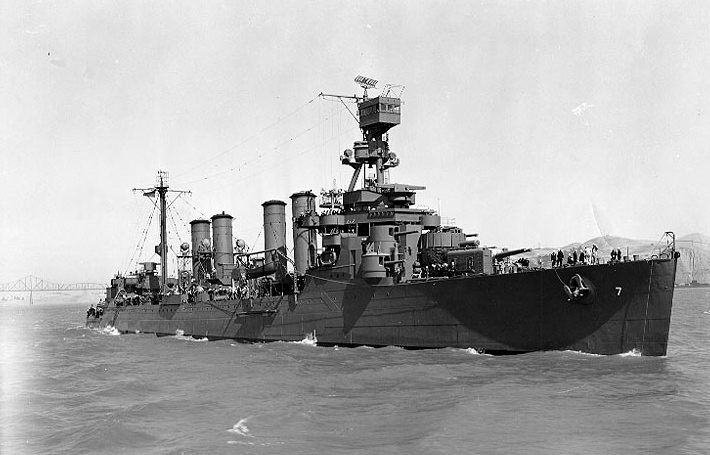
Raleigh was the fourth Omaha-class cruiser. The class was designed as fast scout cruisers, and she was the second Navy ship named for the capital of North Carolina. She was ordered on 29 August 1916 and contracted to Bethlehem's Fore River Shipyard at Quincy, Massachusetts, on 21 August 1917. Her keel was laid on 16 August 1920. She was launched on 25 October 1922, christened by Miss Jennie Proctor, and commissioned on 6 February 1924, Captain William C. Watts in command. She was 555½ feet overall and displaced 7,500 tons standard, with twelve 6-inch guns (some in twin turrets and some in casemates), ten torpedo tubes, and two floatplanes. In peacetime she carried 29 officers and 429 men.
Between the wars
She finished fitting out at the New York Navy Yard. Her first special duty, in 1924, was supporting the Army Air Service's first aerial flight around the world. She cruised from Boston to the Virginia Capes and Hawaii and in the spring of 1928 off California. In 1928–29 she made diplomatic calls at the principal ports of Europe, returning to Hampton Roads on 4 September 1929. From 15 August 1933 she was based at San Diego, with runs to the Caribbean, Alaska and Hawaii. In 1936 she went back through the Panama Canal for overhaul at Norfolk, and on 17 September 1936 Rear Admiral Fairfield raised his flag in her as commander of Squadron 40-T. That squadron protected American lives and interests in European waters during the Spanish Civil War. Omaha relieved her at Villefranche on 28 April 1938. After the 1939 Caribbean fleet problem she returned to San Diego, and later to Pearl Harbor.
Pearl Harbor
On the morning of 7 December 1941 she was moored at berth F-12 off Ford Island, near the old target ship Utah. In the first wave one torpedo passed ahead of her and a second hit her port side amidships, flooding her No. 2 boiler room. She listed so far to port that she seemed about to capsize. While her crew threw topside weight overboard to keep her upright, her gunners helped destroy five Japanese planes. Several men were wounded but none were killed. The tender Whitney and yard craft came alongside the next day, and she was towed into the Navy Yard on 22 December.
The Pacific and the Aleutians
She escorted a convoy from Pearl Harbor to San Francisco from 21 February to 1 March 1942. After overhaul at Mare Island she escorted convoys from 23 July among San Francisco, Hawaii, Samoa and Fiji with Task Force 15. On 3 November she sailed from Pago Pago to hunt four reported Japanese picket ships between the Gilberts and Ellices, but found none. She reached Dutch Harbor on 24 November 1942. Through the winter she searched the Rat and Near Islands for Japanese reinforcement ships and escorted convoys. On 10 January 1943 she covered the occupation of Amchitka with Task Group 8.6. From Adak she patrolled the approaches to Kiska and the Near Islands, and she shelled Kiska on 2 and 12 August 1943. On 1 February 1944 she sailed from Massacre Bay, Attu, with Task Group 94.6, and in the dark early hours of 4 February she bombarded Kurabu Zaki on Paramushiro in the northern Kurils, hitting two dual-purpose batteries and a small merchant ship. After a Puget Sound overhaul she rejoined Task Force 94 at Massacre Bay on 6 June 1944, but her No. 2 main engine broke down on the way to Matsuwa.
Fate
After repairs she sailed from Seattle on 22 June 1945 and went through the Panama Canal to Norfolk. She made two midshipman training cruises in the Caribbean and along the East Coast, then entered the Philadelphia Navy Yard on 29 September 1945. She was decommissioned on 2 November, struck on 28 November, and sold for scrap at Philadelphia on 27 February 1946.
Sources
Wikipedia, "USS Raleigh (CL-7)" (citing DANFS).
NHHC/DANFS, "Raleigh II."