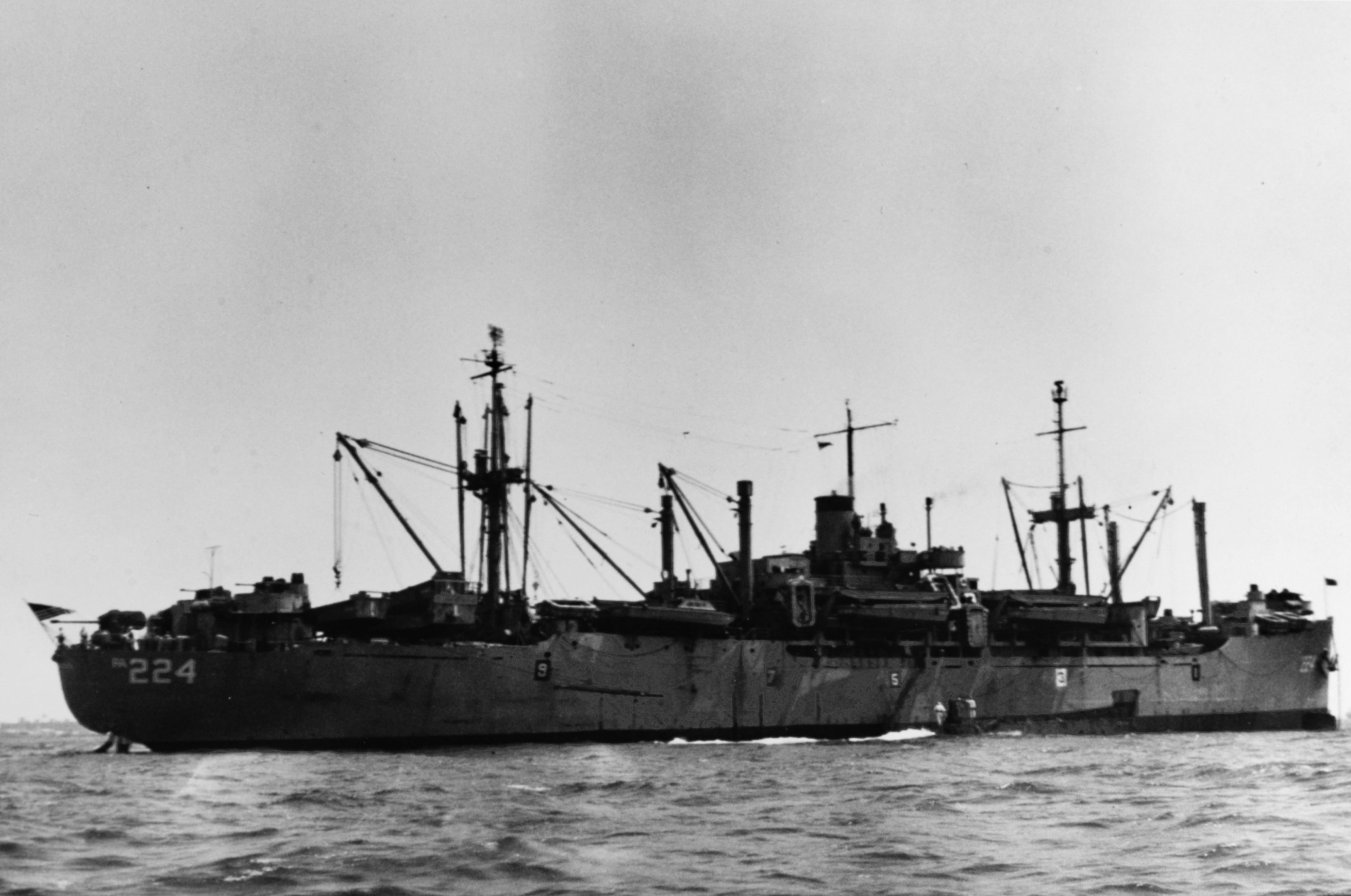
A Texas county is behind the name of Randall (APA-224). Permanente Metals, Yard No. 2, at Richmond laid the keel on 15 September 1944 under a Maritime Commission contract. Mrs. Donald D. Dick sponsored the launch on 15 November 1944. The Navy acquired her and commissioned her on 16 December 1944, Captain Harold R. Stevens in command.
Shakedown and training off California ended with a sailing from San Diego on 9 February 1945 for Pearl Harbor. More training followed. On 2 March she left by way of Eniwetok for the Volcano Islands. Iwo Jima was the arrival on 25 March. Army passengers went off, the cargo followed, and Marines came aboard for a lift to Guam. That March call was a delivery and a pickup, not the opening assault on the island. Pearl Harbor saw her again on 20 April. Drummed petroleum products then went to Kwajalein, and Navy and Marine personnel came aboard for the voyage home. San Francisco was the arrival on 18 June.
On 9 July she sailed for Ulithi, embarked Army units, and continued to Okinawa, arriving on 12 August. The island had already been secured, and this was not an assault landing. With the war ending she drew occupation duty. On 5 September Korea was the destination, units of the 7th Army Division sailing in her. She returned to Okinawa, carried Marines into Taku over 26 to 30 September, made a Philippine run, and pointed at the China coast again. From 22 October through 23 November Chinese troops rode her from Kowloon across to Chinwangtao and on to Tsingtao. On 29 November she turned for home. Men of the Army Air Corps, taken from Okinawa, filled that first Magic Carpet passage, and Seattle was where they landed.
Magic Carpet duty ended in August 1946. From September to December she drilled in Pacific Fleet landing exercises, then returned east for an overhaul and a short layup at New York. Norfolk received her on 24 April 1947. Training along the southeastern seaboard lasted until August 1948, when she went north for operations off eastern Canada. September put her back on exercises off Virginia and the Carolinas. In February 1949 she left for the Caribbean, and that fall she crossed into the Pacific for drills as far west as Hawaii. On 1 December she was at Norfolk again, training reservists and Marines.
Five more years of that work followed, along the Atlantic seaboard, among the Caribbean islands, and on two Mediterranean stretches, March to July 1951 and May to October 1954. Late in 1955 inactivation was ordered. Orange, Texas, took her on 25 January 1956 for the Atlantic Reserve Fleet, and she left commission on 6 April 1956. She stayed at Orange until February 1960, then shifted to a Maritime Administration berth at Mobile in the defense reserve. Her name was struck on 1 July 1960. Mobile kept her until a sale in 1971.